Unit 2: The Policy Brief
2.1: Engage the Conversation
Identify and Assess Key Issues
Purpose of a Policy Brief
LESSON
In the Introduction to this course, you had an opportunity to explore the genre of the policy brief and look at some examples. Now, with your own project in mind, we will examine the purpose and expectations of a policy brief in much more detail, aiming to understand how it is put together as a persuasive document.
While it is a research paper, the policy brief has a very specific mandate to generate some level of action or change. As a persuasive document, the policy brief must be written with a strategic understanding of how best to generate this intended action from its audience.
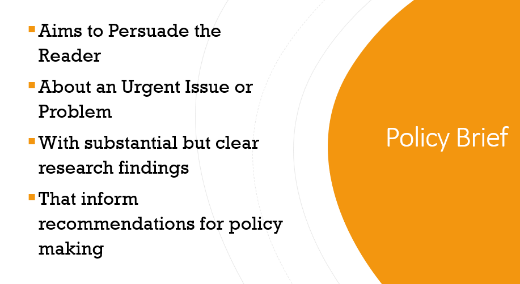
The lessons on rhetorical strategies and clear audience definition from Unit 1 continue to be relevant here. Synthesis of research material is used in the policy brief to make the case for the urgency of an issue or problem and/or to develop potential solutions.
In terms of structure and content, the policy brief generally follows a problem-discussion-recommendation structure. However, the emphasis within this structure can vary depending on what is at stake. For example:
-
The emphasis of the document might be on proving an issue or problem exists, using research to demonstrate its existence and its consequences; recommendations might then focus on a call to recognize and address the issue through policy development.
-
Alternatively, the emphasis might be on advocating for (a) solution(s) to a known problem which is assumed to be recognized, and the research focus is on one or more possible solutions. In this case, recommendations would focus on advocating for a proposed solution through policy development and change.
Finally, as you will see in the examples, a policy brief is brief! The goal is a two-page, concise but substantial piece of advocacy. It is used to capture the interest of audiences who may not be interested in the argument or who need an easy way to communicate the message to advocate for change. Later in this unit, we will consider the challenges of finding research within a relevant discourse community.
READ
-
Begin by watching the short video What Is a Policy Brief?
What Is a Policy Brief? [6:01]
(Navigating Academia, 2023)
-
Read the University of North Carolina at Chapel Hill’s Writing Center document on tips for writing effective Policy Briefs.
For this resource, pay particular attention to the sections on “How do I identify a problem” and “Framing the issue.” We will talk more about these strategies through this unit.
-
Read An Essential Guide to Writing Policy Briefs (Young & Quinn, 2017) and the associated Policy Brief Resources from the International Centre for Policy Advocacy.
There is a lot of information here on the purpose, function, and structure of a policy brief. This information also includes guiding questions and checklists to help you work through this unit and complete your policy brief. There are also examples of policy briefs to study.
-
Read IDRC’s How to Write a Policy Brief.
You’ve seen this one before in the Introduction section of the course. This resource includes step-by-step tips for each section of the policy brief, as well as links to examples. Spend time mapping the examples back to each section of the brief to see how they are written.
LESSON
The readings provide principles and toolkits to support the development of policy briefs across a range of sectors and areas of social, political, and economic life. While the approach to this genre can vary across disciplines and contexts, some overall shared qualities emerge:
You’ll have noted that the different toolkits and examples studied in the readings offer variations on this generic template, especially in the focus and direction of the Discussion. As you develop your own approach, you will shape your discussion section to suit the logic of your piece. This unit includes instructions and templates for doing this in later sections.
Analysis of Sample Policy Brief
READ
Read the following examples of policy briefs.
As you read these, you will notice the essential elements of this genre, despite small variations in the focus or structure of the documents for specific disciplines or functions.
Please note, also, that while many of these examples rely on primary research, for this course, you will be using synthesis of secondary research material to develop your brief.
-
Explore two or three of the policy briefs on the IDRC site. Your goal here is to get a good picture of the audience, purpose, and structure of the brief.
As you read some examples, select one and complete the questions in the “Think and Engage” box below.
-
CMNS 3241 students, read over Assignment 2: Policy Brief (25%) on the TRU Moodle site.
Finding the Discourse Community
LESSON
At all levels of our experience, we exist within larger contexts and communities. Some of them are small, like our household or our classroom; and some are larger, like our workplace, our city, or the communities of shared political, social, or cultural interests that we participate in. Think, for example, of Reddit or other online communities that share interests and a way of engaging with ideas. Often, within these communities there are debates, disagreements, as well as shared values and assumptions. Often, too, ways of communicating, including the tone or vibe, the use of vocabulary, and reliance on a shared basis of knowledge or information work to define the community. For example, members of particular online gaming communities will share knowledge not only about games, but also about the history, key players, and drama or issues that pervade that community; it can be difficult for outsiders to follow or contribute without a strong sense of the vocabulary and references. This is true of any community we belong in, but we don’t always notice it because it can seem so natural.
“Understanding the shape of a discourse and the problems that matter to a discourse community are vital to understanding the nature of the particular problem you are considering and how to solve it” (Pulver, 2020).
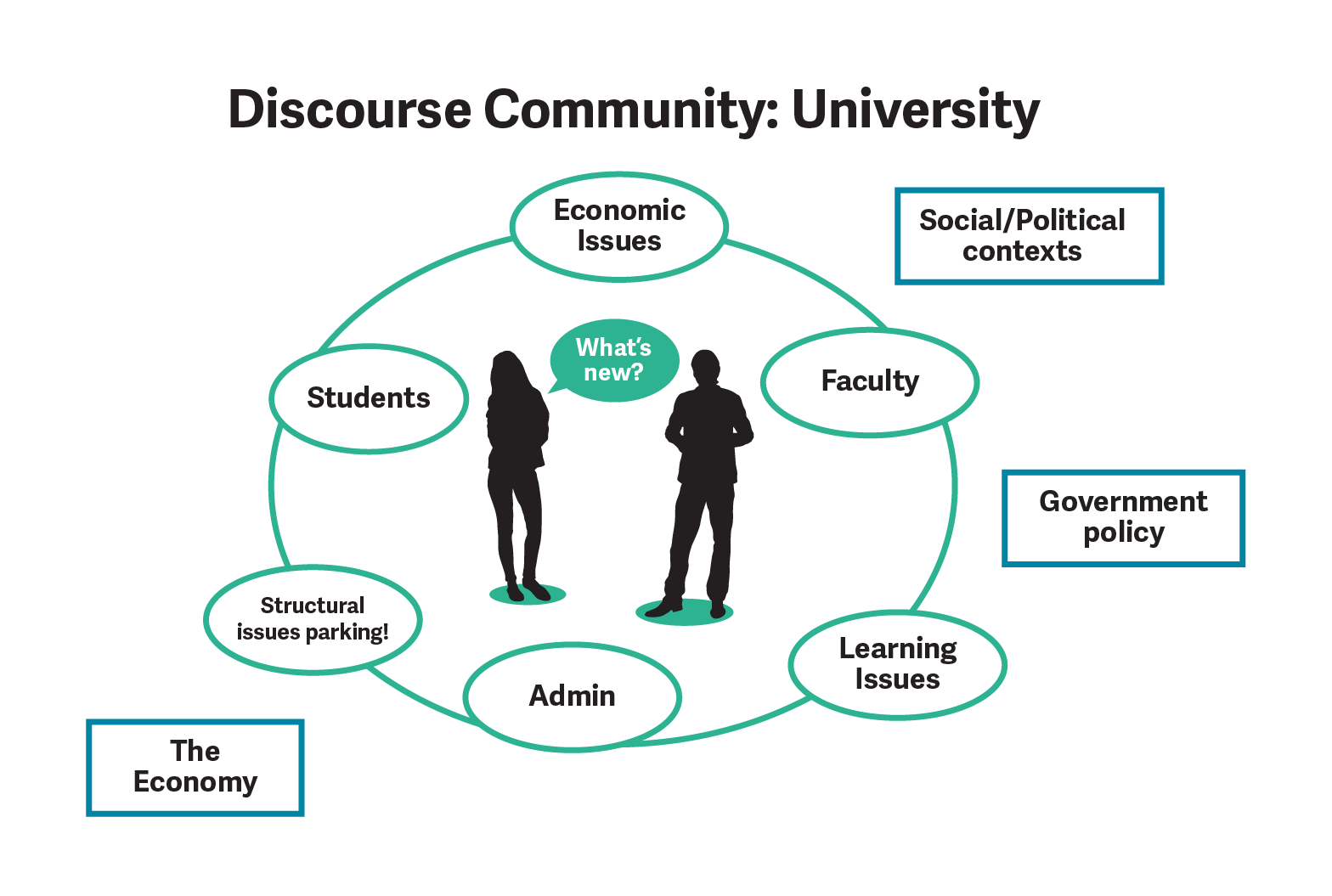
Let’s consider, as an example, a university community. Each one, of course, is different. But generally, we can think about the defining features. First, we can identify the different kinds of participants (students, faculty, and administrators) and the nature of the relationships between them; there will be a shared valuing of the endeavour of university education, but perhaps disagreements and debates over how best to do that. Within this community, there will be a range of recognized assumptions and issues; for example, debate over how best to deliver university classes (in person? online? using lectures or projects?) is ongoing. It becomes heightened at moments of change, such as it did during the pandemic. To participate in these debates in an effective way and provide a contribution that will be meaningful within the community, it’s necessary to draw on a shared knowledge of key figures, arguments, historical events, and narratives, and a shared understanding of what the issues and problems are. We also need to understand and use the language and communication channels that are used to have these debates.
Now, let’s bring this to the broader and more complex level of your policy brief. As you develop the focus and perspective of your project, you are identifying a discourse community. The next challenge is to understand how this community frames the issues and problems you are exploring and to find key research and frame the issues in ways that reflect the community.
(c) Shannon Smyrl and TRU Open Learning CC BY-NC-SA 4.0
READ
-
Read Christian Pulver’s (2020) chapter, “Discourse and Discourse Community.”
THINK and ENGAGE
After you’ve completed the reading, consider some of the different ways that an issue or debate might be mapped by different discourse communities.
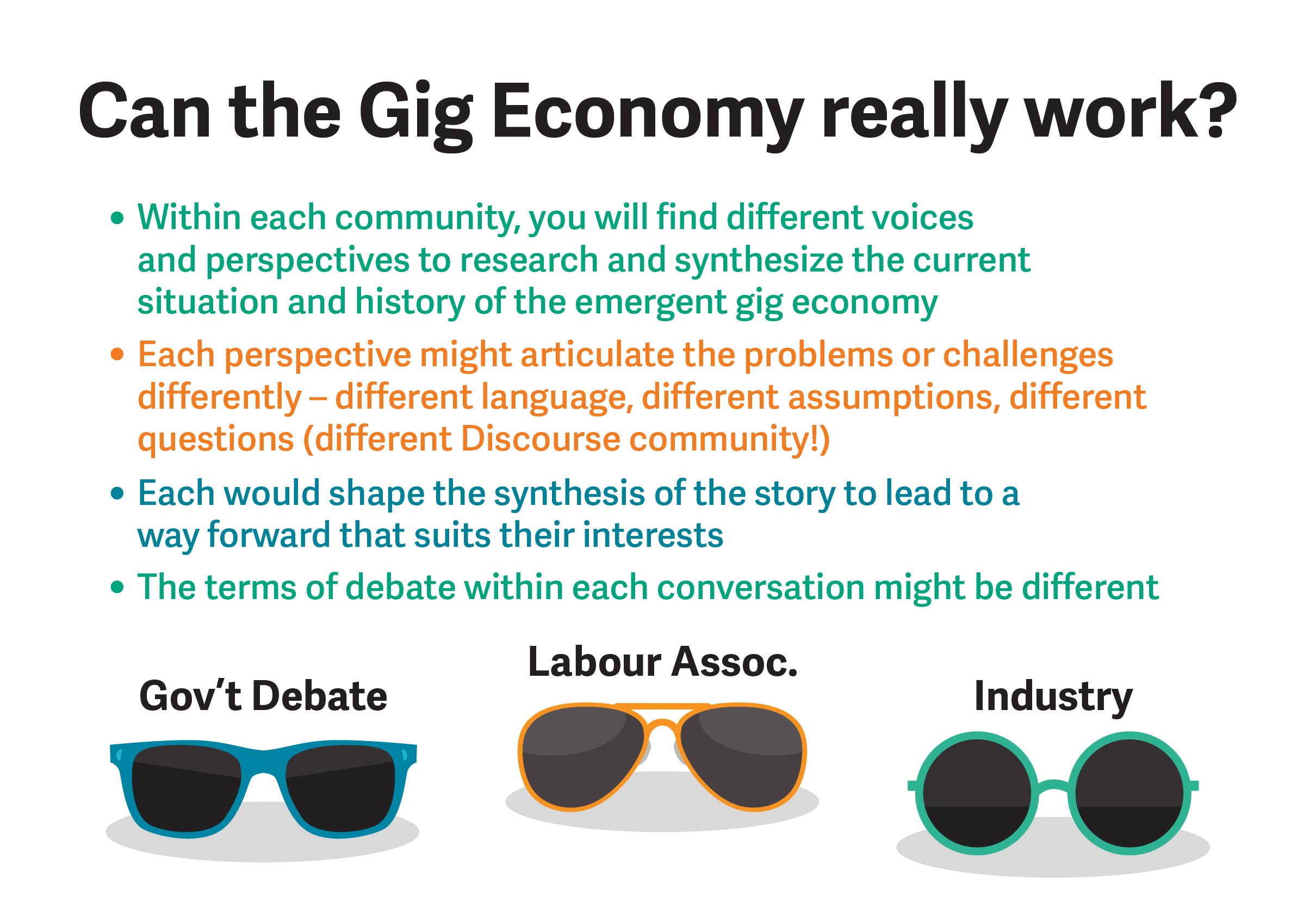
Consider social debate around the value and challenges of the gig economy which includes business models like Uber which rely on hiring independent contractors rather than employees. The question of whether this business model is feasible is explored very differently within different discourse communities.
-
From the perspective of the labour movement, what might be some of the issues or problems associated with the feasibility of the gig economy? How do these relate to the priorities and interests of the community? What assumptions would this community share around this issue?
-
From the perspective of business owners, such as taxi companies or even other sectors of service, what might be some of the issues or challenges? How do these relate to the priorities and interests of the community? What assumptions would this community share around this issue?
-
From the perspective of government regulators, what might be the issues or concerns? How are these tied to the priorities and responsibilities of the government?
Thinking about the discourse community for your specific project will help to ensure the framing of the problem, the focus of the recommendations, and the substance of the research will be valuable and concretely tied to those who have an interest in the topic. You have the opportunity to do this in the Unit Task 3.
Unit Task 3: Determining Your Discourse Community (3% of course grade)
UNIT TASK 3
Note: Students in CMNS 3241 must submit this Unit Task 3 for grades.
Write approximately 300–500 words.
Reflect on the discourse community for your own project. You should already have a sense of the perspective and focus of your project, as it was developed in your proposal.
Now, it’s time to refine this and make it more concrete. This will help you set goals for your in-depth research.
Based on your initial research and thinking about your project, ask yourself the following questions. These are adapted from Christian Pulver’s (2020) graphic, “Mapping the Discourse of a Problem or Controversy,” in your reading. Refer to the reading for more detail as needed.
-
What problem are you investigating? How is this problem discussed within the perspective (or discourse community) that you’re working within? What assumptions are made? Are there key words that are often used?
-
Who are the key figures in this conversation you are engaging? Are they obvious key people or organizations? Or are there key sides or positions in a debate around your problem?
-
Why is this a problem? What are the informing needs or urgent consequences? (This is exigence again—as you work on your topic, try to develop this in more detail than you had before.)
-
How is the problem you’re focused on discussed in the research and public debate? What kind of language is used? What kinds of rhetorical appeals are used? (Where does the evidence come from? What emotions are evoked?) What assumptions are made about how things are or how they could be?
-
How have you positioned your project in relationship to this problem and discourse community? Will your policy brief focus on illuminating and substantiating a significant problem or challenge, or will it assume shared knowledge of the challenges, and emphasize research into specific solutions?
As you begin to plan and extend your research in the next section, continue to ask these questions to make sure you’re on track to finish your research and build your paper.
Unit Task 3 will be graded on a scale of 1% for attempt, 2% for evidence of inclusion of course material, or 3% for thoughtful engagement/interaction with the course material.
Please submit your Unit Tasks 3, 4, and 5 as one document at the end of Unit 2.