Unit 2: The Policy Brief
2.3: Take a Position
Writing for a Defined Interest
In this section, our goals are to:
-
Develop and implement skills in organizing the policy brief so it works as a persuasive and functional advocacy document.
-
Review skills in effective writing to support the completion of the policy brief.
So far, emphasis has been on identifying an issue or problem within a defined discourse community, and on collecting and working with research material as the substance to support writing about that issue or problem in a policy brief.
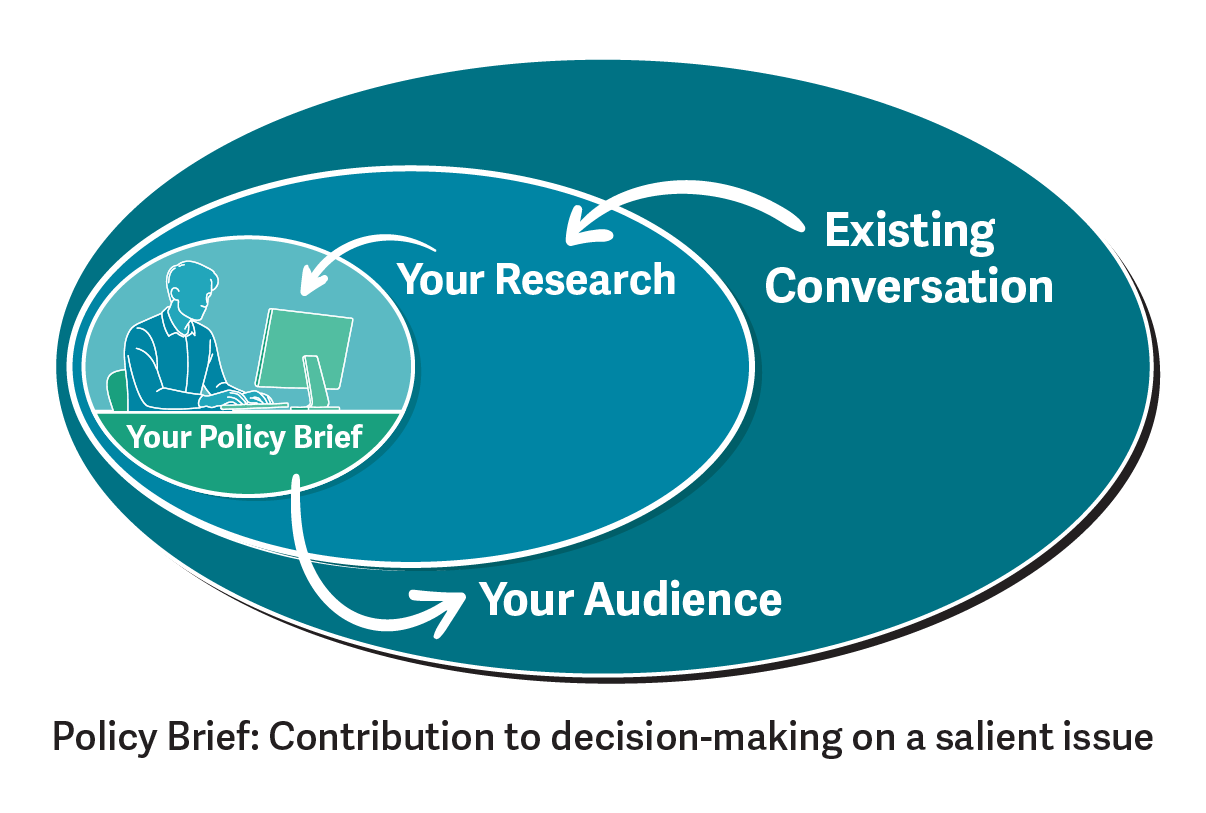
In a research project, we begin with a tentative sense of our issue or question, work with the research material in our discourse community to learn and map the conversations about that issue, and then define the specific position we would like to take in that conversation and organize our message. It’s this last stage that is covered in this section.
Organizing the Policy Brief
A policy brief represents our act of taking a stand within a conversation on an issue. It’s our opportunity to shape the discussion to support recommendations for action. As such, it’s crucial that the goal and outcome of the paper be clearly articulated (both in our minds and on the page), and that the structure and development of that paper supports reaching that goal.
READ
-
Read the IDRC toolkit presentation on How to Write a Policy Brief.
You have already had an opportunity to examine the sections of a policy brief and its overall function. This time, as you go through these slides, think more about the internal logic of the document. How are the sections connected to build towards its overall goal?
-
Read this general introduction to storyboarding as a skill to help organize information and produce content. It’s called From Disney Studios into a Scientific Lab: One Idea That Travelled Far! (IlluScientia, n.d.).
-
Read Patrick Dunleavy’s (2014) article “Storyboarding Research: How to Proactively Plan Projects, Reports and Articles form the Outset.”
LESSON
Writing a research paper can seem daunting and unfamiliar. However, it really is just storytelling. The goal is to write something that takes the audience on a journey, educates them, and leaves them empowered to make choices and decisions at the end.
The challenge is to know what story you want to tell and organize your information to achieve that story. If our organization of information is not strategic, designed to achieve the correct story, the goal of the paper won’t be met.
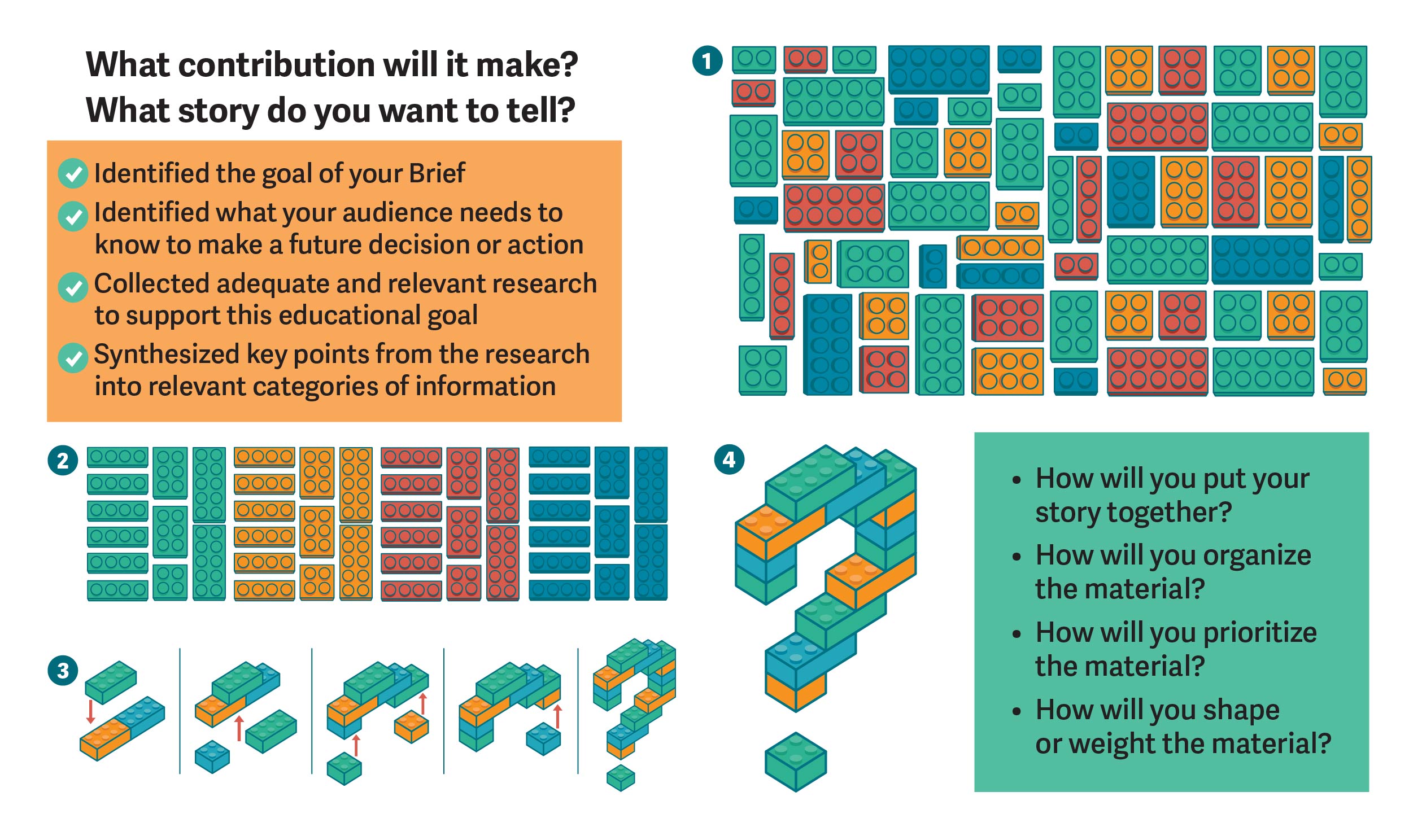
We can use building blocks to help us envision this process. Begin with the goal. What do you want to build? In this case, our goal is to build a castle!
In working towards our castle, we begin with an assortment of building blocks. We have identified these blocks as the ones necessary to form a castle and we have sorted them into relevant categories to make the building easier.
Likewise, in our progress towards the policy brief, we have already identified pieces of relevant research (the individual building blocks) needed for our purpose. Then, we have worked to synthesize this research material into relevant categories of information to make it easier to build the persuasive argument of the policy brief.
Now, it’s time to develop instructions for assembling our policy brief so that we know how we want to go from our categories of information to our goal, or from sorted building blocks to our castle.
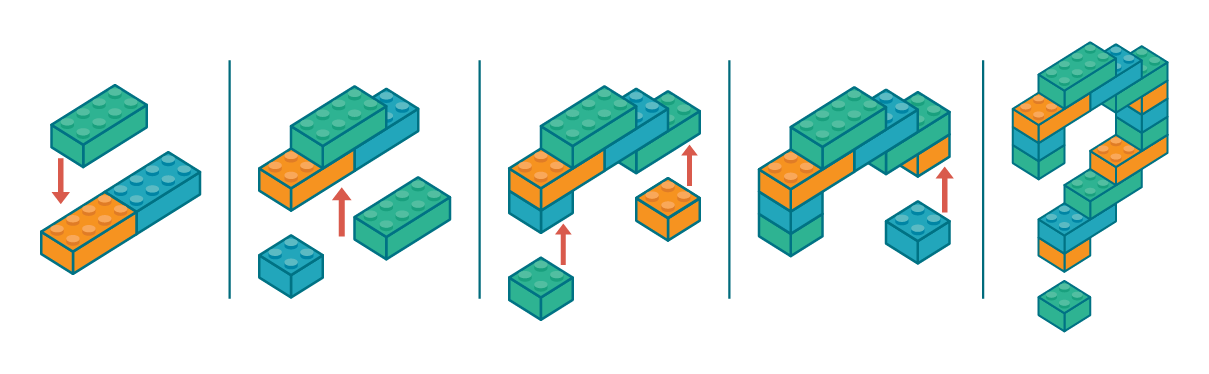
(c) Shannon Smyrl and TRU Open Learning CC BY-NC-SA 4.0
We could just randomly start sticking building blocks together and hope we eventually build a castle. But it is arguably easier to have a plan!
-
What is the logical order of the pieces?
-
What is the function of each piece of information—Does it illustrate a problem? Does it present an argument about an issue? Does it provide an example of a policy solution?
-
What is the relationship between pieces? Do they link as comparison, as multiple examples, or as a movement from problem to solution?
-
Which information is a core priority, and which is supplemental support?
Consider these final principles for organization as you begin to storyboard your policy brief:
-
Think of this as telling a compelling story for your unique audience.
-
The logic of organization should be driven by what the audience needs to hear first, then second, etc. to stay with you and accept your story.
-
Think carefully about your starting assumptions. What premise will you begin with?
Find the point where you, as persuader, and the audience will be on the same page and begin there. For example, decide whether you and your audience already share the assumption that a problem exists, so you start there and thus don’t need to spend a lot of time convincing them of the problem; rather, move on to a case for addressing it. Alternatively, your goal might be to convince your audience there actually is a problem. The starting assumption will shape the architecture of your piece.
-
Think carefully about your closing assumptions.
What idea of value do you want to emphasize by the end of the brief? How will your audience feel about this idea (will they be excited or skeptical)? Shape your story to acknowledge this. Finally, be clear about what your audience will be able to do with this final idea.
-
Design a pathway of persuasion through the main content of the brief that gets from the opening assumption to the closing value statement as directly and cleanly as possible.
Unit Task 5: Produce a Storyboard for Your Policy Brief (3% of course grade)
UNIT TASK 5
Note: Students in CMNS 3241 must submit this Unit Task 5 for grades.
Using the lessons and the readings, produce a storyboardfor your policy Brief.
When producing a storyboard, consider including the following kinds of cues:
-
Headings/subheadings
-
Content cues to indicate what content and its function in the story
-
Transitions; relationships between ideas; highlighting of key info/resources
-
Planned visuals
Here’s how:
-
Begin by brainstorming to get all your ideas out on the table first, just for yourself. Write out or collect all the information, quotations, ideas, etc. that you have so far. Try sticky notes!
-
Then, work on organizing all the content into categories of information that you have identified as relevant. This would include identifying information for the introduction, for the sections of the development section, and even for the recommendations. What are all the different categories of information? (Remember the synthesis work? Try to identify core categories of information from all your research.)
-
Now list all your own ideas about what you want to say or key points you want to make, and match these with your groups of information.
-
Finally, put your categories of information in the order you want them for your paper. To do this, you need to think about the story you want to tell your readers. What’s the best place to start? How will they anticipate the information? Where is the emphasis going to be? Where will they end up at the end?
Transform this brainstorming into a storyboard to help you refine the shape of your story using the model provided in class lessons. As you map out your story, you can think about some of the ways you can highlight and emphasize information. Leave yourself annotated notes about any visuals or examples you’d like to use when you get writing.
To produce your storyboard, you can make a table in Word, or use an online template like this one: StoryboardThat (no need to pay any money). There are tons of these online to choose from.
Unit Task 5 will be graded on a scale of 1% for attempt, 2% for evidence of inclusion of course material, or 3% for thoughtful engagement/interaction with the course material.
Please submit your Unit Tasks 3, 4, and 5 as one document at the end of Unit 2.
Writing Lab: Refresher on Principles of Effective Writing
LESSON
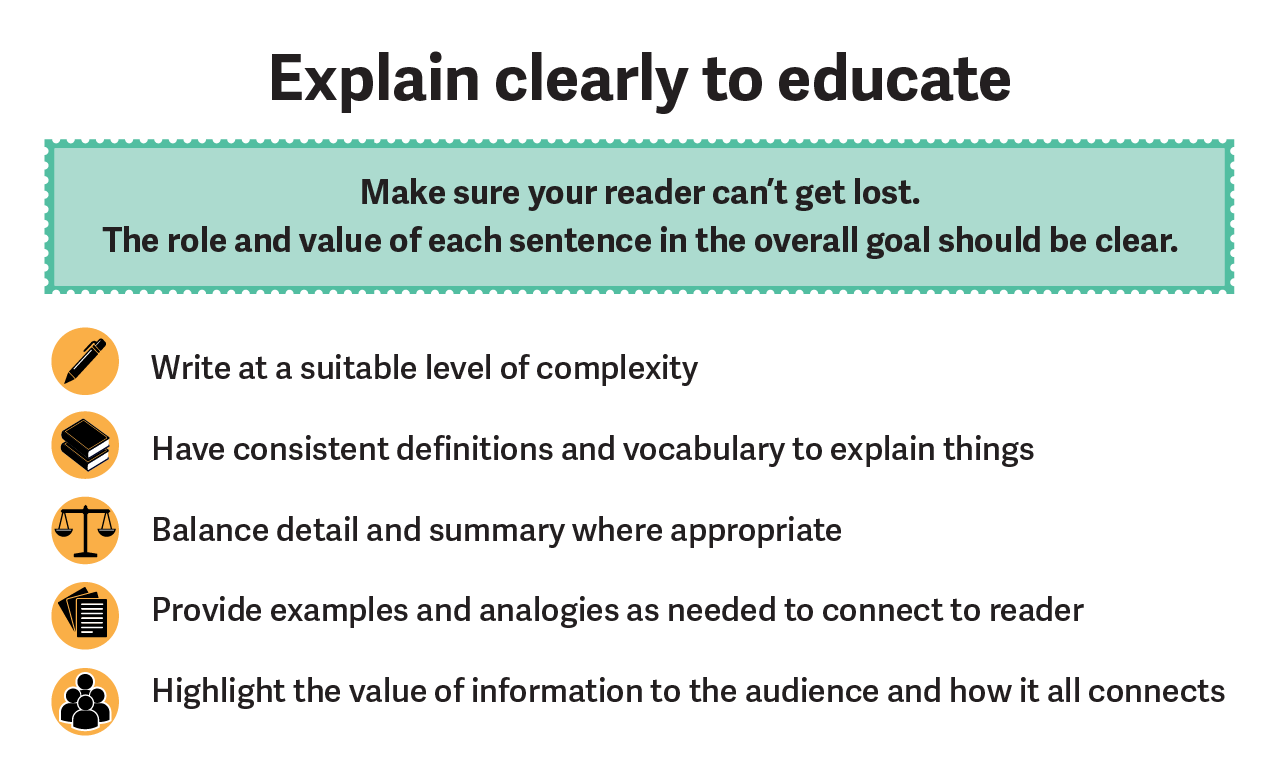
Anyone who does a lot of writing learns, over time, tricks to improve their craft. Often, when we write under pressure or when we are not particularly motivated to complete the task, we find it difficult to take the time to improve our writing, sentence by sentence. However, the meaning and impact of our work is tied directly to the overall effectiveness of our communication skills. If the writing is poor and impedes understanding and impact for our audience, our good ideas will not be appreciated.
Tips for writing improvement are easy to come by. A common example is to remind students not to begin a sentence with “This is” or “There are.” If you look for better ways to structure a sentence, it will inevitably be more concrete and effective. But putting tips and tricks like this into action takes a real commitment. While it’s true that AI in its various forms can offer editing support, it also tends to take out the tone and unique voice of a writer, elements essential for strong, persuasive strategic communication. Take the time to develop your own writing and revision skills.
READ
In this refresher, you will read over tips and tricks for concise and clear writing that is audience focused and professional. Some of this may be new and some of it a review. Put your focus where you need to and ensure you can apply these skills for your course project.
-
Read Writing Concisely from the University of North at Chapel Hill’s Writing Center.
-
Read Dr. Karen Palmer’s (2020) “Writing Clearly and Concisely” from The Roughwriter’s Guide.
As you work through this one, take the time to view the videos and do the practice activities provided at the end.
-
Complete Lessons 1, 2, and 3 from Duke Graduate School Scientific Writing Resource (Sheffield, 2011).
If you are not completely confident in your skills, considering completing the practice sheets provided with this resource.