Unit 1: The Proposal
1.1: The Logic Behind Proposal Writing
Knowledge Mobilization and the Value Proposition
LESSON
At the most general level, a proposal is to make an offer of something of value. In a professional context, we might:
-
Propose to offer our services to complete work for someone (such as persuading a prospective client that we offer the best value for money).
-
Propose a course of action (such as persuading our manager to invest in training).
-
Propose some kind of research to help with expanding knowledge and potentially to inform decision-making (such as persuading a client to fund research into a pressing social issue to inform policy decision-makers, which is our scenario for this course!).
All professional proposals require similar attention to audience identification, and the development of a clear sense of rationale and a value proposition. The proposal should offer a pursuit of action or knowledge that is clearly valuable in a well-defined context.
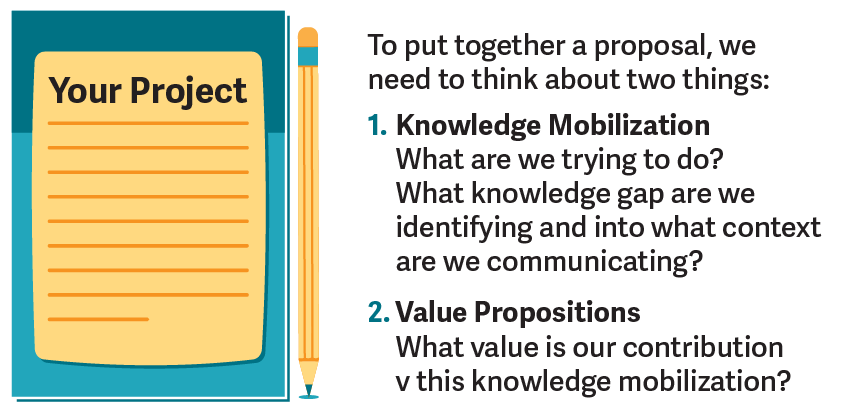
In the case of a research style proposal, which is our focus, we can position the proposal as an argument for specific knowledge mobilization: our project is to develop researched recommendations to inform future policy development related to the nature of flexible work and to develop communication documents to share those researched recommendations to multiple audiences.
Let’s break this down, using our course scenario as an example, so that the relationship of the proposal to the whole project becomes clear:
(c) Shannon Smyrl and TRU Open Learning CC BY-NC-SA 4.0
Defining what it wants to do, the intended knowledge mobilization, is not the full job of a proposal. The proposal must also convince its audience of the value of the proposed project within a social context. We need a clear sense of the why: What benefits will come from the effort and investment in this research?
Professional proposals will require a variety of distinct templates, depending on their industry and core purpose. We can identify, however, essential elements of a good proposal:
-
Establishes the promised goal or deliverables—What project is being proposed and what will be the goal and outcomes of that project?
-
Establishes a clear purpose—What has motivated the need to propose the project?
-
Establishes a clear value proposition—Why is this proposed project important currently? What will be the benefit of the promised goal or deliverables?
-
Establishes a clear audience and context—Who will benefit from the proposed project? Who is the audience for the proposal itself and how can they best be persuaded to support it?
READ
-
Begin by reading “‘Knowledge to Action’ Framework” and “Building a Knowledge Management Plan” (Bruce et al., n.d.).
These readings help us contextualize your full course project in the idea of knowledge mobilization—you have a contribution to make to a social debate and want it to be engaged by larger communities.
-
It’s always helpful to have an example. Now read over the International Centre for Policy Advocacy’s (2024) Resource – The Policy Research Proposal.
This reading illustrates an example of a strategy to write a proposal for a contribution to policy debates; this one focuses on primary research whereas yours will be mostly secondary research, but the model is illustrative of your own project.
-
Finally, read “Understanding Your Value Proposition” (Bruce et al., n.d.).
Here we begin to get into the specific goal of any proposal document—establishing the value proposition. You will use the five questions outlined in this reading as a basis for developing your own proposal.
Review the Proposal Template
The template for the proposal directs you to focus on the key elements of knowledge mobilization and value proposition. Your challenge is to define a project that expands our knowledge and action on a relevant issue that will have clear value for a specific community. Once you are familiar with the template, it’s time to begin to think about the actual content of the project. This is in the next lesson.
(c) Shannon Smyrl CC BY-NC-SA 4.0
Distinguishing Proposal and Project
Writing a proposal for a project is more complex than it sometimes appears. To do it well, we must first have at least a general sense of the project we want to undertake; we can’t propose to do a project that is not at least somewhat defined, and we should know the purpose, audience, and scope of the project we want to do. The next section, below, on defining the rhetorical situation, will help with this. We may not have completed in-depth research, but we must know enough about the topic to propose an interesting approach to it.
To write a proposal, however, we also need to figure out the purpose for the proposal itself so we can position our readers to follow our logic. We need to frame our project idea within a proposal that clearly establishes the value of doing the project for a specified community.
Using the course scenario, let’s consider this brief example of developing a project idea and then placing it into a proposal:
Topic: Flexible Work—Issues, Opportunities, and Risks
-
Focus: Career success for working caregivers and the role of accessible child-care options
-
More focus: Flexibility for caregivers to manage effective child care within the structure of the workday could have potential economic as well as social benefits (more career success, economic benefit to employers, stable and less stressful family dynamics—see what the research might show).
Resulting Project Idea
-
Research ways in which caregivers struggle to manage child-care responsibilities within the structure of employment (select office work sector). Research resulting challenges of restrictive or inaccessible child-care options due to the nature of work conditions, and what the benefits of resolving these challenges might be to developing policy recommendations.
-
Purpose of the project: To research and produce a policy brief that engages with the issue of conflict between the structure of work schedules and the demands of child care to produce recommendations for resolution in the interests of families and the larger labour market
-
Audience: Policy- and change-makers within industry and government areas related to economic development and child and family well-being
Subsequent Proposal for This Project
-
Purpose of the proposal: To outline the knowledge mobilization achieved through the proposed project and to establish the value of doing the project
-
Audience: The group or organization deciding to support or fund the project being proposed
From this example, we can see the beginning idea of a project related to the course scenario. It does not have to have all the answers, but work has been done to scope a concrete and defined focus and issue related to the general topic. We can see what issues or concerns will be explored, whose interests would be considered, and how it might connect to questions of policy development. Using this project idea, we would then move to the proposal, to present this idea as a valuable and worthwhile endeavour.
When writing in the proposal, it’s important to distinguish between the project and the proposal itself. Consider the distinctions in these two sentences:
-
“The proposal aims to demonstrate the value of a project related to child-care accessibility.”
-
“The proposed project will examine how access to flexible scheduling might reduce the challenges associated with poor child-care accessibility.”
The next sections will help develop the language skills needed for an effective and persuasive proposal.
Defining the Rhetorical Situation
LESSON
As you prepare to write the proposal, the first step may be the most challenging. This is to figure out exactly what perspective and focus you want to take in this project. The RFP gives you several suggestions to select from, but it can be overwhelming. This lesson is designed to help you narrow down the focus and scope of your approach to this project by selecting a particular set of interests to work within.
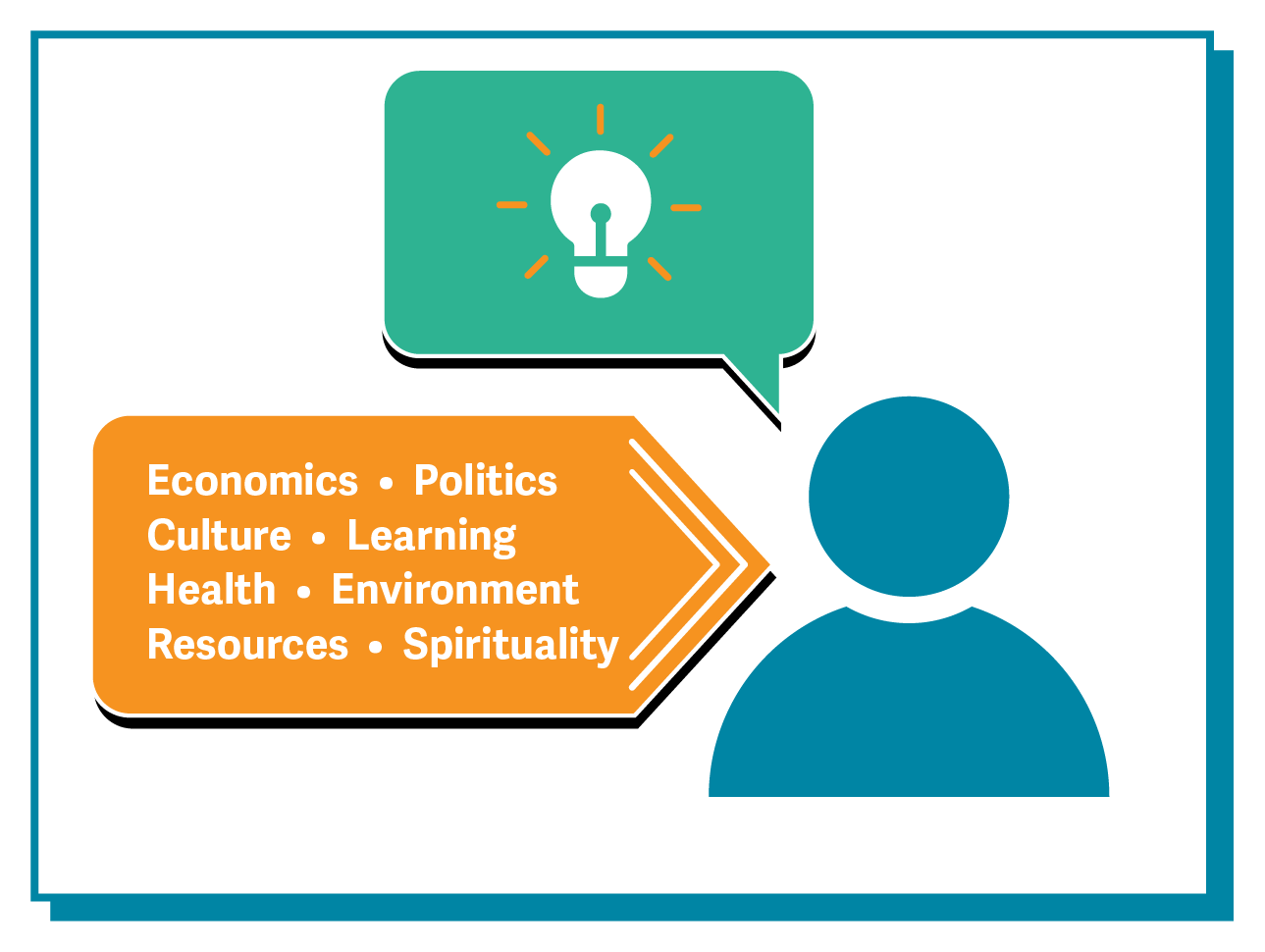
We don’t think and write in a bubble. Rather, we always already exist in conversation with the society and cultures around us. When we do research and absorb the news of the day, we are learning different ideas and perspectives in those conversations; and when we offer our own ideas and arguments, we are providing more perspectives back into society—participating in that conversation. And, when we do this, we are doing it from a specific perspective and framed in the interests of a specific position.
(c) Shannon Smyrl and TRU Open Learning CC BY-NC-SA 4.0
One way to define this is with the concept of “rhetorical situation”:
“The rhetorical situation involves the interplay among the speaker’s or writer’s purposes, text, audience, and academic, public, or professional context within which the communication occurs” (Topf, 2020).
Let’s first consider perspective and framing. In our course project, the general topic is “Flexible Work—Risks, Opportunities, and Issues.” Any contributions to this general topic will be informed by the interests and perspectives taken.
For example, specific consideration of the impact flexible working arrangements might have on working parents would be one way to approach this. The interests and perspective of working parents might be considered from an economic lens (exploring, for example, questions of daycare access and costs) or a health and wellness lens (exploring, for example, the value of flexible work on family dynamics). In comparison, the question of flexible working arrangements might raise quite different issues from the perspective of business owners or entrepreneurs looking at it through an economic lens or a technology lens.

An adult working while a child is painting at the same table by OPPO Find X5 Pro on Unsplash
The next thing to consider is timing and motivation. Why now? What conditions within the larger social conversation lead to the motivation or urgency to develop a position at any given moment? For example, post-pandemic conversations and debates around the nature of work have been the motivation or exigence that led to the choice of topic for our course project. The timing or kairos for conversations rethinking the nature of work is good now, as we collectively negotiate what a return to “normal work” might look like.
More specifically, as you select a perspective and issue for your own approach to the course project, think carefully about what kinds of issues might be urgent in the existing social conversation. For instance, using our example from above, we might conclude that complicated access to daycare (due to cost and availability) is an emergent crisis for many families (exigency); given this urgent social situation (kairos), we could define value in research into approaches to flexible work arrangements that would benefit families or working parents (perspective and lens). Taken together, these considerations form the rhetorical situation for your project.
Your goal for this unit is to prepare a similar rhetorical situation which will become the foundation of your proposal.
(c) Shannon Smyrl and TRU Open Learning CC BY-NC-SA 4.0
Consider how this is summarized in a passage from your readings:
To reiterate, when you locate what you believe to be urgent for the given time, you have a rhetorical situation: you can refine your purpose, figure out who your argument impacts the most, and decide on the best type of text to reach readers who have the power to make the change you seek and under what conditions. Think of it this way: exigence and kairos are the fuel that drives our rhetorical choices forward. (Mele, 2020a)
READ
-
Start by reading the short lesson, “Rhetoric” (Topf, 2020).
Here is an introduction to the basic terms and concept of the rhetorical situation.
-
Read, and dig in with more depth.
Understanding the motivation and urgency in an existing context or social conversation is key to defining value for a proposed project. Read “Rhetorical Situation, Exigence, and Kairos” (Mele, 2020a).
Unit Task 2: Defining Project Focus and Perspective (3% of course grade)

UNIT TASK 2
| Defining Project Focus and Perspective For this unit task, you reflect on not only a refined scope for your proposed project, but also how you will articulate the rationale, audience, and value of your project in the proposal. Remember, the purpose of a proposal is to persuade the audience of the value and credibility of the proposed project. The purpose is not to do the project itself; that comes later! Note: Students in CMNS 3241 must complete this unit task for grades. Submission instructions can be found on the course Moodle site. Aim for about 500 words. Your response, however, can be point form and does not have to be polished. The questions are progressive—designed to help you develop the content and motivation needed for your proposal. The more work you do here, the more material you will have for your Project Proposal assignment. Answer the following questions: Part A
Part B Prepare to write the proposal.
Your answers to these questions will help you develop the substance of your Project Proposal assignment; writing about the current situation and the project plan and scope, in addition to how you will approach your persuasion, will help you to write a final persuasive proposal that clearly demonstrates the value of your project. Unit Task 2 will be graded on a scale of 1% for attempt, 2% for evidence of inclusion of course material, or 3% for thoughtful engagement/interaction with the course material. Please submit your Unit Task 1 and Unit Task 2 as one document at the end of Unit 1. [Production: link, please] |