Unit 2: The Policy Brief
| Site: | TRU Open Courses |
| Course: | Advanced Professional Communication |
| Book: | Unit 2: The Policy Brief |
| Printed by: | Guest user |
| Date: | Monday, 12 October 2026, 3:44 PM |
Overview
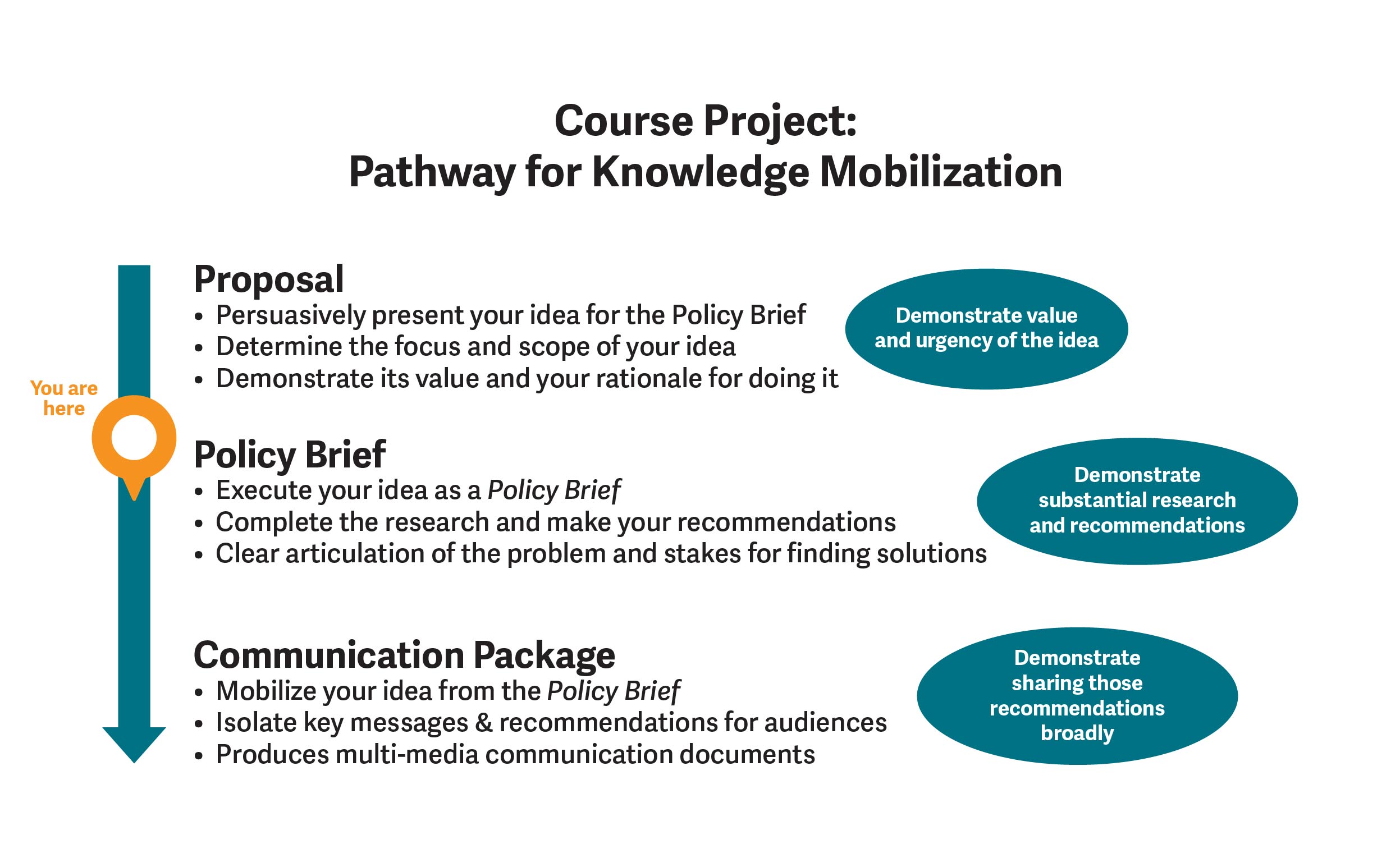
In Unit 1, focus was on the production of an effective persuasive research proposal, grounded in a specific context and perspective, with a strong sense of audience and purpose. In our course scenario, the proposal defined the scope and perspective of your project on flexible work and argued for its value. At this stage, you should have a good idea of your project idea and be ready to develop it into a well-researched policy brief with concrete recommendations. It’s time to deliver on the project you proposed in the first assignment.
By the end of this unit, you will be able to:
-
Explain the purpose and nature of a policy brief as a genre of strategic writing.
-
Demonstrate skills in defining a relevant discourse community for a project and synthesizing key issues and voices.
-
Demonstrate skills in effective strategic positioning and argumentation.
-
Design and produce a policy brief with an effective structure to meet the document purpose.
Topics
-
2.1 Engage the Conversation
-
2.2 Map the Conversation
-
2.3 Take a Position
-
2.4 How to Tell a Good Story
Consider each topic of this unit as the close equivalent to a standard week of work in a 3-credit, 13-week course. Plan to spend about 3–4 hours working the course material in each of the four sections, plus additional time to apply the information to work on your course project.
Here is a visual reminder of how the course assignments build on each other.
2.1: Engage the Conversation
Identify and Assess Key Issues
Purpose of a Policy Brief
LESSON
In the Introduction to this course, you had an opportunity to explore the genre of the policy brief and look at some examples. Now, with your own project in mind, we will examine the purpose and expectations of a policy brief in much more detail, aiming to understand how it is put together as a persuasive document.
While it is a research paper, the policy brief has a very specific mandate to generate some level of action or change. As a persuasive document, the policy brief must be written with a strategic understanding of how best to generate this intended action from its audience.
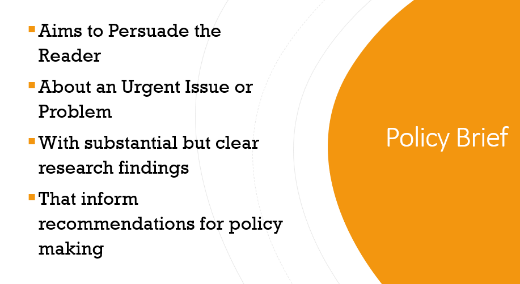
The lessons on rhetorical strategies and clear audience definition from Unit 1 continue to be relevant here. Synthesis of research material is used in the policy brief to make the case for the urgency of an issue or problem and/or to develop potential solutions.
In terms of structure and content, the policy brief generally follows a problem-discussion-recommendation structure. However, the emphasis within this structure can vary depending on what is at stake. For example:
-
The emphasis of the document might be on proving an issue or problem exists, using research to demonstrate its existence and its consequences; recommendations might then focus on a call to recognize and address the issue through policy development.
-
Alternatively, the emphasis might be on advocating for (a) solution(s) to a known problem which is assumed to be recognized, and the research focus is on one or more possible solutions. In this case, recommendations would focus on advocating for a proposed solution through policy development and change.
Finally, as you will see in the examples, a policy brief is brief! The goal is a two-page, concise but substantial piece of advocacy. It is used to capture the interest of audiences who may not be interested in the argument or who need an easy way to communicate the message to advocate for change. Later in this unit, we will consider the challenges of finding research within a relevant discourse community.
READ
-
Begin by watching the short video What Is a Policy Brief?
What Is a Policy Brief? [6:01]
(Navigating Academia, 2023)
-
Read the University of North Carolina at Chapel Hill’s Writing Center document on tips for writing effective Policy Briefs.
For this resource, pay particular attention to the sections on “How do I identify a problem” and “Framing the issue.” We will talk more about these strategies through this unit.
-
Read An Essential Guide to Writing Policy Briefs (Young & Quinn, 2017) and the associated Policy Brief Resources from the International Centre for Policy Advocacy.
There is a lot of information here on the purpose, function, and structure of a policy brief. This information also includes guiding questions and checklists to help you work through this unit and complete your policy brief. There are also examples of policy briefs to study.
-
Read IDRC’s How to Write a Policy Brief.
You’ve seen this one before in the Introduction section of the course. This resource includes step-by-step tips for each section of the policy brief, as well as links to examples. Spend time mapping the examples back to each section of the brief to see how they are written.
LESSON
The readings provide principles and toolkits to support the development of policy briefs across a range of sectors and areas of social, political, and economic life. While the approach to this genre can vary across disciplines and contexts, some overall shared qualities emerge:
You’ll have noted that the different toolkits and examples studied in the readings offer variations on this generic template, especially in the focus and direction of the Discussion. As you develop your own approach, you will shape your discussion section to suit the logic of your piece. This unit includes instructions and templates for doing this in later sections.
Analysis of Sample Policy Brief
READ
Read the following examples of policy briefs.
As you read these, you will notice the essential elements of this genre, despite small variations in the focus or structure of the documents for specific disciplines or functions.
Please note, also, that while many of these examples rely on primary research, for this course, you will be using synthesis of secondary research material to develop your brief.
-
Explore two or three of the policy briefs on the IDRC site. Your goal here is to get a good picture of the audience, purpose, and structure of the brief.
As you read some examples, select one and complete the questions in the “Think and Engage” box below.
-
CMNS 3241 students, read over Assignment 2: Policy Brief (25%) on the TRU Moodle site.
Finding the Discourse Community
LESSON
At all levels of our experience, we exist within larger contexts and communities. Some of them are small, like our household or our classroom; and some are larger, like our workplace, our city, or the communities of shared political, social, or cultural interests that we participate in. Think, for example, of Reddit or other online communities that share interests and a way of engaging with ideas. Often, within these communities there are debates, disagreements, as well as shared values and assumptions. Often, too, ways of communicating, including the tone or vibe, the use of vocabulary, and reliance on a shared basis of knowledge or information work to define the community. For example, members of particular online gaming communities will share knowledge not only about games, but also about the history, key players, and drama or issues that pervade that community; it can be difficult for outsiders to follow or contribute without a strong sense of the vocabulary and references. This is true of any community we belong in, but we don’t always notice it because it can seem so natural.
“Understanding the shape of a discourse and the problems that matter to a discourse community are vital to understanding the nature of the particular problem you are considering and how to solve it” (Pulver, 2020).
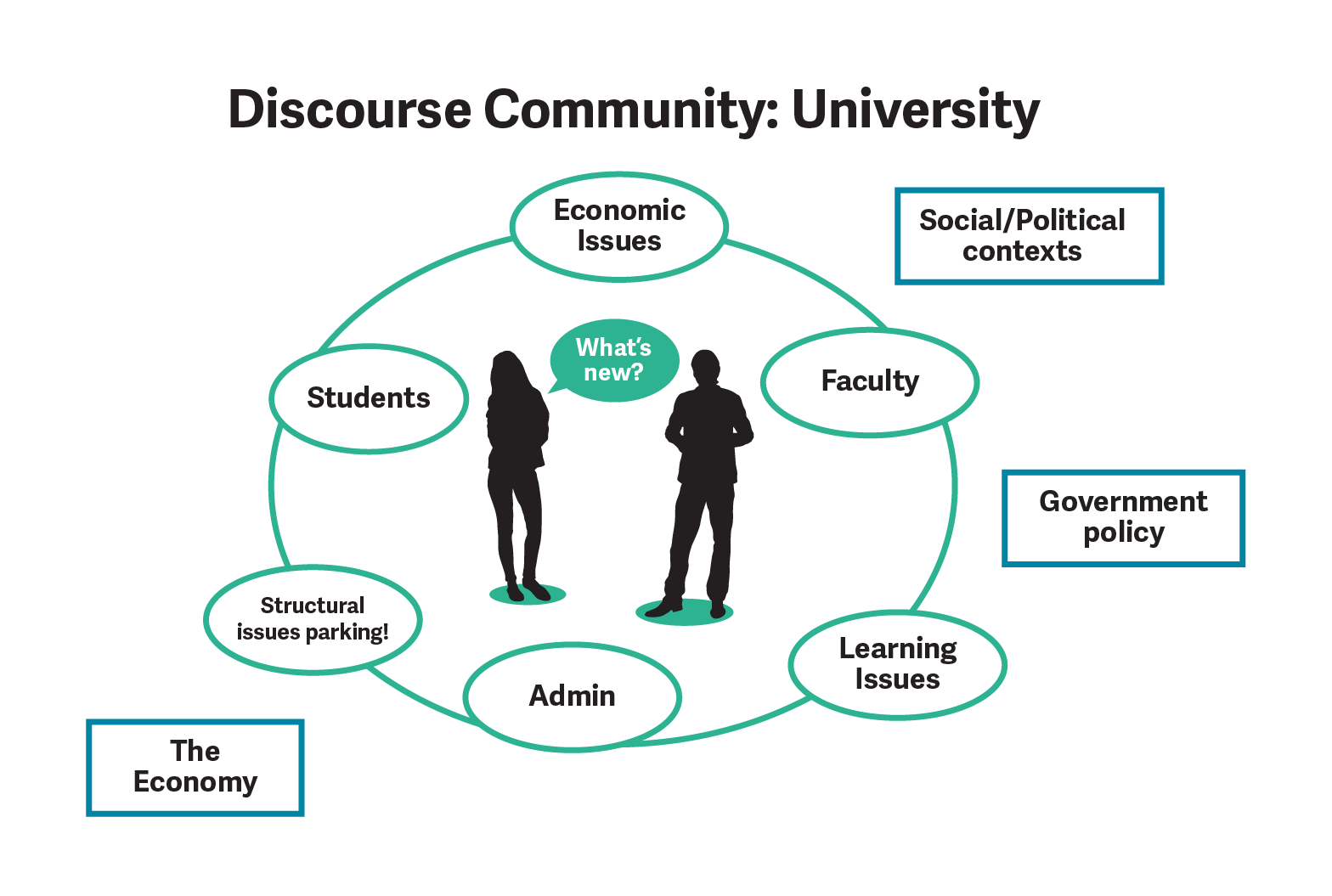
Let’s consider, as an example, a university community. Each one, of course, is different. But generally, we can think about the defining features. First, we can identify the different kinds of participants (students, faculty, and administrators) and the nature of the relationships between them; there will be a shared valuing of the endeavour of university education, but perhaps disagreements and debates over how best to do that. Within this community, there will be a range of recognized assumptions and issues; for example, debate over how best to deliver university classes (in person? online? using lectures or projects?) is ongoing. It becomes heightened at moments of change, such as it did during the pandemic. To participate in these debates in an effective way and provide a contribution that will be meaningful within the community, it’s necessary to draw on a shared knowledge of key figures, arguments, historical events, and narratives, and a shared understanding of what the issues and problems are. We also need to understand and use the language and communication channels that are used to have these debates.
Now, let’s bring this to the broader and more complex level of your policy brief. As you develop the focus and perspective of your project, you are identifying a discourse community. The next challenge is to understand how this community frames the issues and problems you are exploring and to find key research and frame the issues in ways that reflect the community.
(c) Shannon Smyrl and TRU Open Learning CC BY-NC-SA 4.0
READ
-
Read Christian Pulver’s (2020) chapter, “Discourse and Discourse Community.”
THINK and ENGAGE
After you’ve completed the reading, consider some of the different ways that an issue or debate might be mapped by different discourse communities.
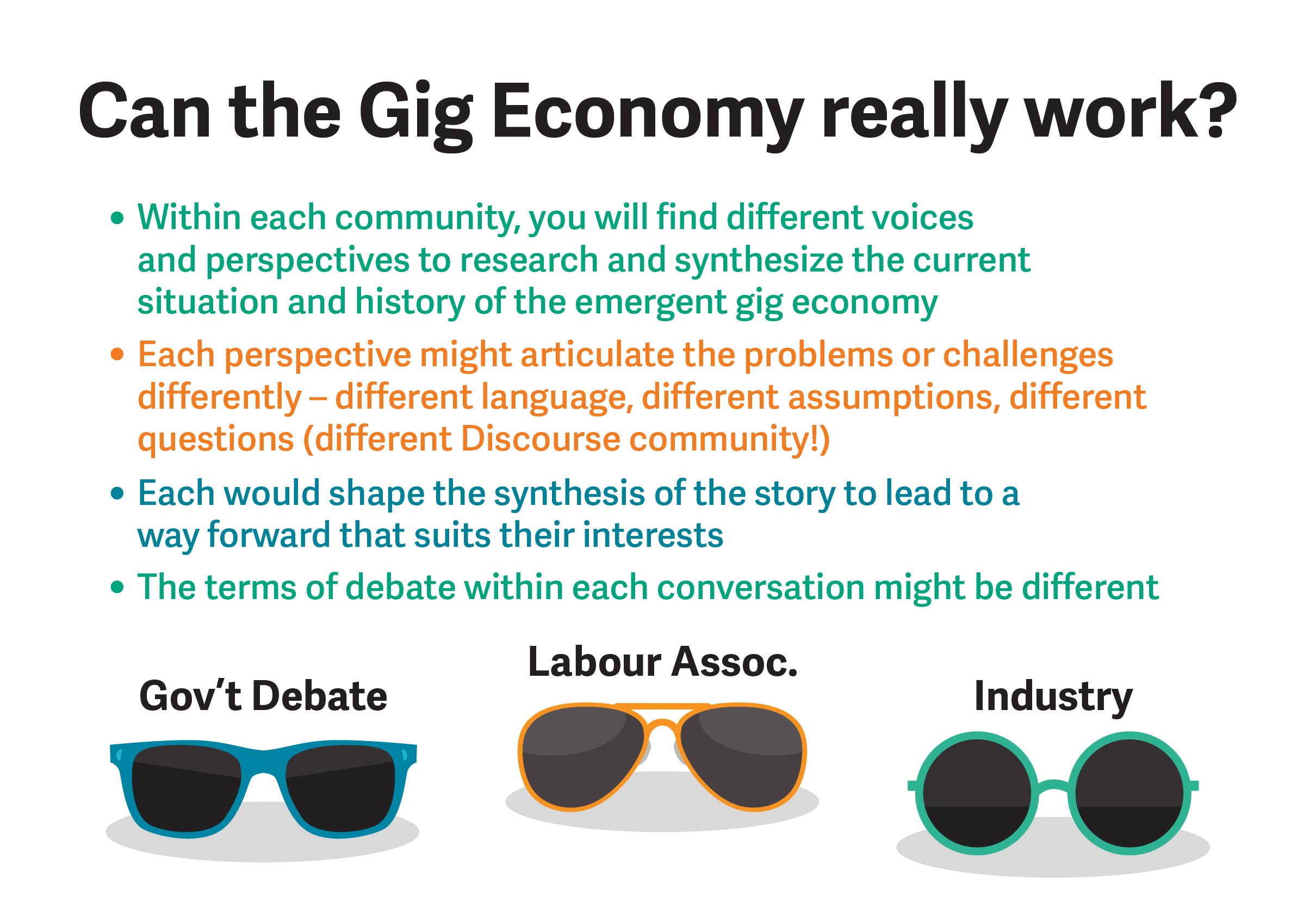
Consider social debate around the value and challenges of the gig economy which includes business models like Uber which rely on hiring independent contractors rather than employees. The question of whether this business model is feasible is explored very differently within different discourse communities.
-
From the perspective of the labour movement, what might be some of the issues or problems associated with the feasibility of the gig economy? How do these relate to the priorities and interests of the community? What assumptions would this community share around this issue?
-
From the perspective of business owners, such as taxi companies or even other sectors of service, what might be some of the issues or challenges? How do these relate to the priorities and interests of the community? What assumptions would this community share around this issue?
-
From the perspective of government regulators, what might be the issues or concerns? How are these tied to the priorities and responsibilities of the government?
Thinking about the discourse community for your specific project will help to ensure the framing of the problem, the focus of the recommendations, and the substance of the research will be valuable and concretely tied to those who have an interest in the topic. You have the opportunity to do this in the Unit Task 3.
Unit Task 3: Determining Your Discourse Community (3% of course grade)
UNIT TASK 3
Note: Students in CMNS 3241 must submit this Unit Task 3 for grades.
Write approximately 300–500 words.
Reflect on the discourse community for your own project. You should already have a sense of the perspective and focus of your project, as it was developed in your proposal.
Now, it’s time to refine this and make it more concrete. This will help you set goals for your in-depth research.
Based on your initial research and thinking about your project, ask yourself the following questions. These are adapted from Christian Pulver’s (2020) graphic, “Mapping the Discourse of a Problem or Controversy,” in your reading. Refer to the reading for more detail as needed.
-
What problem are you investigating? How is this problem discussed within the perspective (or discourse community) that you’re working within? What assumptions are made? Are there key words that are often used?
-
Who are the key figures in this conversation you are engaging? Are they obvious key people or organizations? Or are there key sides or positions in a debate around your problem?
-
Why is this a problem? What are the informing needs or urgent consequences? (This is exigence again—as you work on your topic, try to develop this in more detail than you had before.)
-
How is the problem you’re focused on discussed in the research and public debate? What kind of language is used? What kinds of rhetorical appeals are used? (Where does the evidence come from? What emotions are evoked?) What assumptions are made about how things are or how they could be?
-
How have you positioned your project in relationship to this problem and discourse community? Will your policy brief focus on illuminating and substantiating a significant problem or challenge, or will it assume shared knowledge of the challenges, and emphasize research into specific solutions?
As you begin to plan and extend your research in the next section, continue to ask these questions to make sure you’re on track to finish your research and build your paper.
Unit Task 3 will be graded on a scale of 1% for attempt, 2% for evidence of inclusion of course material, or 3% for thoughtful engagement/interaction with the course material.
Please submit your Unit Tasks 3, 4, and 5 as one document at the end of Unit 2.
2.2: Map the Conversation
What are people saying about this issue?
In this section, our goals are to:
-
Develop a research plan, identifying the kinds of material you need to map the conversation around your topic and meet your goals.
-
Review skills in the synthesis of research material, ensuring you know how to draw together information from multiple sources into a single summary effectively and without plagiarizing any sources.
Your policy brief will be based on a synthesis of research material that you collect and put together to support your identification of a problem or issue and/or your recommendation for policy changes and other forms of action. As such, your research material needs to be a logical and fair account of the conversation within the discourse community you’ve identified and are working within. The challenge now is to find these voices and conversations to bring them into your paper.
Finding Research Material
LESSON
The challenge of academic and professional research rests in our relative ability to sort through and discern the value of what we find. It’s all too easy to find information, using internet search tools and even social media platforms. We become used to the algorithmic logic of these tools sorting information for us, and we risk becoming complacent by accepting their filtering and prioritization to shape what information we work with.
However, this is not enough. A strategic and critically informed approach to research always considers the information needs of the project at hand, working within the conversations of the defined discourse community and acknowledging the sources of authority, the critical assumptions, and the ongoing research being done within that community. Our tasks as critical researchers are to find and map this conversation, then be able to add our own voices. One place to start is to be always mindful of the authority, content, and purpose of information, which you will read about now.
READ
-
Read this introductory lesson in “Finding and Evaluating Research Sources” from Susan Last’s (2019) Technical Writing Essentials.
This resource is a good starting place for those who have not done a lot of academic research, as it gets us thinking about the authority and value of different kinds of research material. It’s possible to use a broad range of sources, but it’s crucial to understand what kind of knowledge, information, and authority your sources have.
Planning a Research Strategy
LESSON
Conducting research can be overwhelming. The following steps for a simple research strategy—identify, write, search, and document—are designed to support you in isolating the information needs for your project, and finding significant sources that are interconnected within the conversations related to the scope and perspective you have taken.
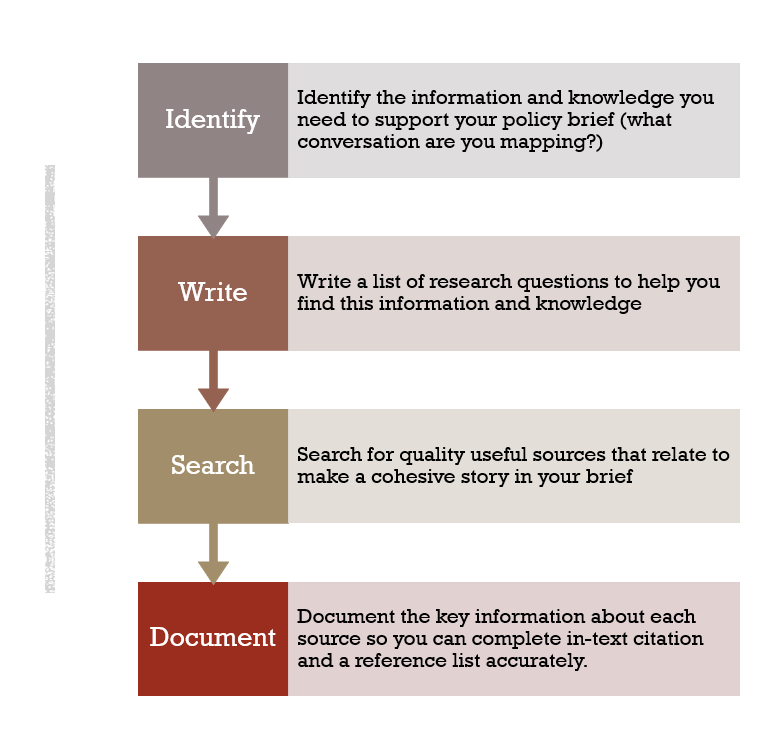
In the following explanation of the strategy, an example is used for illustrative purposes. Here’s the example project:
-
Problem: Many caregivers lack the flexibility in their work conditions to manage effective child-care options, leading to extra long days or compromises in the quality and access of child care.
-
Policy brief idea: On-site child care at large organizations could improve the flexibility and well-being of caregivers during their day, providing for a more productive work environment. This policy brief will conduct research on the potential benefits of on-site child care to both families and employers, and the potential challenges of achieving it.
-
Goal: To provide a persuasive case on an economic and social basis for on-site child care to support a call for regulation that requires it by large employers
So, to develop this project, we can begin a research strategy.
Identify
Write
Search
Document
Synthesizing Research Material
Sometimes, policy briefs are based on primary research, when an organization or advocacy group conducts a study and reports on the findings of that study as evidence and support for the call to action in the policy brief. Other times, such as in our course project, policy briefs are based on secondary research, drawing together evidence and support from multiple pieces of research to build the call to action.
This act of drawing together evidence and support from multiple sources can be tricky. In this section, we will review the nature and strategies for effective synthesis of research material.
READ
-
Read from University Writing Lessons, “Study Room 4” (Smryl, n.d.), Lesson A: “Organizing and Grouping Information” and Lesson B: “Combining and Evaluating Ideas.”
These are interactive lessons. It might be valuable, at first, to simply read through the material, and then work on the practice activities after you have a sense of the lessons.
LESSON
The logic of synthesis is to come to a larger conclusion or set of recommendations based on the cumulative knowledge and information from multiple voices. This is, notably, different from an analysis in which a thesis or argument is developed through key points that may be supported with evidence from different sources.
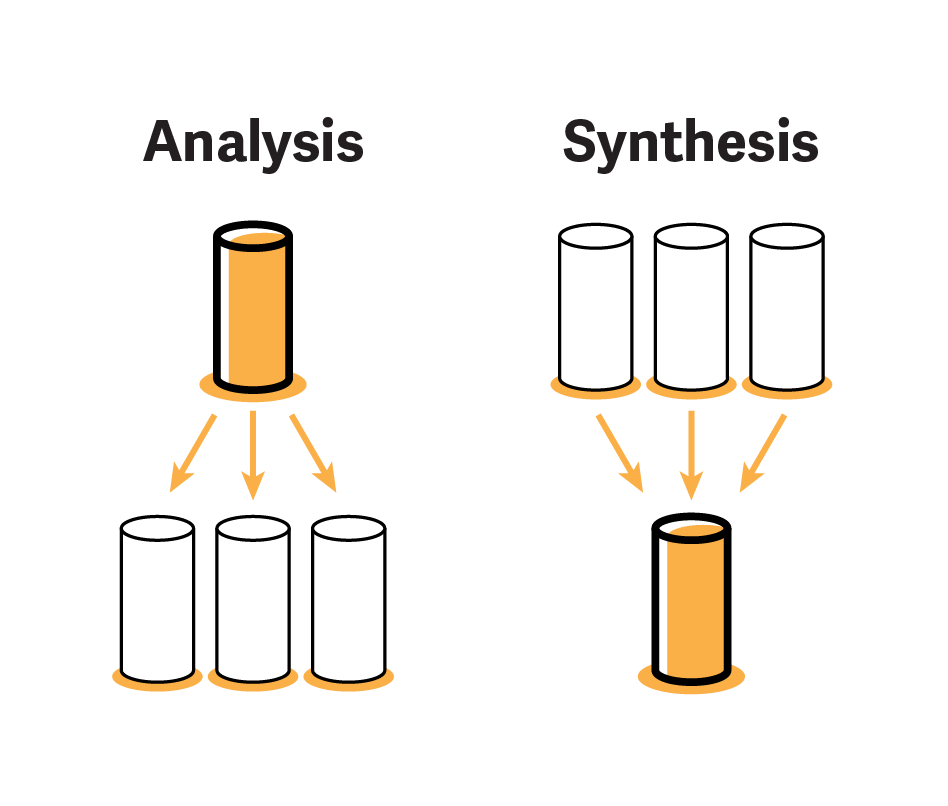
(c) Shannon Smyrl and TRU Open Learning CC BY-NC-SA 4.0
In synthesis writing, the key topics or points of discussion are identified, and information from the set of course material is brought together under those points and mapped, looking, for instance, at comparisons, contrasting views, and multiple examples.
The goal of synthesis is in the name; rather than simply providing a summary of each source, the goal is to explore the relationships between what different authors say about a point of discussion and then, based on these explorations, make some conclusions or recommendations. The persuasion of a policy brief comes through the synthesis of information about a problem and then the pointing to next steps.
Let’s look at a fun example.

What if you wanted to tell a story about all these chocolate bars? How would you begin to manage all the interesting information?
To make our story about the candy bars meaningful, we need to move beyond simply summarizing each candy bar in turn. This would make for a long and unshaped tale, with boring summary and no sense of the relationships between the candy bars.

Research summaries capture the details of each source, but they don’t allow for any synthesis of information. How can the information from each source be made meaningful in connection to the other sources?
We can begin to ask questions about how we might categorize the information.
-
What kinds of information could you identify about these candy bars?
-
What different categories of information do you think are most relevant?
-
Why would you choose those particular categories of information over others?
Try this with some friends!
Gather a selection of candy bars, or a different item, and ask two or three people to sort them into categories. What different categories do people make? Talk about why they think their categories are relevant.
How we might choose to make significant categories of information will depend on what’s important to us. The categories of information we identify are linked to our goal for collecting and synthesizing information.
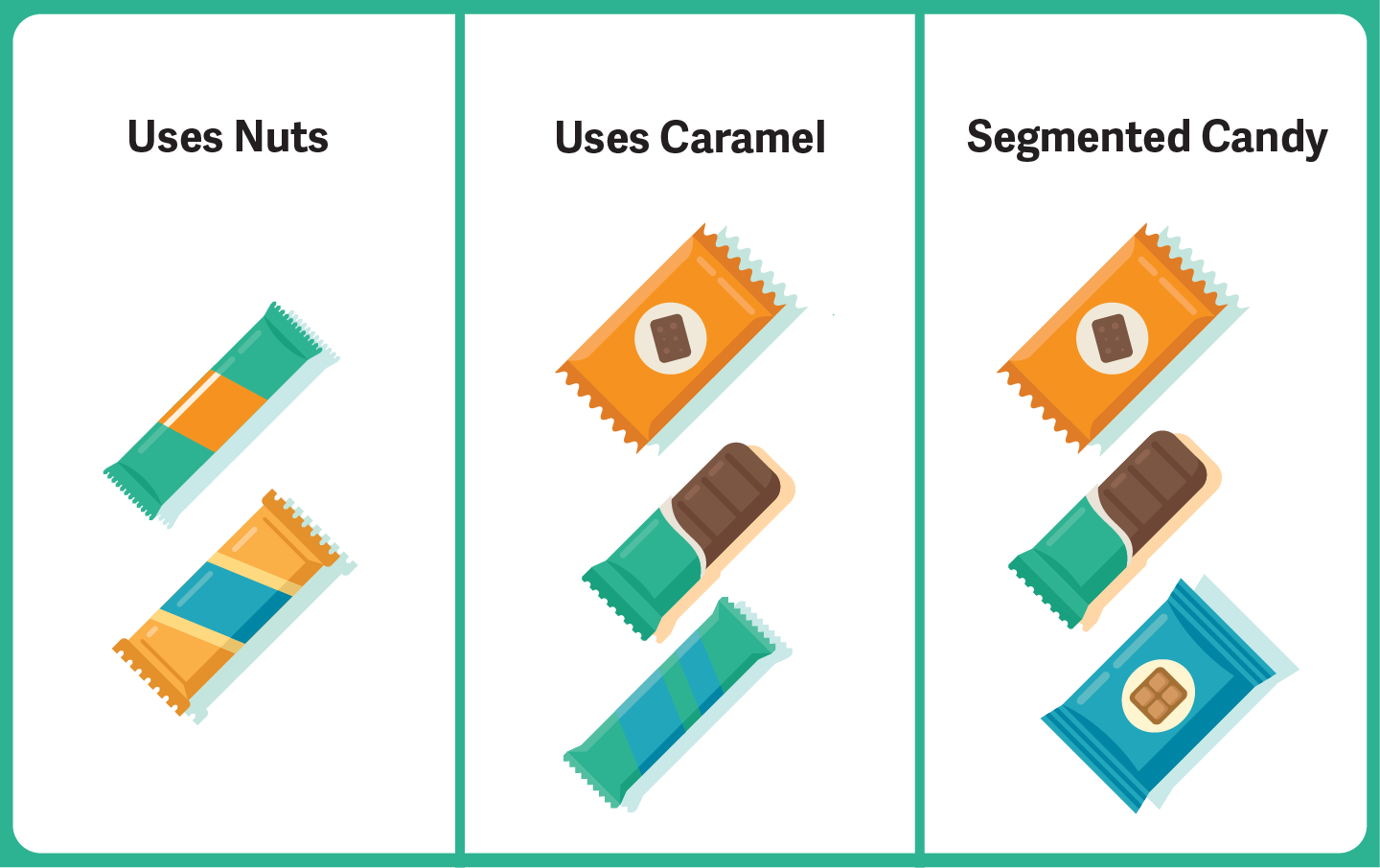
For example, someone with a peanut allergy would certainly be motivated to organize the samples by the presence of peanuts. Others, motivated by comparing the eating experiences, might focus on categories of ingredients, shape, and type of chocolate. And yet others who were motivated by marketing goals might identify categories connected with the image, style, and colour of the packaging.
A research synthesis draws together information from a variety of sources into significant categories of discussion, defined by the information needs of the project.
The challenge, in developing a research synthesis, is identifying these significant categories.
Thinking about what kinds of information and knowledge are relevant to the issue and within the larger discourse community is key. We must ask what information we need to achieve our goal, and then go through each source and find any information that can contribute to our understanding of that category. A table like this may help with notetaking:
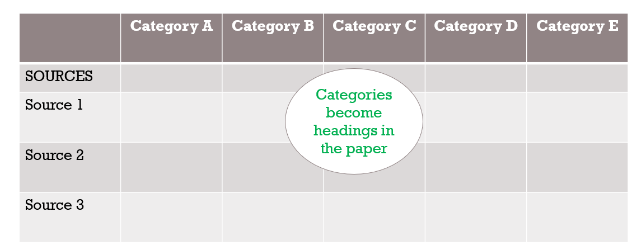
Synthesis writing smoothly interweaves the information from multiple sources to build an understanding of the conversation around a particular topic or category of information, as in this funny example:
Synthesis Writing
Use of Nuts
In some candy bars nuts are used in whole or chunky form (Snickers, 2012), while in others they are ground into the chocolate (Toblerone, 2014).
Use of Caramel
Two approaches dominate in the use of caramel. Mars (2011) and Twix (2014) both use it as a layer; Caramilk (2016) fills segments with caramel instead.
Segmented Candy
Approaches to segmented candy show very little variation. Candy is either segmented into “finger” shapes (Kitkat, 2010; Twix, 2017) or “squares” (Caramilk, 2016)
(c) Shannon Smyrl CC BY-NC-SA 4.0
Documenting Research Material Accurately
READ
-
“Quoting, Paraphrasing, and Summarizing Sources” (Bennetch et al., 2021)
Complete the practice material.
-
Acknowledging, Paraphrasing, and Quoting Sources (University of Wisconsin–Madison, 2003)
-
University Writing Lessons (Smyrl, n.d.), “Boot Camp 3 – Writing with Research.”
Complete the full lessons in Boot Camp 3 to work on your skills.
Unit Task 4: Produce a Research Strategy and Annotated Bibliography (3% of course grade)
UNIT TASK 4
Note: Students in CMNS 3241 must submit this Unit Task 4 for grades.
In this task, the goal is to set up your research strategy to ensure that you find supporting material for your policy brief that is focused within a clear discourse community and is relevant to the perspective and issues you’ve identified for your project.
Use the sample provided earlier in this unit as a guide to completing this task.
Part A: Produce a Research Strategy which includes:
-
Identify.
Outline the conversations you are mapping: Identify the different kinds of information and knowledge you need to support your policy brief—what are some areas of the discourse community in which you might look for useful voices and ideas?
-
Write.
Write a list of research questions that are as focused as possible to help you find the information and knowledge you need. What do you need to know?
-
Search.
Based on your questions, make a preliminary list of search terms, and organizations or publications where you might begin looking for your research. As you find things, use clues to help you find more sources related in the same conversation.
-
Document.
Document the key information about each source you find so that you can assess its authority and relevance to your project and, if you end up using it, so that you have the information needed for citation.
Part B: Produce a preliminary annotated bibliography.
Find a minimum of three sources (you can change them later if your project evolves).
For each source, produce:
-
The proper APA citation.
-
A brief (2–4 sentences) statement about what information or argument the source contains, why it will be helpful to your project, and why it’s a credible or useful voice to include with connections to your discourse community.
If you need help with APA citation, see TRU’s APA Citation Style Guide (7th Edition).
Finishing parts A and B will help you to fully engage in the research for your policy brief. Research may be an ongoing process, so don’t worry if you don’t find everything you need right away.
Unit Task 4 will be graded on a scale of 1% for attempt, 2% for evidence of inclusion of course material, or 3% for thoughtful engagement/interaction with the course material.
Please submit your Unit Tasks 3, 4, and 5 as one document at the end of Unit 2
2.3: Take a Position
Writing for a Defined Interest
In this section, our goals are to:
-
Develop and implement skills in organizing the policy brief so it works as a persuasive and functional advocacy document.
-
Review skills in effective writing to support the completion of the policy brief.
So far, emphasis has been on identifying an issue or problem within a defined discourse community, and on collecting and working with research material as the substance to support writing about that issue or problem in a policy brief.
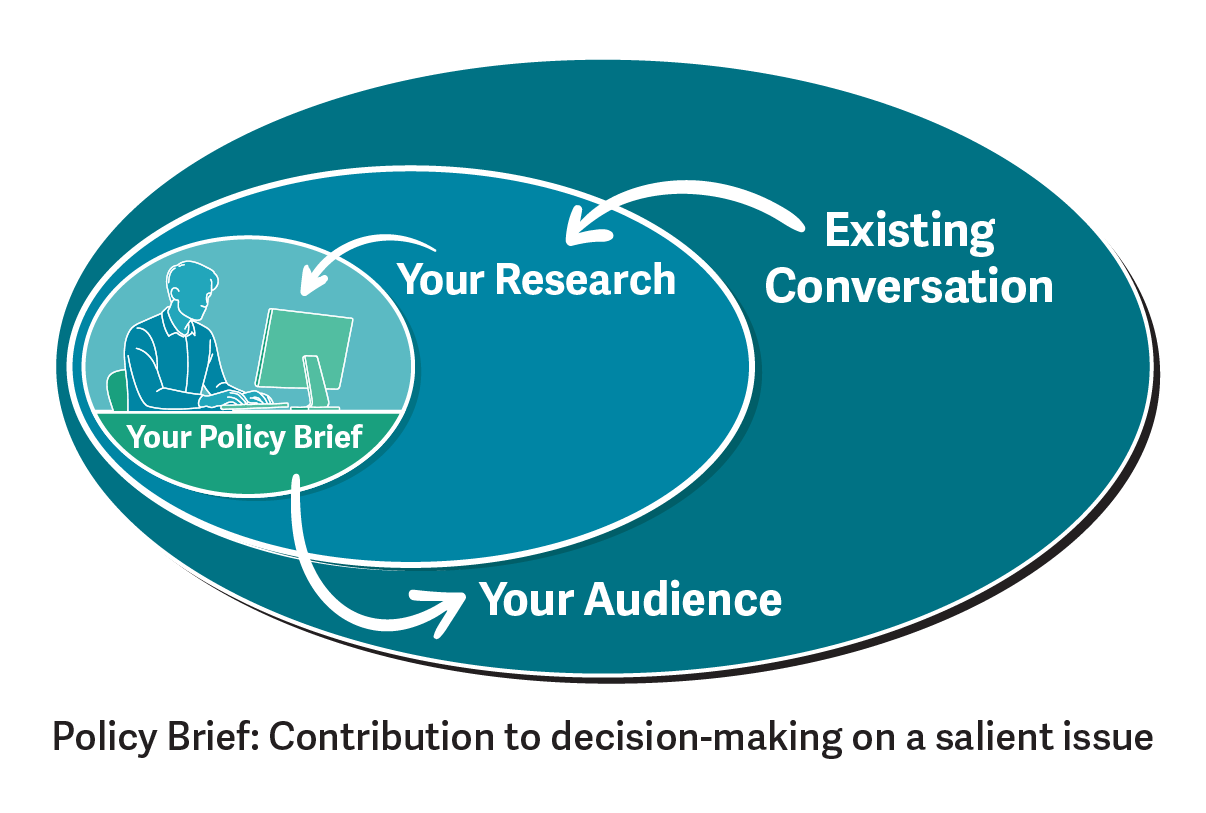
In a research project, we begin with a tentative sense of our issue or question, work with the research material in our discourse community to learn and map the conversations about that issue, and then define the specific position we would like to take in that conversation and organize our message. It’s this last stage that is covered in this section.
Organizing the Policy Brief
A policy brief represents our act of taking a stand within a conversation on an issue. It’s our opportunity to shape the discussion to support recommendations for action. As such, it’s crucial that the goal and outcome of the paper be clearly articulated (both in our minds and on the page), and that the structure and development of that paper supports reaching that goal.
READ
-
Read the IDRC toolkit presentation on How to Write a Policy Brief.
You have already had an opportunity to examine the sections of a policy brief and its overall function. This time, as you go through these slides, think more about the internal logic of the document. How are the sections connected to build towards its overall goal?
-
Read this general introduction to storyboarding as a skill to help organize information and produce content. It’s called From Disney Studios into a Scientific Lab: One Idea That Travelled Far! (IlluScientia, n.d.).
-
Read Patrick Dunleavy’s (2014) article “Storyboarding Research: How to Proactively Plan Projects, Reports and Articles form the Outset.”
LESSON
Writing a research paper can seem daunting and unfamiliar. However, it really is just storytelling. The goal is to write something that takes the audience on a journey, educates them, and leaves them empowered to make choices and decisions at the end.
The challenge is to know what story you want to tell and organize your information to achieve that story. If our organization of information is not strategic, designed to achieve the correct story, the goal of the paper won’t be met.
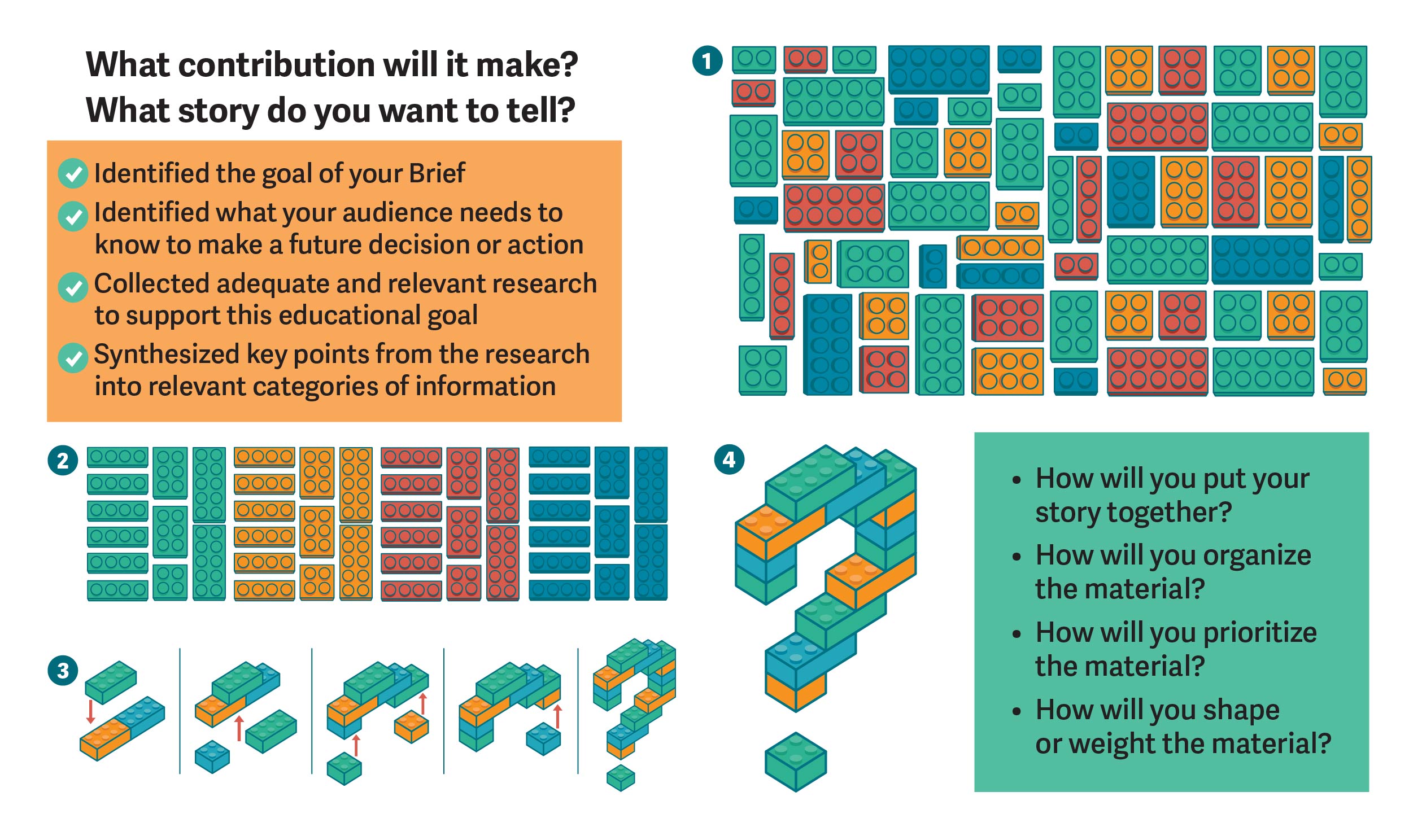
We can use building blocks to help us envision this process. Begin with the goal. What do you want to build? In this case, our goal is to build a castle!
In working towards our castle, we begin with an assortment of building blocks. We have identified these blocks as the ones necessary to form a castle and we have sorted them into relevant categories to make the building easier.
Likewise, in our progress towards the policy brief, we have already identified pieces of relevant research (the individual building blocks) needed for our purpose. Then, we have worked to synthesize this research material into relevant categories of information to make it easier to build the persuasive argument of the policy brief.
Now, it’s time to develop instructions for assembling our policy brief so that we know how we want to go from our categories of information to our goal, or from sorted building blocks to our castle.
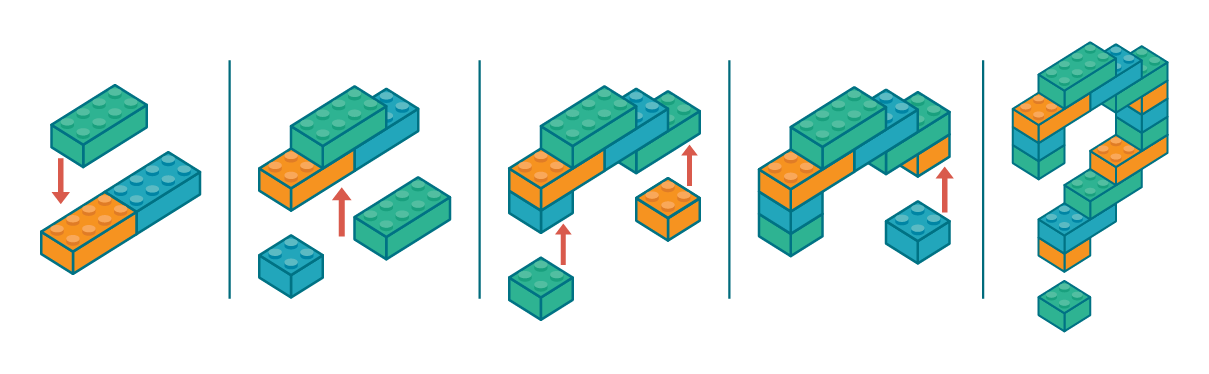
(c) Shannon Smyrl and TRU Open Learning CC BY-NC-SA 4.0
We could just randomly start sticking building blocks together and hope we eventually build a castle. But it is arguably easier to have a plan!
-
What is the logical order of the pieces?
-
What is the function of each piece of information—Does it illustrate a problem? Does it present an argument about an issue? Does it provide an example of a policy solution?
-
What is the relationship between pieces? Do they link as comparison, as multiple examples, or as a movement from problem to solution?
-
Which information is a core priority, and which is supplemental support?
Consider these final principles for organization as you begin to storyboard your policy brief:
-
Think of this as telling a compelling story for your unique audience.
-
The logic of organization should be driven by what the audience needs to hear first, then second, etc. to stay with you and accept your story.
-
Think carefully about your starting assumptions. What premise will you begin with?
Find the point where you, as persuader, and the audience will be on the same page and begin there. For example, decide whether you and your audience already share the assumption that a problem exists, so you start there and thus don’t need to spend a lot of time convincing them of the problem; rather, move on to a case for addressing it. Alternatively, your goal might be to convince your audience there actually is a problem. The starting assumption will shape the architecture of your piece.
-
Think carefully about your closing assumptions.
What idea of value do you want to emphasize by the end of the brief? How will your audience feel about this idea (will they be excited or skeptical)? Shape your story to acknowledge this. Finally, be clear about what your audience will be able to do with this final idea.
-
Design a pathway of persuasion through the main content of the brief that gets from the opening assumption to the closing value statement as directly and cleanly as possible.
Unit Task 5: Produce a Storyboard for Your Policy Brief (3% of course grade)
UNIT TASK 5
Note: Students in CMNS 3241 must submit this Unit Task 5 for grades.
Using the lessons and the readings, produce a storyboardfor your policy Brief.
When producing a storyboard, consider including the following kinds of cues:
-
Headings/subheadings
-
Content cues to indicate what content and its function in the story
-
Transitions; relationships between ideas; highlighting of key info/resources
-
Planned visuals
Here’s how:
-
Begin by brainstorming to get all your ideas out on the table first, just for yourself. Write out or collect all the information, quotations, ideas, etc. that you have so far. Try sticky notes!
-
Then, work on organizing all the content into categories of information that you have identified as relevant. This would include identifying information for the introduction, for the sections of the development section, and even for the recommendations. What are all the different categories of information? (Remember the synthesis work? Try to identify core categories of information from all your research.)
-
Now list all your own ideas about what you want to say or key points you want to make, and match these with your groups of information.
-
Finally, put your categories of information in the order you want them for your paper. To do this, you need to think about the story you want to tell your readers. What’s the best place to start? How will they anticipate the information? Where is the emphasis going to be? Where will they end up at the end?
Transform this brainstorming into a storyboard to help you refine the shape of your story using the model provided in class lessons. As you map out your story, you can think about some of the ways you can highlight and emphasize information. Leave yourself annotated notes about any visuals or examples you’d like to use when you get writing.
To produce your storyboard, you can make a table in Word, or use an online template like this one: StoryboardThat (no need to pay any money). There are tons of these online to choose from.
Unit Task 5 will be graded on a scale of 1% for attempt, 2% for evidence of inclusion of course material, or 3% for thoughtful engagement/interaction with the course material.
Please submit your Unit Tasks 3, 4, and 5 as one document at the end of Unit 2.
Writing Lab: Refresher on Principles of Effective Writing
LESSON
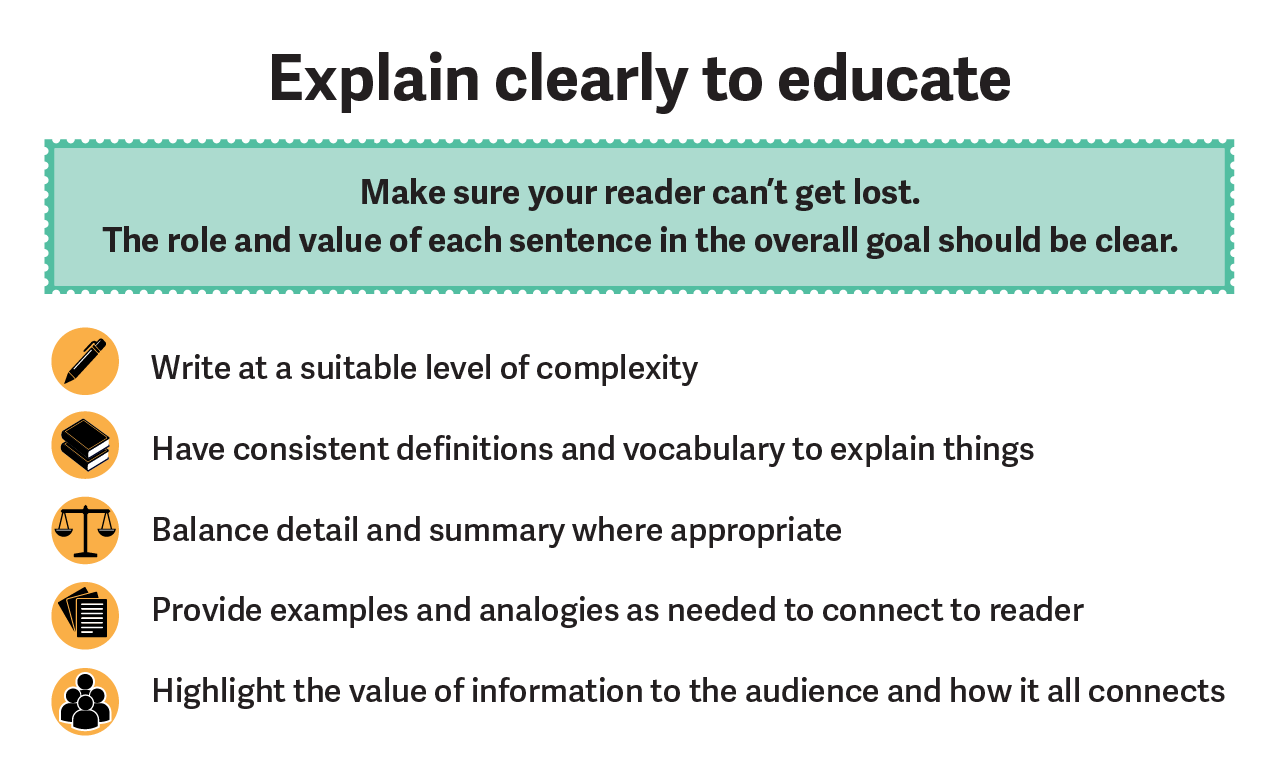
Anyone who does a lot of writing learns, over time, tricks to improve their craft. Often, when we write under pressure or when we are not particularly motivated to complete the task, we find it difficult to take the time to improve our writing, sentence by sentence. However, the meaning and impact of our work is tied directly to the overall effectiveness of our communication skills. If the writing is poor and impedes understanding and impact for our audience, our good ideas will not be appreciated.
Tips for writing improvement are easy to come by. A common example is to remind students not to begin a sentence with “This is” or “There are.” If you look for better ways to structure a sentence, it will inevitably be more concrete and effective. But putting tips and tricks like this into action takes a real commitment. While it’s true that AI in its various forms can offer editing support, it also tends to take out the tone and unique voice of a writer, elements essential for strong, persuasive strategic communication. Take the time to develop your own writing and revision skills.
READ
In this refresher, you will read over tips and tricks for concise and clear writing that is audience focused and professional. Some of this may be new and some of it a review. Put your focus where you need to and ensure you can apply these skills for your course project.
-
Read Writing Concisely from the University of North at Chapel Hill’s Writing Center.
-
Read Dr. Karen Palmer’s (2020) “Writing Clearly and Concisely” from The Roughwriter’s Guide.
As you work through this one, take the time to view the videos and do the practice activities provided at the end.
-
Complete Lessons 1, 2, and 3 from Duke Graduate School Scientific Writing Resource (Sheffield, 2011).
If you are not completely confident in your skills, considering completing the practice sheets provided with this resource.
2.4: How to Tell a Good Story
Polish Your Work
In this section, our goals are to:
-
Apply skills in effective document design to finalize the policy brief.
-
Apply skills in revision to ensure a polished final product.
In the previous section, skills in organizing the policy brief were covered to support the drafting of a brief for the course project. Now, in this final section of Unit 2, skills in document design and revision will be covered, ready to apply in the polishing of your draft project into an effective policy brief.
Effective Document Design
READ
-
Read and complete the exercises in “Effective Document Design” in Communication@Work (Smith, 2019).
This reading covers a wide range of skills needed to ensure the presentation of a professional, polished, and effective report.
-
Read “Integrate Visuals and Apply Design Principles” (Schaller & Wolf, 2020).
This reading will supplement your knowledge of document design with more depth about how to incorporate visuals into the document.
-
If you haven’t already, go back and review the tips on How to Write a Policy Brief in the IDRC toolkit.
LESSON
The readings, practice activities, and engagement questions provide a comprehensive account of the principles of effective document design. In this section, we will just itemize the most salient of principles to keep them top of mind as you finalize your writing.
Drawing from the works in the readings, we can assert the following four essential principles:
-
Audience-Focused Visual Story
-
At the end of the day, the visual story of your policy brief should be designed with audience in mind.
-
Readers will scan the document first, looking for a sense of what they are reading and why they should keep reading it; the core message and main points should be easy to find visually. Reluctant readers will need early and consistent incentive to keep engaged.
-
A consistency between content, tone, and style is important to reinforce rather than disrupt meaning.
-
-
Clear, Concise, and Coherent Expression
-
From the headings to the call-out boxes, to the individual paragraphs and sentences, the writing should be clear, concise, and coherent. Expression should never be an impediment to understanding, but rather a supplement to the goals of the communication, whether persuasive or informative.
-
-
Consistent and Accessible Layout
-
Page design should be consistent and accessible, making effective use of margins, spacing, colour, and font.
-
Headings and other forms of emphasis should be consistently applied, using font size and colour, as well as content.
-
Accessibility strategies should be applied to the document.
-
Text boxes, quotes, sidebars, visuals, and the like should be consistently formatted in a style suitable to the goals of the document and located logically in the page layout to create a coherent “look” for the document.
-
-
Strategic Visuals
-
The policy brief is a short document and a visual may or may not be relevant. Avoid gratuitous visuals, but if you have one that contributes to the meaning of your work, go ahead and use it.
-
Skills and Motivation for Revision and Proofreading
It’s worth it. It really is worth the time to go back and revise and proofread your work. Many students often complete their assignments just at the due date, leaving off this final element of professionalization. However, strong attention to the finer details of the document design and writing will ensure you secure the authority and persuasiveness of the work. Great ideas are not great if they cannot mobilize engagement and action. Poor writing will devalue your great ideas.
READ
-
Read the handout Revising Drafts from the University of North Carolina at Chapel Hill.
-
Read the handout Editing and Proofreading from the University of North Carolina at Chapel Hill.
EXAM PREPARATION
Students in CMNS 3241 will have a final exam for this course. Information from Unit 2 that will be covered on the final exam:
-
Exercises related to the refresher on clear and concise writing, along with coherence and cohesion
-
Exercises related to using source material in your writing, including paraphrase
Unit Tasks 3, 4, and 5 (9% of course grade), and Assignment 2: Policy Brief (25% of course grade)
ASSIGNMENT TIME
Once you have completed Unit 2, you have the tools you need to complete Assignment 2: Policy Brief.
CMNS 3241 students, please log into TRU Moodle for assignment instructions.
-
Unit Tasks 3, 4, and 5 (9%) – please submit as one document
-
Unit Task 3: Determine your Discourse Community (3%)
-
Unit Task 4: Produce a Research Strategy and Annotated Bibliography (3%)
-
Unit Task 5: Produce a Storyboard for Your Policy Brief (3%)
-
-
Assignment 2: Policy Brief (25%)
References
Bennetch, R., Owen, C., & Keesey, Z. (2021). Effective professional communication: A rhetorical approach. University of Saskatchewan. https://www.saskoer.ca/rcm200/chapter/chapter-27-quoting-paraphrasing-and-summarizing-sources/
CBC Radio. (2020, July 17). Childcare is an economic issue Canadians need to tackle, say economists and parents alike. https://www.cbc.ca/radio/costofliving/the-economics-of-childcare-plus-the-surge-in-cosmetic-procedures-hidden-by-face-masks-1.5652124/childcare-is-an-economic-issue-canadians-need-to-tackle-say-economists-and-parents-alike-1.5652144
Choe, D. E., Barreda, S., Galán, C. A., Gardner, F., Wilson, M. N., Dishion, T. J., & Shaw, D. S. (2024). Early interventions may boost academic skills among disadvantaged children. Policy Brief, Center for Poverty & Inequality Research, 12(5). https://poverty.ucdavis.edu/sites/main/files/file-attachments/choe_early_predictors_brief-reduced.pdf?1707131448
Dunleavy, P. (2014, October 31). Storyboarding research: How to proactively plan projects, reports and articles from the outset. The London School of Economics and Political Science. https://blogs.lse.ac.uk/impactofsocialsciences/2014/10/31/storyboarding-research-dunleavy/
Findlay, L. C., Wei, L., & Arim, R. (2021). Patterns of participation in early learning and child care among families with potential socioeconomic disadvantages in Canada. Statistics Canada. https://doi.org/10.25318/36280001202100800002-eng
Gunaseelan, V. (2021, January 27). A new normal for child care in Canada: Accessible, affordable, universal. Wellesley Institute. https://www.wellesleyinstitute.com/a-new-normal-for-child-care-in-canada-affordable-accessible-universal/
IlluScientia. (n.d.). From Disney Studios into a scientific lab: One idea that travelled far! https://www.illuscientia.com/resources/storyboard-for-research-design/
International Centre for Policy Advocacy. (n.d.a). How to write a policy brief. https://idrc-crdi.ca/sites/default/files/idrcpolicybrieftoolkit.pdf
International Centre for Policy Advocacy. (n.d.b). Policy brief resources. https://icpolicyadvocacy.org/policy-brief-resources
International Development Research Centre. (n.d.). How to write a policy brief. https://idrc-crdi.ca/en/funding/resources-idrc-grantees/how-write-policy-brief
Last, S. (2019). Technical writing essentials. University of Victoria. https://pressbooks.bccampus.ca/technicalwriting/
Navigating Academia. (2023, July 4). What is a policy brief? [Video]. YouTube. https://www.youtube.com/watch?v=pvupkji29ZU
Palmer, K. (2020). Writing clearly and concisely. In K. Palmer & Van Lieu, S. (Eds.), The roughwriter’s guide. https://pressbooks.pub/roughwritersguide/chapter/writing-clearly-and-concisely/
Peterson, R. (2020, October 16). Corporate Canada needs to take on child care. Policy Options. https://policyoptions.irpp.org/about/our-commitment-to-readers/
Pulver, C. J. (2020). Discourse and discourse community. In Roger Williams University Department of Writing Studies, Rhetoric, and Composition, Thinking rhetorically: Writing for professional and public audiences. https://rwu.pressbooks.pub/thinkingrhetorically/chapter/discourse-and-discourse-community/
Schaller, J., & Wolf, T. (2020). ENG 1210: Technical writing. Central New Mexico Community College. https://mytext.cnm.edu/course/english-1119/
Sheffield, N. (2011). Duke graduate school scientific writing resource. Duke University. https://sites.duke.edu/scientificwriting/
Smith, J. (2019). Communication@Work. Seneca Polytechnic. https://pressbooks.senecapolytechnic.ca/buscomm/
Smyrl, S. (n.d.). University writing lessons: A Creative Commons university writing resource. Thompson Rivers University, Open Learning. https://engl1101-sw2.trubox.ca/
Thomas, D. (2020). Woman typing on a Macbook [Photograph]. Unsplash. https://unsplash.com/photos/woman-in-brown-and-white-fur-coat-sitting-on-chair-HA-0i0E7sq4
University of North Carolina at Chapel Hill. (n.d.a). Editing and proofreading. https://writingcenter.unc.edu/tips-and-tools/editing-and-proofreading/
University of North Carolina at Chapel Hill. (n.d.b). Policy briefs. https://writingcenter.unc.edu/tips-and-tools/policy-briefs/
University of North Carolina at Chapel Hill. (n.d.c). Revising drafts. https://writingcenter.unc.edu/tips-and-tools/revising-drafts/
University of North Carolina at Chapel Hill. (n.d.d). Writing concisely. https://writingcenter.unc.edu/tips-and-tools/conciseness-handout/
University of Wisconsin–Madison. (2003). Acknowledging, paraphrasing, and quoting sources. https://writing.wisc.edu/wp-content/uploads/sites/535/2018/07/Acknowledging_Sources.pdf
Young, E., & Quinn, L. (2017). An essential guide to writing policy briefs. International Centre for Policy Advocacy. https://icpolicyadvocacy.org/sites/default/files/2024-04/icpa-policy-briefs-essential-guide.pdf