Unit 3: The Communications Package
| Site: | TRU Open Courses |
| Course: | Advanced Professional Communication |
| Book: | Unit 3: The Communications Package |
| Printed by: | Guest user |
| Date: | Monday, 12 October 2026, 3:44 PM |
Overview
Quality research, such as the development of a policy brief, becomes valuable when it is shared. Research should not be left on a shelf but used strategically to increase knowledge and, in many cases, to persuade others to act. This is how the advocacy potential of a policy brief is fully realized.
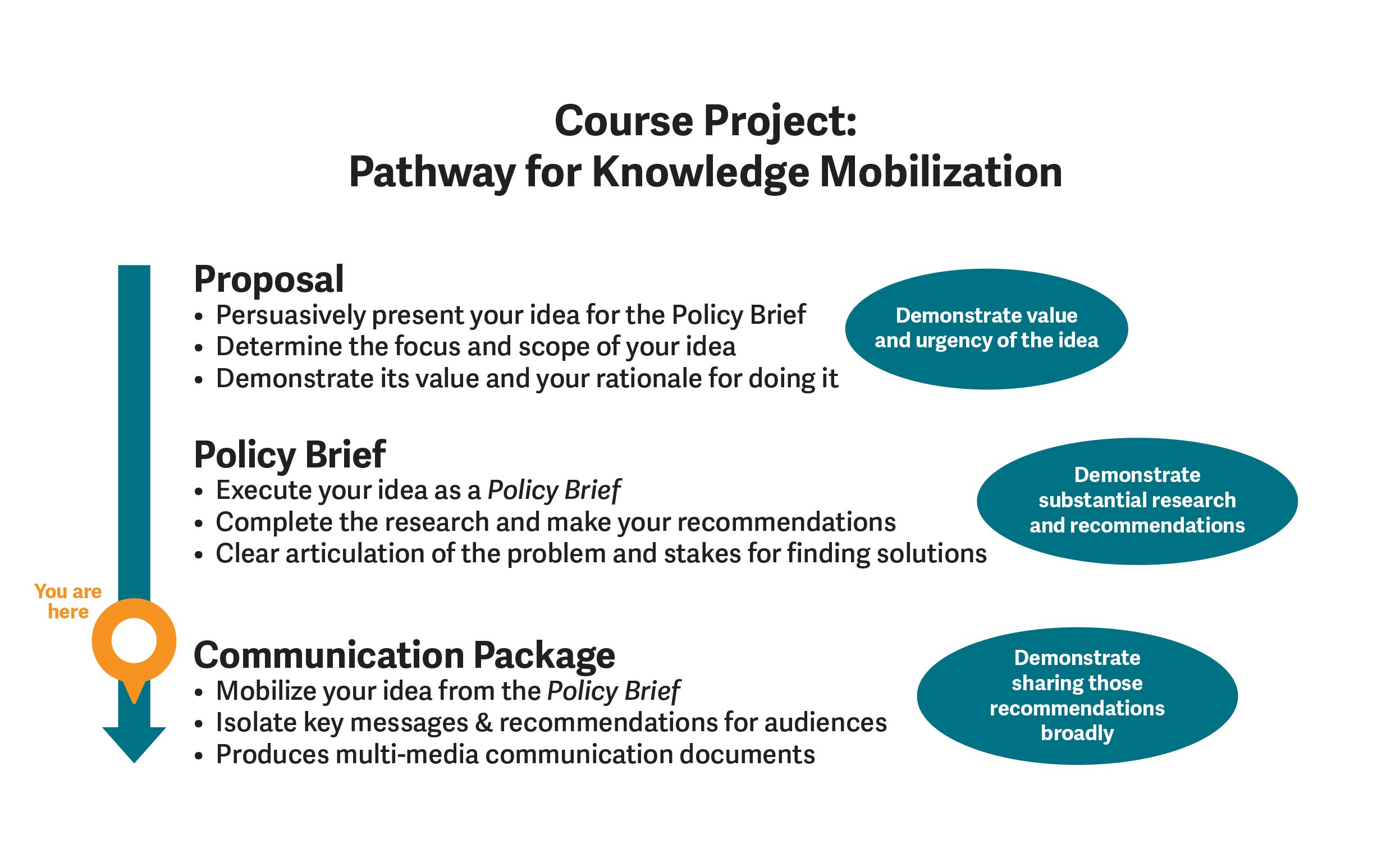
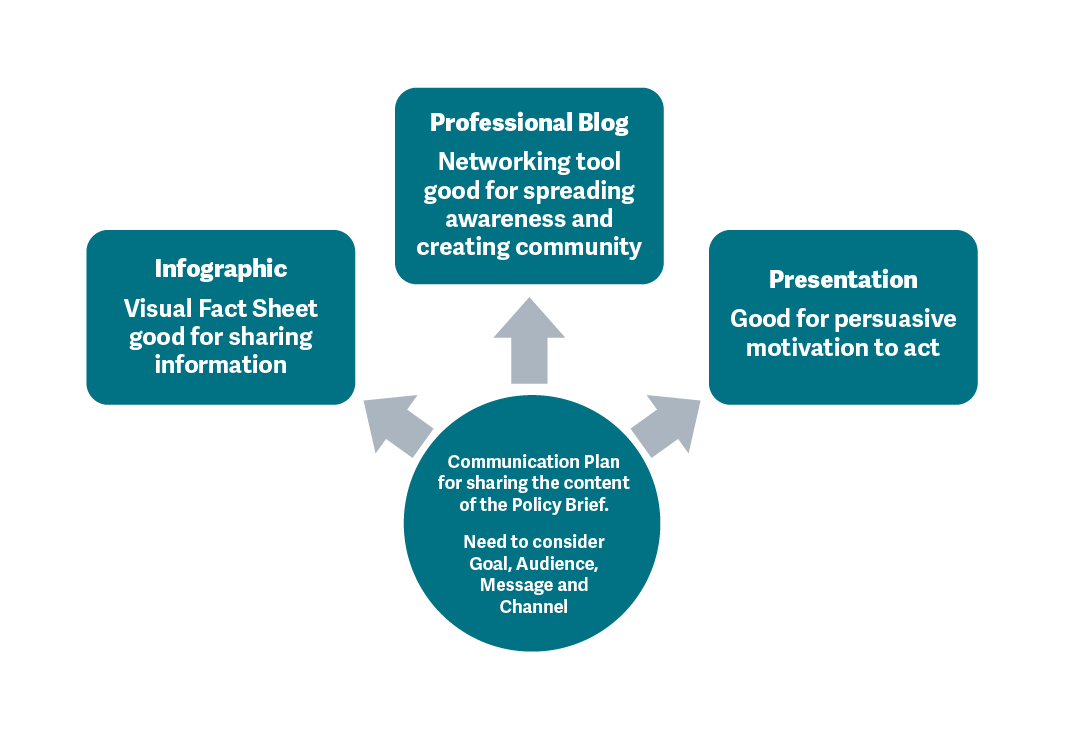
The material covered in this unit will support the development of a communications package designed to disseminate the advocacy messages of the policy brief. The communications package will include a simplified strategic communication plan, as well as three communication documents: a presentation, an infographic, and a professional blog posting.
Principles and best practices of knowledge mobilization, as an element of strategic communication planning, are explored. In addition, to support the development of a communications package, we will cover skills and techniques related to the development of communication materials across multiple modalities.
By the end of this unit, you will be able to:
-
Shape strategic messages pulled from a larger knowledge project.
-
Develop a communication plan that links message, audience, and channel in strategic and effective ways for a communication goal.
-
Develop communication materials that effectively and professionally use and balance multimodal forms of communication.
-
Develop communication materials that use the connective community potential of social media to make an impact.
Topics
-
3.1 Preparing for Knowledge Mobilization
-
3.2 Leveraging Principles of Visual Literacy
-
3.3 Playing Speech off Text in Effective Presentations
-
3.4 Leveraging Community for the Cause
Consider each section of this unit as the close equivalent to a standard week of work in a 3-credit, 13-week course. Plan to spend about 3–4 hours working the course material in each section, plus additional time to apply the information to work on your course project.
Here is a visual reminder of how the course assignments build on each other:
3.1: Preparing for Knowledge Mobilization
In this section, we will explore some theory and best practices for the development of a strategic plan for the dissemination of your research. Then, later in the unit, you will find more practical lessons supporting the development of different communication documents called for in the plan. To help to put all this context, begin by becoming familiar with the Communications Package assignment.
READ
-
First, read “Definitions” from Knowledge Management and Communication (Bruce et al., n.d.).
-
Now read over Assignment 3: Communications Package.
Note, as you read it over, to reflect on how the communications package will be a project of “knowledge dissemination.” Take note of the four individual pieces required for this package. Skills and techniques for each piece are covered in turn in the sections of this unit.
Sharing Your Research
LESSON
Knowledge mobilization is, for the most part, another term for strategic communicaiton. At times, we can distinguish between strategic communicaiton that is more focused on the interests of a particular organization than in general knoweldge distribution. However, for the purposes of our course project, these concepts align. The main idea here is a strategic sharing of information (from those who create it to those who could use it) for a specific purpose, which might range from increased knowledge to generating action.
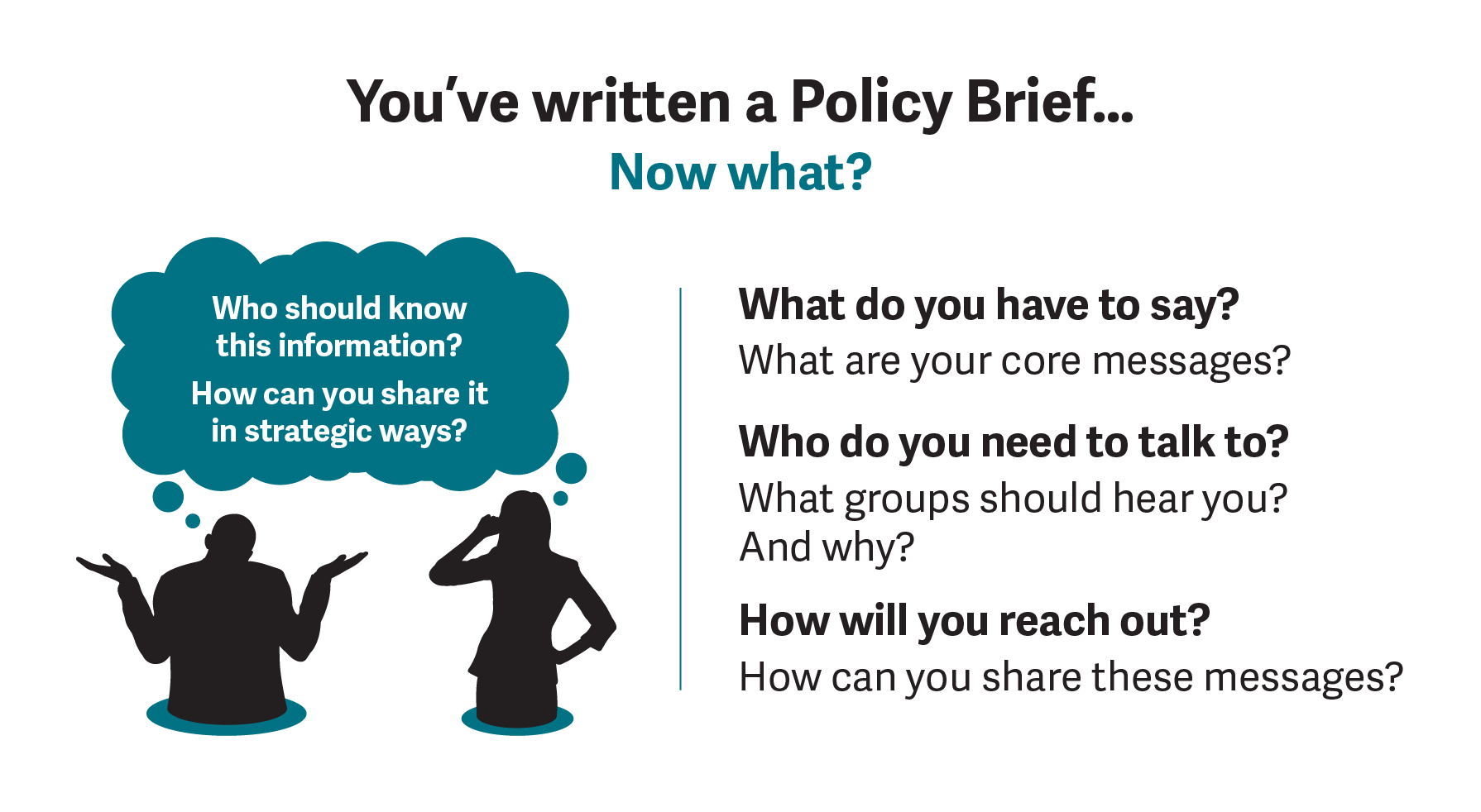
Whereas the policy brief was a project in knowledge synthesis, drawing together many voices within a conversation, the communications package is a project in knowledge dissemination, getting the information out to those who need it. Developing a plan for knowledge dissemination ensures that your efforts are strategic and therefore effective.
READ
-
Read “Building a KMB Plan” in Knowledge Management and Communication (Bruce et al. n.d.).
LESSON
The OER Knowledge Management and Communication (Bruce et al., n.d., Chapter 12) cites Lavis et al.’s (2003) five fundamental questions needed to develop a plan for knowledge dissemination:
-
Audience: To whom should research knowledge be transferred?
-
Message: What knowledge should be transferred to decision-makers?
-
Messenger: By whom should the knowledge be transferred?
-
Mechanism: How should the knowledge be transferred?
-
Impact: With what effect should the knowledge be transferred?
Thinking strategically about each one of these fundamental questions is key to effective dissemination of knowledge. However, taking them in isolation is not enough. The interdependence of these factors must be considered.
For simplicity’s sake, given the nature of our course project, let’s assume that the messenger stays constant—it’s you within the discourse community you connected with for the project.
We can then begin to think about the relationships of the other four factors:
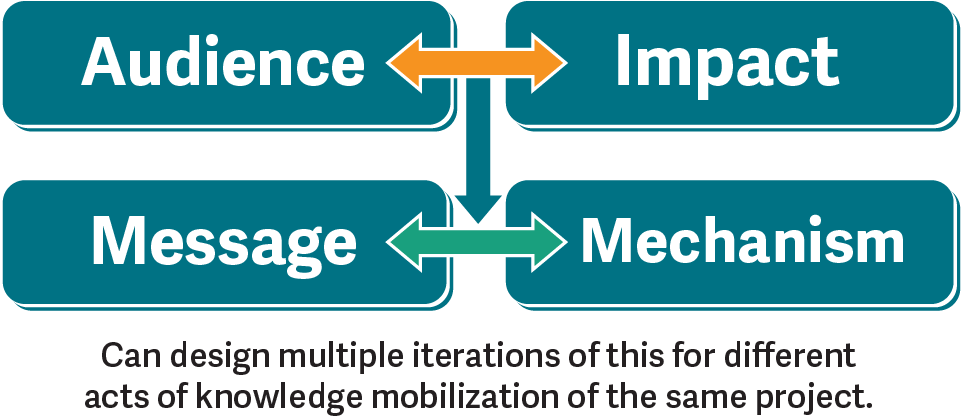
An initial choice of audience will constrain subsequent choices around message and mechanism, as well as impact.
Likewise, an initial focus on a specific message taken from the larger knowledge project (in our case, the policy brief) will drive decisions around audience, mechanism, and impact. The same logic is true of impact and mechanism.
Let’s consider a simple example. You have research that demonstrates the importance of exercise in preventing disease later in life. You have not only evidence of this preventable feature of exercise, but also information on what kinds of exercise are most beneficial.
Now, imagine your options from different directions:
-
Impact—You most want audiences to change their behaviour and exercise more.
-
How would different audiences react to this message? Select an audience: youth, parents, retirees.
-
Given the audience and impact you selected, how might you best shape the message to generate a change in behaviour for that audience? Your message for youth or retirees might be different, but overall, your goal to change their behaviour to exercise more would be the same.
-
Given the audience and message you’ve selected for this impact, which mechanism or channel would you pick? How can you match your mechanism choice to the key features of your audience and message?
-
Now, flip it around. You have been directed to develop a social media campaign that gets audiences to exercise more. How will this change your selection of audience? Message?
-
-
Message—You most want to communicate this link between exercise and long-term health.
-
What impact would you like to focus on? Sharing the information or generating action?
-
Given this impact and message, who might be the most likely target audience?
-
Given the impact, message, and audience, what channels might you use?
-
Now, flip it around. You have been directed to give this message to young people. How might the impact and channel differ?
-
Working through these different thought scenarios is a way to conceptualize the interconnectedness of these four categories; when developing communication plans, it’s important to be nimble in working through these intersections to make the most effective communication.
Intent, Audience, Message, and Channel in Detail
READ
-
Read chapters 27, 28, and 29 from Knowledge Management Communications. (Bruce et al., n.d.).
-
Read “Key Message Development: Building a Foundation for Effective Communications” (Wetherhead, 2011).
LESSON
Defining Intent or Goal
Overall, you may have several goals to achieve in your plan for knowledge dissemination, but each communication piece should have just one. In your final course assignment, for example, you will have three individual communication pieces, and each should have a clearly defined intent; they do not have to be the same.
Consider the range of intents that might be invoked through communication:
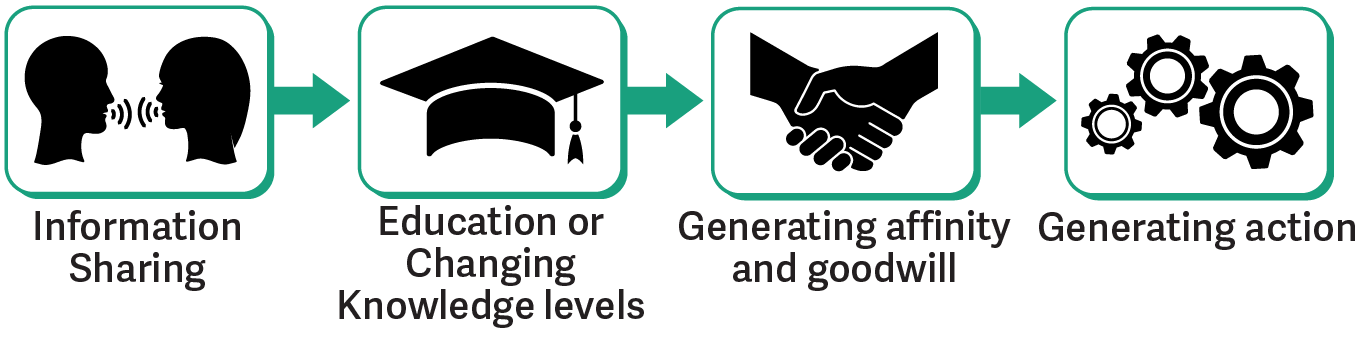
Sometimes, our goal is simply to share information, but our goals can be progressively more persuasive, as we might be interested in our audience learning or adopting the information we share or even gaining an affinity or agreement with it, and finally, we may be interested in prompting action by our audience. The ability to achieve any one of these goals depends very much on the audience relationship to the message we have on offer; how we craft a message will depend very much on what our intent is and how the audience feels about it.
For example, we might want to share with students the date that registration opens, an intent that has no expectation of response. However, we may instead want to share this date with the intent of getting all students registered before they miss an opportunity. This intent of action requires a completely different message and possibly different mechanisms for communication.
As you develop your communication plan, think strategically about the specific intents for each communication piece.
Audience
The selection of target audience is often driven by the goal or intent of the communication, as noted in your reading. The nature of the recommendations in the policy brief and the goals for knowledge dissemination will often dictate a specific audience. However, it’s also possible that in the course of sharing research and information, opportunities come to connect with audiences that had not been anticipated. In such cases, thinking carefully about the intent and message suitable for an audience is key.
|
Desired Outcome/Goal |
Examples of Target Audience |
|---|---|
|
Recognition from industry partners |
Industry partners |
|
Recognition from the academic community |
Specific academic journals, other researchers |
|
Increased recognition by senior leadership at your institution |
Senior Leadership, Research Chairs, Marketing and Communication department |
|
Engagement and interest in your research from undergraduate and graduate students at your institution |
Students, reaching assistants, teaching faculty, student clubs |
|
Interest from media outlets about your research and academic activities |
Marketing and Communications department, newspaper outlets, radio stations, television stations |
(Bruce et al., n.d., Chapter 28) CC BY-NC-SA 4.0
Once selected, the interests and orientation of an audience are defining elements. We need to ask the following kinds of questions:
-
What is their interest in the knowledge begin shared? Why would they care?
-
What is their disposition? Are they amenable or wary of it?
-
What are you asking of them (intent)? Can they provide that? How can they be motivated?
Message
Use the questions and strategic process outlined in chapter 28 from Knowledge Management Communications (Bruce et al., n.d.) as a template for defining the message of your communication pieces; this resource reminds you to think carefully about the relationship to intent, audience, and channel when shaping your message.

A group of bowls full of food by engin akyurt on Unsplash
When working with a larger project, like a policy brief or other research project, it can be difficult to pull out threads of individual messages from the whole. Filtering information for different goals, to different people, means we need to approach our research paper flexibly without linear intent; we might think of our research as a buffet meal rather than a five-course presentation. When we write a research paper, we work carefully to tie all the pieces together in a logical and effective linear product, as you have just experienced writing the policy brief. But now, we can deconstruct this into a table of information nuggets to be selected and communicated at will. You might find, for example, a need to communicate simply the recommendations; or you might focus on a specific finding or point of research within the larger work that you want to share with a particular audience.
Mechanism or Channel
As outlined in your readings, selection of mechanism or channel is made carefully in the context of audience profile and message creation. For example, some information is better shared in some media over others, and we know this from our everyday life. Consider emergent social roles around when, what, and how to text people. Some information is more suitable for texting than other, and certain audiences respond differently to and are more adept at text messaging than others. When we get this wrong, communication can sometimes break down! Message adaptability and audience preference and competency must be considered.
The selection of mechanism or channel is also often influenced by a project’s budget and timelines. While sometimes a national ad campaign might be desirable, it’s not always feasible!
Developing the Communication Planning Document
Communication plans vary in complexity and components, as they are custom built for a wide variety of communication contexts and challenges. For example, consider this resource for information and tips on communication planning suitable for project management: “Communication Planning” (Watt, 2021).
Similarly, you can find plenty of information and templates related to the design of communication plans for campaigns or media events, such as this one from The Community Tool Box (Center for Community Health and Development, n.d.): “Developing a Plan for Communication.”
For the context of this course project, we use a simplified communication planning document, designed to have you think about the fundamental strategy needed in communication planning; you will think strategically about the relationships between impact, audience, message, and mechanism, as you plan ways to communicate content from the policy brief.
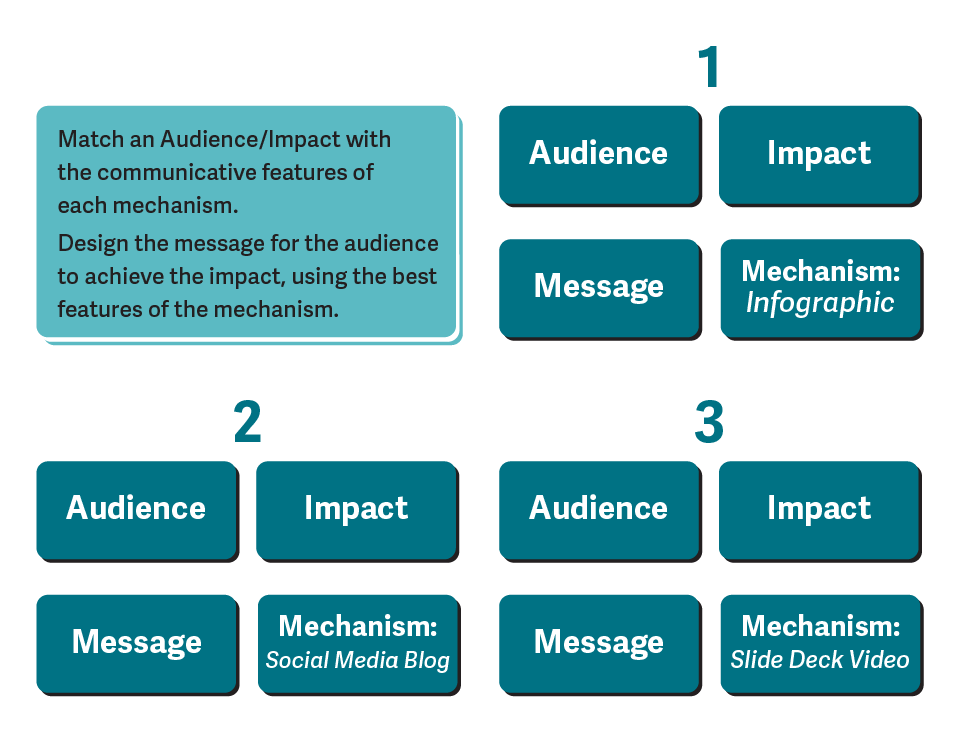
Before jumping in to produce the infographic, professional blog post, and slide deck video, you must create an overall communication planning document for this knowledge mobilization, using the ideas covered in this section of the unit.
In the project, the mechanisms or channels are fixed. This gives you a starting point in beginning to plan for audience, message, and intent. Each mechanism lends itself better to some kinds of intent or goal than others. For example, the professional blog may be particularly suited to the intent to generate good will or affinity for a set of ideas, while the slide deck video, with more direct audience contact and depth, might be more suited to persuasion and a call to action. Finally, infographics, in their design, might be well suited in communicating specific messages or lessons. Each of these mechanisms also engages the audience differently, demanding various amounts of time and energy.
With these mechanisms as a guide, you can begin to define an impact, audience, and message for each of the three elements in the communications package. The unit task below will help you begin this process, and then you can continue using the template provide in the assignment.
Unit Task 6: Determine Goal, Audience, and Messages (2% of course grade)
UNIT TASK 6
The purpose of this task is for you to begin to think about ideas for the knowledge dissemination of information from your policy brief. At this stage, don’t worry too much about connecting audience, message, intent, and channel together. Just begin to identify information for audience, intent, and message. Then, using these ideas, you can start making the connections when completing your communications package for the assignment.
All together, write about 500 words.
Question 1: Audiences
Try to be very specific here and think of advocacy groups, organizations, government ministries, networks, etc.
-
Who could benefit from knowing information in your policy brief?
-
Who is in a position to act on the recommendations in your policy brief in some way?
-
Who would you like to share specific information from the policy brief with because it may benefit you, either by strengthening your network or by linking you with a group with more power?
-
Who would be in a position to continue to distribute your policy brief findings to wider groups?
-
Other audience ideas?
Question 2: Audience Disposition
-
Pick three audiences you’ve defined above. For each one:
-
Explain why you think this audience will be interested in information from your research (or why you think there is benefit in them receiving information).
-
Consider how the audience may be disposed to receiving the information (excited, wary, indifferent?).
-
Consider how each audience may want to engage with the material and/or be part of the knowledge mobilization. Will they want to simply receive it? Continue to share and disseminate it? Act on it in some way? Be persuaded by it to change?
-
Question 3: Main Messages
-
Overall, what are three main messages that you think emerge as important out of your policy brief research/findings?
Unit Task 6 will be graded on a scale of 1% for attempt, 1.5% for evidence of inclusion of course material, or 2% for thoughtful engagement/interaction with the course material.
Please submit your Unit Tasks 6, 7, and 8 as one document at the end of Unit 3.
3.2: Leveraging Principles of Visual Literacy
Translating Ideas into Images
At this point, once the strategic planning for the communications package is done and the intent, audience, and message of each communication item have been determined, it’s time to focus on the actual development of the different communication pieces.
This section introduces the idea of multimodal communication as an element of engaging storytelling. It then continues to introduce a set of techniques for leveraging strong visual literacy skills in the development of an infographic or other visual-dominant forms of communication.
Introduction to Multimodal Communication
The goal for this section is to appreciate and explore how the forms of our storytelling have a transformational impact on the content. Different forms of media can be used, leveraging their unique potential to shape, persuade, and engage an audience’s appreciation of your core messages.
READ
-
Watch Joe Sabia’s 2011 TED Talk The Technology of Storytelling.
The Technology of Storytelling [3:34]
(Sabia, 2011) CC BY-NC-ND 4.0
This is 3 minutes of fun, but also should get you thinking about the importance of audience engagement in your story and how you can use the media you have to achieve it.
-
Read Ann Fillmore’s (2016) lesson on “Multimodal Communication.”
LESSON
In the context of strategic communication, the question of how we tell our story, or communicate our core messages, is intricately connected to audience and goal, as we have been exploring. We can think carefully about how our choice and use of different modalities shapes how we tell these stories.
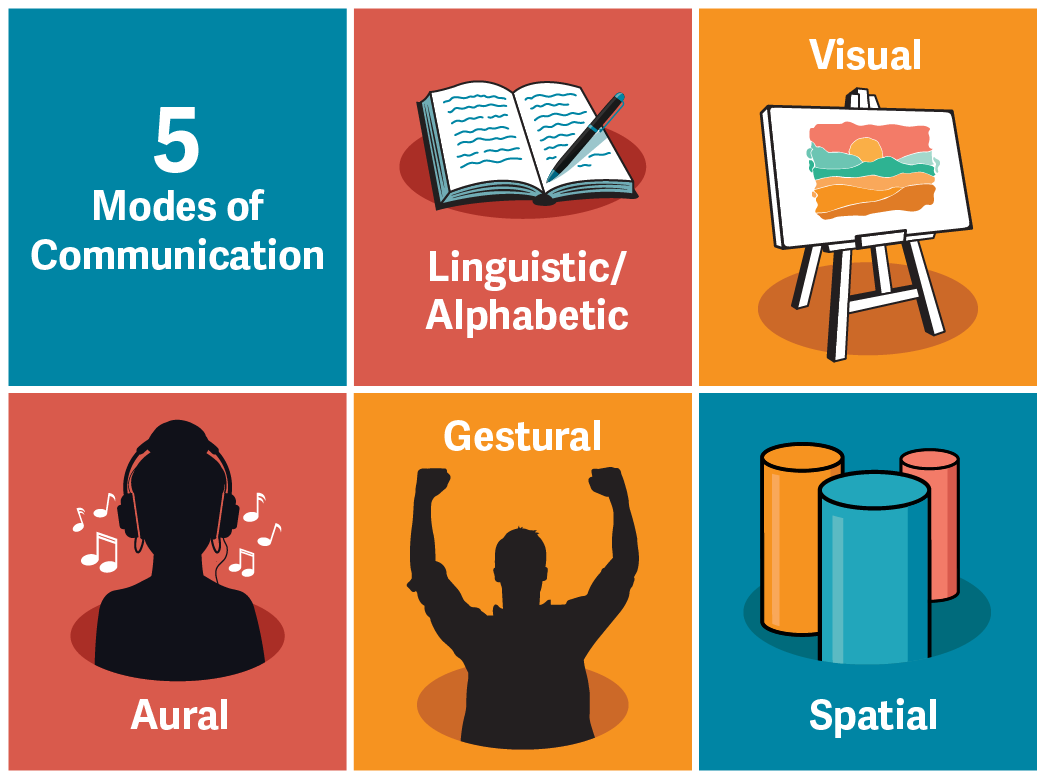
Audiences often prefer to receive different kinds of information through different modalities. Consider for a moment your own preferences. How do you prefer to get your news? How about learning new information? What about for entertainment?
-
Video (watch/listen)
-
Newspapers/books/articles (read)
-
Radio/podcast/lecture (listen)
-
News feeds/social media/websites (scan multimodal)
How does it feel when you have to receive information in a mode that just feels wrong for the content? Ask other people in your life, including people of other generations or other areas of professional interest, these same questions. Are there different preferences?
So, from the producer’s point of view, selecting modality is a rhetorical decision, made to achieve the intended goal of the communication for the intended audiences. News today is available across a wide range of modalities to ensure the broadest possible audience, but how that news is presented varies significantly by modality, responsive to its unique features. Take a moment to track a recent news story across a newspaper, television news broadcast, and social media; how is the story shaped differently across these modalities?
Multimodal communication strategies aim to reach a broader audience not only by sending a message across multiple modalities, but also sometimes by combining modalities to make an experience richer. Consider, for example, the intersections between popular entertainment on a streaming service and the associated social media coverage inviting interactive fan participation.
When making rhetorical decisions about modality, we can consider these following tips:
-
Know the communication strengths of each mode and match to intent, audience, and message. If you know you are doing an infographic, make decisions about intent, audience, and message that align well with that mode.
-
Know the features and restrictions of any platform for communication (print, web, audio, etc.) and accommodate for them.
-
Explore options to combine modes to amplify communicative effect.
-
Ensure each mode used adds meaning and value; avoid gratuitous use of multimodal communication if it doesn’t add something.
-
Assess your own communicative competency. Do you have the resources and skills to use the mode effectively?
Leveraging Visual Literacy
READ
-
Watch Christoph Niemann’s (2018) TED Talk You Are Fluent in This Language (and Don’t Even Know It).
You Are Fluent in This Language (and Don’t Even Know It) [12:32]
(Niemann, 2018) CC BY-NC-ND 4.0
-
Now read the short essay by Dahliani Reynolds (2020) on “Visual Rhetoric.”
LESSON
As Niemann suggests in his talk, this cultural moment is characterized by strong visual literacy skills. Our media environment is saturated with visual information, and we are increasingly able to act as visual producers, using a range of digital tools, in ways that were not always possible in an earlier media era. Visual expression is now a normative part of our daily communication.
This literacy is a strong foundation on which to think carefully about how we use the visual mode to achieve professional and strategic communication challenges. We can begin to think about achieving our core messages across the range of modes, which requires us to consider, as noted in the readings, the unique contributions of each mode.
The use of visuals for communication, or visual rhetoric, requires the same care and attention to content, tone, and style as we would need with words. When using visuals to communicate and create meaning, we must be attentive to the cultural resonances of our visual rhetoric as well as the register or tone (formal or informal, for example). Visuals communicate quickly and often with a lot of direct impact, so nuance can be more challenging than when using words; in this sense, be mindful of the messages, both implicit and explicit, being communicated through image selection.
Using Visual Tools Effectively for an Infographic Style Document
READ
Think of these readings as a best-practice toolkit for the development of an infographic, or similar kinds of visually dominant communications. Put this toolkit to good use:
-
Skim through the readings to get an overall picture of the skills and techniques covered.
-
Refer back to specific sections in designing and developing the infographic for your communications package.
-
Use the principles in this toolkit as a guide for the overall quality and effectiveness of your document.
Readings:
-
“How to Make an Infographic in 5 Easy Steps” (Velarde, 2025)
-
“Infographic Copy 101: How to Write an Infographic That’s Easy to Understand” (Memon, 2021)
-
“What Makes a Good Infographic?” (Hooper, 2025)
In completing the communication planning for the infographic, strategic decisions can be made in the context of the communicative potential of this mechanism. Infographics or other visual-heavy fact sheets lend themselves well to quick and efficient consumption of information, usually a simple or really focused idea or core message. They are less suitable for a complex situation that requires persuasion for audience engagement.
Unit Task 7: Leveraging Visual Communication (2% of course grade)
UNIT TASK 7
To practise thinking strategically about the use of visual communication, and to get familiar with the best-practice techniques for developing infographics, your task is to analyze and compare three sample infographics.
Alas, while there are some good elements in these samples, each of these infographics has some problems in design and overall effectiveness. By filling in the table provided, please evaluate the different aspects of each infographic, indicating whether it is effective or not, and why.
Sample 1—Health Benefits of Coffee vs. Tea (Jackson, 2015)
Sample 2—Benefits of Drinking Tea (Suja Organic, 2014)
Sample 3—Health Benefits of Drinking Coffee (The Star, 2025)
Unit Task 7 will be graded on a scale of 1% for attempt, 1.5% for evidence of inclusion of course material, or 2% for thoughtful engagement/interaction with the course material.
Please submit your Unit Tasks 6, 7, and 8 as one document at the end of Unit 3.
Effective? Yes/No and Why
Effective? Yes/No and Why
|
Aspect |
Sample 1 |
Sample 2 |
Sample 3 |
|---|---|---|---|
|
Title: Is it catchy with a clear indication of the topic? |
|||
|
Introduction: Concise summary of what we get in the infographic? |
|||
|
Sources: If used, listed clearly at bottom? |
|||
|
Structure: Effective structure to match the story they want to tell? Is the relationship between the chunks of information clear? |
|||
|
Content: A clear scope and message? A manageable amount of information for the form? Achieves its goal? |
|||
|
Text/Visual Balance: Text is used appropriately to enhance the visual story, not for new info? |
|||
|
Visual Choices: Selection of visual devices (icons, images, charts, graphs, colour, etc.) makes sense and leads to increased clarity and transparency of information? |
3.3: Playing Speech off Text in Effective Presentations
Presentations can be difficult to pull off effectively. They are a familiar, even common, form of communication, but are rarely as engaging and effective as they can be. The first step is to have a well-organized oral delivery and some attractive supporting slides. Certainly, your resources this section will provide some tips on this. But the next step is a more difficult nuanced and cohesive relationship between the oral delivery and the visuals, playing the oral delivery and the visuals against each other for strategic purposes.
You see this done well, of course, in many TED talks—the visuals are designed not simply to reinforce or replicate the oral delivery, but often to enhance, layer meaning, and even comment on the oral delivery. If you can get this dynamic play between the modalities, you have reached something a bit more engaging.
Presentation Design Standards and Multimodal Techniques
READ
-
Watch David Phillips’s 2014 TED Talk How to Avoid Death by PowerPoint.
How to Avoid Death by PowerPoint | David JP Phillips [20:31]
(TEDx Talks, 2014)
This presents a provocative challenge to rethink how we design presentations to align with our cognitive capabilities. Pay special attention to the five design principles that he elicits through the talk and aim to apply them to your own work.
-
Read Chapter 10, “Designing and Delivering Presentations” in Fundamentals of Engineering Technical Communications (Wahlin, n.d.).
-
Read the article “10 Tips on How to Make Slides That Communicate Your Idea” (TED Staff, 2014) from the TED Blog.
LESSON
A presentation combines multiple modalities: audio, visual images, and written language. We’ve examined principles and techniques for written language already through this course. Let’s consider the semantic contributions of audio and visual images to any communication piece.
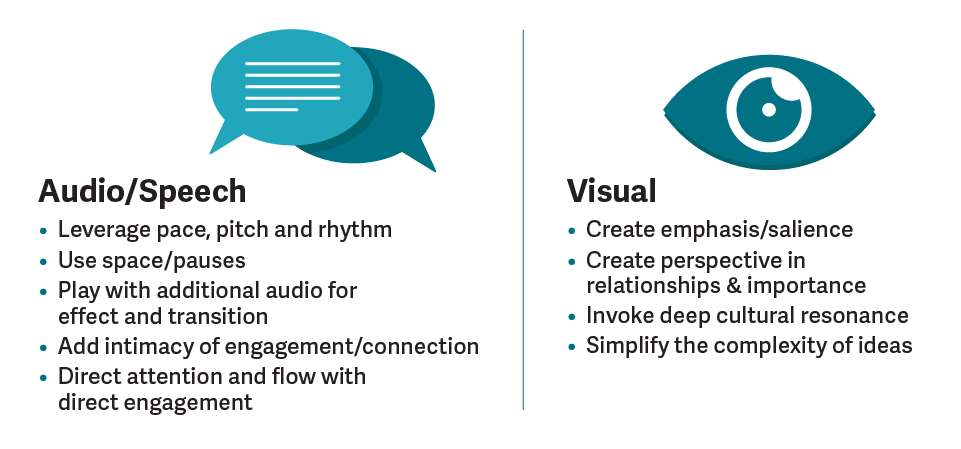
The creative combination of modes come together into a more meaningful whole, when done well. A presentation without visuals can sometimes be difficult to follow and salient ideas might not stand out. Effective and timely use of visuals can work to add meaning in several ways:
-
Visuals can align with the oral presentation as a form of reinforcement or emphasis to help consolidate meaning.
-
Visuals can enhance the content in the oral presentation, adding additional nuance or resonance to the meaning.
-
Visuals can comment on the content in the oral presentation, used to provide irony, humour, or a reflective interpretation.
Consider thus ways to layer meaning in the sound/visual relationship of your design. These rhetorical choices in a presentation design should be developed with consistent use of the best practices outlined for slide deck design in the resources for this section. A successful presentation achieves the intent of the communication through the unique needs of an audience’s ability to take in the core message.
Designing the Presentation for the Course Project
When planning the slide deck presentation, make strategic decisions in the context of the communicative potential of this mechanism. The multimodal nature combines the engagement of oral delivery with the potential to communicate complex ideas with visual support. In this way, the mechanism lends itself well to both information transfer and more persuasive intents.
Consider also the various contexts and audiences that might be suitable for this type of communication. Presentations are often given in broad public settings, such as conferences or community forums, and also used widely in more internal contexts, such as organizational planning or training.
Unit Task 8: Connecting the Visual and the Oral (2% of course grade)
UNIT TASK 8
In this unit task, the goal is to analyze how good presenters develop connections between visual and oral communication for a larger communicative effect.
Find a TED Talk on a subject that interests you—anything (as long as they use visuals!). As you enjoy the talk, reflect on how the speaker strategically uses visuals to make meaning in combination with their oral presentation. Write about 150 words outlining some examples of effective use of visuals to support oral delivery, linking back to principles from the coursework and resources.
-
Overall, what function do the visuals play? Do they align with or restate the verbal ideas? Do they elaborate or enhance them? Do they provide additional commentary or resonance to the meaning?
-
Do you find the visuals helpful in understanding the talk? What would change if you listened only, without them?
-
In either speech or visuals, how does the speaker include signposts in the talk to help you follow along?
-
To what degree does this TED Talk apply the five design principles from Phillips’s talk? Explain how it does or does not use the principes and whether it has an impact on overall effect.
Unit Task 8 will be graded on a scale of 1% for attempt, 1.5% for evidence of inclusion of course material, or 2% for thoughtful engagement/interaction with the course material.
Please submit your Unit Tasks 6, 7, and 8 as one document at the end of Unit 3.
3.4: Leveraging Community for the Cause
In this section, we will examine two examples of professional blogs used as forms of training and advocacy. This genre, which is the final element of the communications package for this course, has become a ubiquitous means of connecting professional, social, and issues-based communities around important conversations. As such, as a tool for knowledge dissemination, it works well across a range of intent from information sharing, through engagement and affinity, to persuading action and change.
READ
-
Read Section 19 of Chapter 33, “Using Social Media for Digital Advocacy,” from The Community Tool Box (Center for Community Health and Development, n.d.).
-
Now read the shorter blog post on “The Power of Social Media for Advocacy and Social Change” (Ruiz, 2023).
This resource provides information on the potential for social media mechanisms to work for knowledge dissemination (such as sharing the findings of a policy brief), but it also functions as an example of a professional blog post that is required as part of the Communications Package assignment.
LESSON
Of course, in the broader digital environment, multiple platforms for social media engagement exist, each comprising multimodal functions that can be leveraged for strategic communication. The challenge in developing strategic communication for this environment is the sheer range and complexity of options.
In addition to the ideas presented in the readings for this unit, we can isolate some key questions to shape rhetorical decisions when working with social media; these questions will, of course, look very familiar by now, as they are related to audience, message, and intent. However, the unique features and diversity of choice within these mechanisms shapes our decision-making. The nuances of the media environment are important. Each platform, commercial or non-profit, public or private, carries a unique culture and set of functional capabilities. We intuitively know this from our own personal experiences. We know what we will find on LinkedIn compared to TikTok!
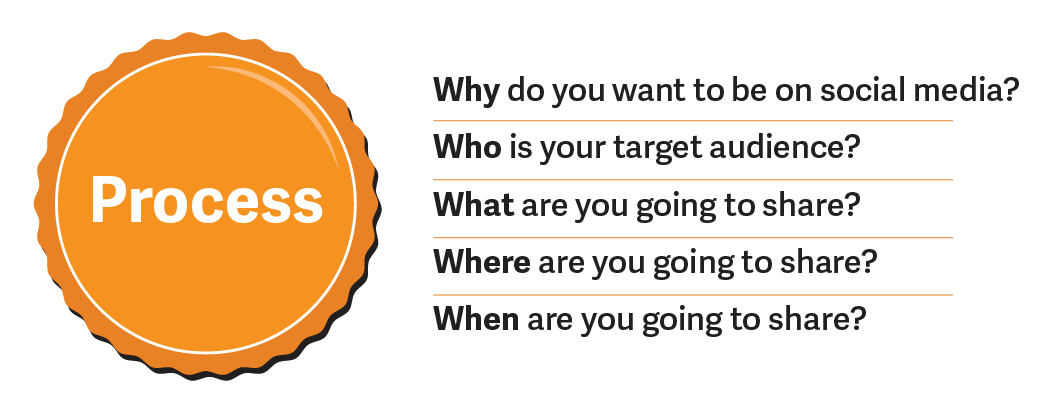
As with any other communication challenge, we need to find alignment between the selection of intent (the why), audience (the who), message (the what), and mechanism (the where and when). Within the social media environment, we need an extra step of differentiating an appropriate platform and combination of modes; what kind of multimodal experience would be best? This includes considering relationships between audiences and multimodal potential of different platforms, along with metrics on demographic reach of any platform.
Designing the Professional Blog
For this final piece of the communication project, many of the variables have been set for you. Professional blog posts, such as those seen on LinkedIn or other industry sites, are text heavy with some use of visuals to support and engage viewers; they are shaped for a professionally oriented context focused on networking, training, and other forms of community connectivity. These features will help you to shape the message-audience relationship for this element of the communications package.
EXAM PREPARATION
Students in CMNS 3241 will have a final exam for this course. Information from Unit 3 that will be covered on the final exam:
-
Salient characteristics of different modes of communication
-
Best-practice techniques for the development of infographics, presentations, and professional blogs or stories
Unit Tasks 6, 7, and 8 (6% of course grade), and Assignment 3: Communications Package (20% of course grade)
ASSIGNMENT TIME
Once you have completed Unit 3, you have the tools you need to complete Assignment 3: Communications Package.
CMNS 3241 students, please log into TRU Moodle for assignment instructions.
-
Unit Tasks 6, 7, and 8 (6%) – please submit as one document
-
Unit Task 6: Determine Goal, Audience, and Messages (2%)
-
Unit Task 7: Leveraging Visual Communication (2%)
-
Unit Task 8: Connecting the Visual and the Oral (2%)
-
-
Assignment 3: Communications Package (20%)
References
Akyurt, E., (2022). A group of bowls full of food [Photograph]. Unsplash. https://unsplash.com/photos/a-group-of-bowls-full-of-food-gaLpc1k6AXo
Bruce, C., Maclean, B., Loughlean, C., Capell, D., Hobson, D., Phipps, D., Knox, D., Shantz, E. Crocco, F., Muloongo, J., Morrish, J., Bowes, J., Banting, J., Gregory, J., Keefer, K., Jacobs, L., Langford, M., Stringer, M., Reibling, S., Whitney, S., & De Brabandere, S. (n.d.). Knowledge management and communication. Trent University. https://ecampusontario.pressbooks.pub/knowledgemanagement/
Center for Community Health and Development. (n.d.). The community tool box. University of Kansas. https://ctb.ku.edu/en
Fillmore, A. (2016). Multimodal communication. In SLCC English Department, Open English @ SLCC. Salt Lake Community College. https://pressbooks.pub/openenglishatslcc/chapter/multi-modal-communication-writing-in-five-modes/
Flipsnack. (2022). Podcast host waiting for answer [Photograph]. Unsplash. https://unsplash.com/photos/a-man-sitting-at-a-desk-with-a-laptop-and-microphone-kl6ia5PyWP4
Hooper, L. (2025, August 21). What makes a good infographic? Venngage. https://venngage.com/blog/good-infographic/
International Development Research Centre. (n.d.). How to grow women-owned businesses. https://idl-bnc-idrc.dspacedirect.org/server/api/core/bitstreams/448e3464-4bed-400e-9e56-adef2c47639f/content
Jackson, E. (2015). Health benefits of coffee vs. tea. TommieMedia. https://www.tommiemedia.com/health-benefits-of-coffee-vs-tea/
Memon, M. (2021, December 1). Infographic copy 101: How to write an infographic that’s easy to understand. Visme. https://visme.co/blog/how-to-write-an-infographic/
Niemann, C. (2018). You are fluent in this language (and don’t even know it) [Video]. TED Conferences. https://www.ted.com/talks/christoph_niemann_you_are_fluent_in_this_language_and_don_t_even_know_it?language=en&subtitle=en
Reynolds, D. (2020). Visual rhetoric. In Roger Williams University Department of Writing Studies, Rhetoric, and Composition, Thinking rhetorically: Writing for professional and public audiences. https://rwu.pressbooks.pub/thinkingrhetorically/chapter/visual-rhetoric/
Ruiz, C. (2023, April 26). The power of social media for advocacy and social change. Westbow Gives Back. https://westbowgivesback.ca/social-media-for-advocacy-and-social-change/
Sabia, J. (2011). The technology of storytelling [Video]. TED Conferences. https://www.ted.com/talks/joe_sabia_the_technology_of_storytelling?subtitle=en
TED Staff. (2014, July 15). 10 tips on how to make slides that communicate your idea, from TED’s in-house expert. TED Blog. https://blog.ted.com/10-tips-for-better-slide-decks/
TEDx Talks. (2014, April 14). How to avoid death by PowerPoint | David JP Phillips | TEDxStockholmSalon [Video]. YouTube. https://www.youtube.com/watch?v=Iwpi1Lm6dFo
Velarde, O. (2025, January 2). How to make an infographic in 5 easy steps (2025 guide). Visme. https://visme.co/blog/how-to-make-an-infographic/#sketch-a-wireframe-of-your-infographic
Wahlin, L. (Ed.). Fundamentals of engineering technical communications. Ohio State University. https://ohiostate.pressbooks.pub/feptechcomm/
Watt, A. (2021). NSCC project management. Nova Scotia Community College. https://pressbooks.atlanticoer-relatlantique.ca/projectmanagement/
Wetherhead, D. (2011, December 6). Key message development: Building a foundation for effective communications. PRsay. https://prsay.prsa.org/2011/12/02/key-message-development-building-a-foundation-for-effective-communications/