
Unit 1: The Proposal
The Proposal
A woman sitting at a table reading a paper by Anastassia Anufrieva on Unsplash
1.2: Strategies for Persuasive Communication
The resources in this section help you to build skills in identifying audience need, defining the purpose for communicating, along with building some tools for persuasive writing. The skills and tips covered here will apply to all your assignments for the course. But you will have an opportunity to apply them first to the development of your Project Proposal assignment.
Writing for Your Audience—User-Centred Design
Take a moment to think about how some popular advertisements match their purpose to their audience. For example, the “Hey Siri” campaigns are designed to condition consumers to use Siri on Apple devices for a range of conveniences, from trivia, to directions, to recipes. The purpose of the advertisements is to increase use of the Apple platform. But they do this through an investment in the audience’s desire for more and more convenience, showing the value proposition to the audience. It would not work if the advertisements focused on Apple’s own motivation to have consumers use their platforms to facilitate increased data collection.
Strategic writing aims to link the purpose of a communication to the needs of the audience in order to be effective in the given context.
READ
-
Start with “Writing Purposefully” by Kate Mele (2020c).
-
And then read “Writing Audience into Your Text” (Mele, 2020b).
These readings remind us that any form of strategic writing is writing for a purpose to a specific audience. Audience and purpose need to be thought of together, as mutually informing concepts. Our purpose is shaped by the intended audience and our audience is defined by our purpose.
Keep these integrated concepts to mind as you shape the persuasive message of your proposal.
-
Finally, a general reminder of basic principles of user-focused strategies for professional writing: “Using Rhetorical Principles to Produce Reader-Centered Writing” (Last et al., 2022).
This excellent article should be used as a checklist for your writing in this course to ensure you are writing not for yourself, not in a bubble, but for a specific audience, to engage a specific context and bring a specific perspective.
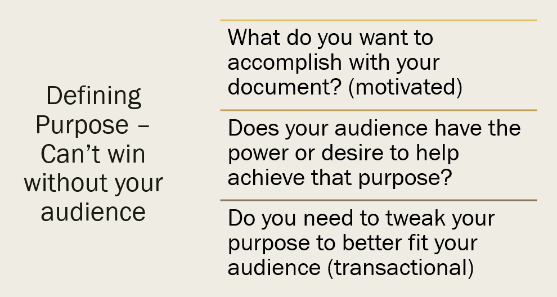
This strategy of writing with purpose for a specific audience is key for effective proposals. Aim to transfer this skill to your proposal. If you conduct research and explore an idea without a clear connection with the audience or communities of interest involved, your project won’t have value and won’t generate change. Think carefully about who will be the audience for your proposal. What do they know? What do they care about? What problems do they face in relation to your topic? How can you best persuade them of the value of your project?
Consider this example approach to the course project:
Topic idea: Debate over including child-care facilities within the workplace to enhance parental access to quality work environment
Purpose of project: To examine the challenges of providing child care in the workplace and make recommendations for policies that will facilitate increased provision of child care by employers—The project will focus on the economic benefits and so take the perspective of economic development.
Purpose of the proposal: To demonstrate to decision-makers in the context of economic development that this area of research into workplace daycare is valuable as it addresses their potential interest in economic development opportunities
Note that if we shifted the context of the project away from economic development, towards the perspective of family health and well-being, then the argument for the value of the research would be much different as the interests of the audience would be different.
Writing to Persuade
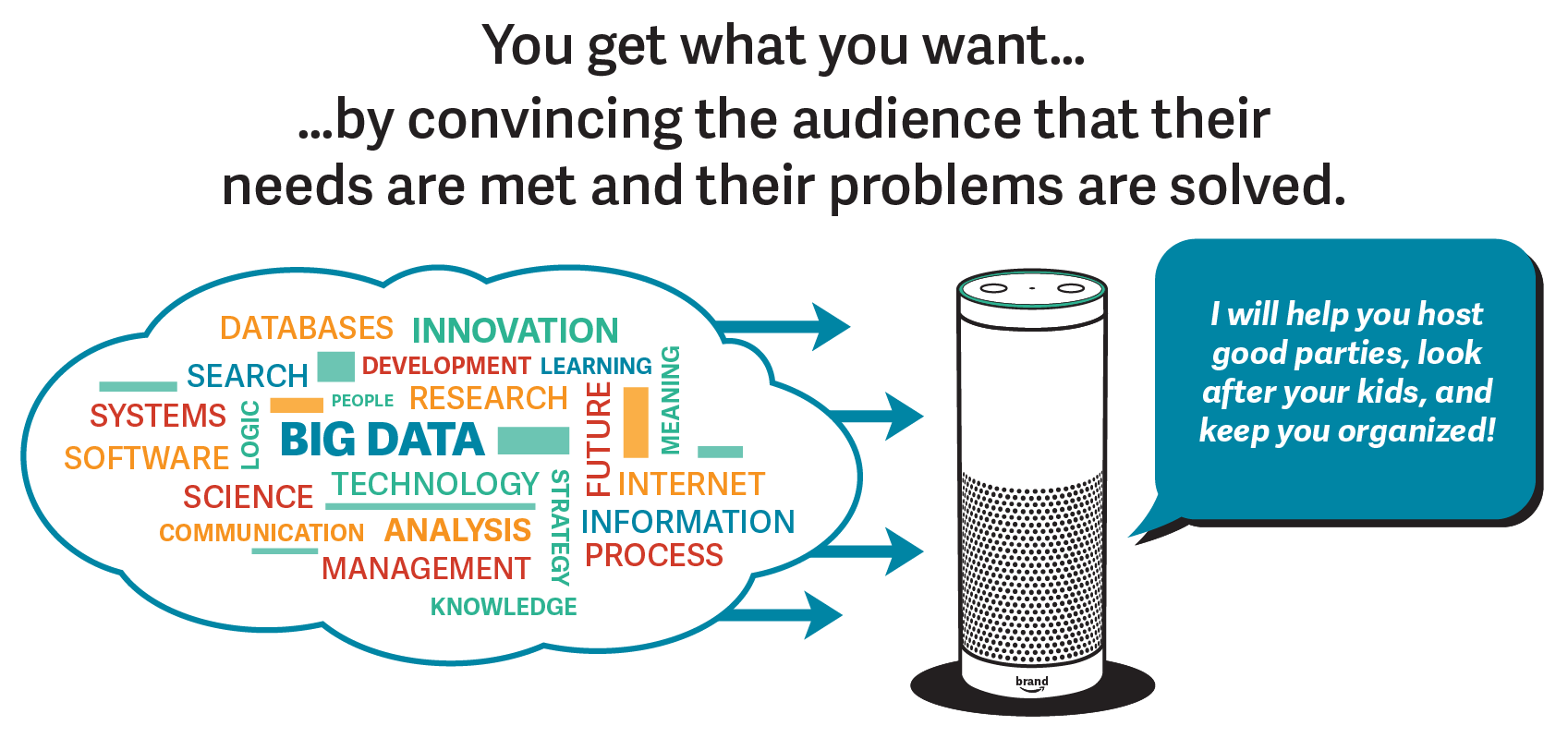
As mentioned, a proposal is a persuasive document. A proposal must convince the reader that the plan of research is worth doing in the interests of a defined perspective and community. To do this, in addition to linking purpose and audience, as discussed above, we need to write persuasively, using specific tools of persuasion to ensure our message has credibility (ethos), appeal (pathos), and substance (logos).
(c) Shannon Smyrl and TRU Open Learning CC BY-NC-SA 4.0
READ
-
Watch the TED-Ed video What Aristotle and Joshua Bell Can Teach Us About Persuasion.
What Aristotle and Joshua Bell Can Teach Us About Persuasion [4:39]
(Neil, 2013)
-
Then read “The Rhetorical Triangle: Ethos, Pathos and Logos” (Cruthers, 2021).
-
And one more summary of the concepts: “Logos, Ethos, Pathos” (McMurrey et al., 2022).
Note the focus here is on the primacy of logos in professional writing, but that elements of pathos and ethos are built into how the document is put together and how the story is told, as much as in the content, which tends to be dominated by strategies of logos.
In writing the proposal, as with any professional document, balancing the three elements of the rhetorical triangle can ensure an effective persuasive piece of writing.
Logos:
-
The proposal is structured logically and effectively with a clear purpose and objective.
-
The proposal is based on relevant evidence and examples so that it is substantive and authoritative.
-
The proposal is written with concrete and professional language so that it provides a substantial message.
Ethos:
-
The credibility of the proposal is established with quality accurate professional writing, use of the conventions of the genre, a professional level of language, use of the template, and given headings.
-
The credibility of the proposal is established with quality content such as research and data to secure reader trust, relevant vocabulary, and the clear sense of engagement with existing research and debate in the perspective chosen.
Pathos:
-
The proposal is written with clear attention to audience needs and motivation. What problems or challenges are facing the audience? And why will this research help them?
Refresher on Principles of Document Design
The skills covered in this course are relevant across a range of disciplines and industries. Students often come into the study of strategic communication from a variety of backgrounds and interests. This section on principles of document design might be all new to you, or a refresher, depending on your background. Take time to go through the video lesson, take notes where needed, and confirm your knowledge where you can. The activity below will help you to synthesize the information from this video.
READ
Watch Basic Principles of Document Design.
Basic Principles of Document Design [35:42]
(Lanier, 2018)
This video is a refresher on basic principles. Many of you will have come across these principles in earlier communication courses or work experiences., but this is a good opportunity to conduct a gap analysis of your skills using this video. Use the questions in the “Think and Engage” box while you watch, and put your emphasis on the areas that are least familiar to you.
EXAM PREPARATION
Students in CMNS 3241 will have a final exam for this course. Information from Unit 1 that will be covered on the final exam:
-
Principles of an effective proposal
-
Principles and elements of the rhetorical situation
-
Best practices for persuasive writing
-
Skills in effective document design
Unit Tasks 1 and 2 (5% of course grade), and Assignment 1: Project Proposal (20% of course grade) Due
ASSIGNMENT TIME
Once you have completed the Introduction and Unit 1, you have the tools you need to complete Assignment 1: Project Proposal.
CMNS 3241 students, please log into TRU Moodle for assignment instructions.
-
Unit Tasks 1 and 2 (5%) – please submit as one document
-
Unit Task 1: Decode the RFP (2%)
-
Unit Task 2: Defining Project Focus and Perspective (3%)
-
-
Assignment 1: Project Proposal (20%)