
Introduction
Course Scenario Overview
Progressive Project
LESSON
When clients, like government ministries or corporations, are looking for someone to complete a project as a contract, they will often put out a request for proposals, or RFP. This common professional document outlines the client’s expectations and requirements for a project, enabling potential consultants to submit their proposal for how they would complete the project. If they win and their proposals are accepted, then they get to complete the project they outlined in their proposal.
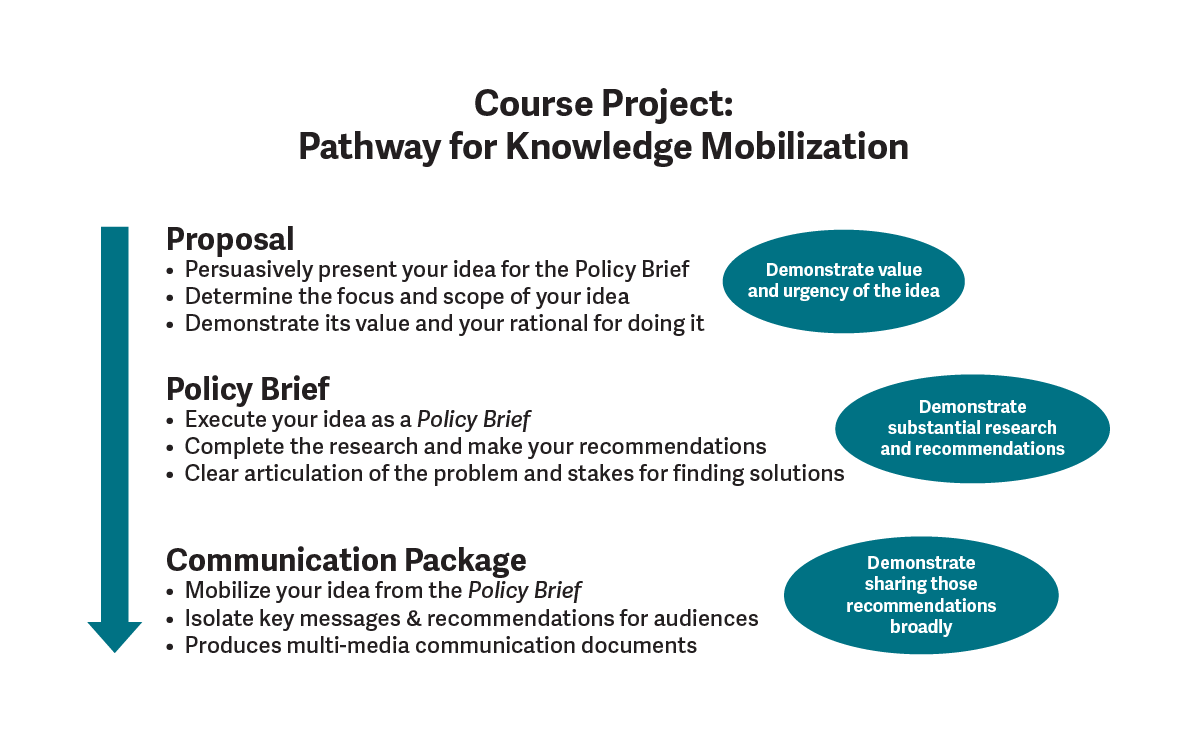
This course is structured around a simplified and hypothetical version of this process. Students are given a Request for Proposals which outlines the expectations and requirements for the course project. Based on this, students produce a proposal, and then go on to research and write a policy brief and a communications package to share their work with different audiences. These documents are thus connected as a single, progressive multi-step project.
For students registered in CMNS 3241, each stage of the project corresponds to a graded term assignment:
-
Project Proposal (20%)—You will submit a proposal to conduct research that meets specific goals and criteria. These goals and criteria will be provided in the assignment.
-
Policy Brief (25%)—You will then complete the actual “research” paper that you proposed in the Project Proposal assignment. A policy brief is a type of research paper.
-
Communications Package (20%)—Finally, you will develop a plan and materials to mobilize the knowledge from your policy brief, with an emphasis on accessible forms of communication for different audiences, including an infographic, a community presentation, and a social media story.
(c) Shannon Smyrl and TRU Open Learning CC BY-NC-SA 4.0
For those students being graded on their assessments, to be successful, it’s important that you complete everything in order, including the project tasks associated with each unit; these tasks build the skills you need to complete the unit assignments. Given the progressive nature of the course, students are encouraged to await instructor feedback before submitting subsequent assignments.
You will have the opportunity to study the Request for Proposals in the task at the end of this Introduction.
But first, let’s read through the course scenario to gain an idea of the kind of research you will be working on in this course.
Scenario: Call for Research to Inform Policy Development around Issues of Flexible Work
LESSON
We will use the following scenario to guide our work through the course. Note that this scenario is realistic in its intent, but somewhat simplified for the purposes of this course project:
Course Scenario
Flexible Work: Issues, Opportunities, and Risks
Many economic, social, and cultural factors combine today to raise diverse questions about the nature and feasibility of flexible work. Factors like increased automation, changing technology, remote/hybrid work opportunities, accessibility and equity issues, environmental challenges, and the instability of the gig economy are just some of the issues that pressure us, as a society, to rethink questions of flexibility and work. See Flexible Work Arrangements (Canadian Centre for Occupational Health and Safety, 2021) and Flexible Work Arrangements for Federally Regulated Employees (Government of Canada, 2025).
Focus/Scope
The impact of a changing world of flexible work is different for different groups, across fields and industries. Labour market impact might include questions of employment rates, job satisfaction, and productivity; economic impacts might include questions of growth, innovation, and competitiveness; and health and social impacts might include questions of balance, mental and physical health, and social values.
Perspective/Interest
But not everyone is affected by these issues in the same way. Many interest groups will have diverse views about the issues, risks, and opportunities related to flexible work; these interest groups include labour, small business, large organizations, non-profits, public interest groups, as well as segments of the population such as shift workers, working parents, and accessibility advocates.
Taking Action
Ministries within the BC provincial government are facing pressure to develop policy stances on a variety of issues related to the changing nature of work, including increasing opportunities to define and implement flexible work models. These policy stances might be needed across many different government portfolios, including economic development and innovation, labour, environment, health and social initiatives, and family development.
To support the development of policy stances across these areas, the government is soliciting research on the topic of flexible work and the potential issues, risks, and opportunities it represents across a range of sectors and interest groups. The goal is to gather arguments representative of a range of perspectives and interests on this issue across the region to inform future decision-making.
As such, the government will put out an RFP (request for proposals), asking for proposals to complete such research by submitting policy briefs and a communication plan to disseminate the information from the policy briefs.
Everything in the course will be linked to this scenario and your work to produce the communication documents requested. The first step will be to assess the Request for Proposals and begin to plan your Project Proposal assignment. To do this, you will be asked to start thinking about the perspective and focus you would like to take for your project; hints about that are suggested in the scenario. This work is outlined in your unit task below. (Note: For students of CMNS 3241, this unit task is graded.)
Orientation: What Is a Policy Brief?
The course scenario project really turns on the research and production of a policy brief. First you will focus on a specific topic and develop a proposal to write a policy brief, and then you will research and write the policy brief. After writing it, you will work on distributing the knowledge from that brief to larger audiences. Therefore, it would be helpful to look at some sample policy briefs, so you know what you are being asked to do!
In Unit 2, there are more developed lessons on the expectations, content, and form of policy briefs. For now, we will just have a general introduction to the genre. Your goal in this section is to read over some samples to get a feel for what you will be developing.
Policy briefs can take many forms, but essentially these are short (brief!) presentations of research and recommendations designed to inform decision-making about policy issues. The goal is a persuasive piece of research that works to convince decision-makers to shape policy in the interests or to the benefit of a particular group.
READ
To gain an initial understanding of a policy brief, explore the following resources, focusing specifically on looking at samples of policy briefs*:
-
The IDRC (International Development Research Centre, n.d.) document How to Write a Policy Brief includes links to several examples in the template section. Study the examples and we will return to this document in Unit 2 for applied practice.
-
UC Davis Center for Poverty and Inequality Research also has a library of sample Policy Briefs to examine. Choose two or three to read through, looking at the overall goal and structure of the documents.
*Remember, for the projects in this course, you will be using secondary research only. Many of these examples refer to primary research projects which are beyond our scope!
Unit Task 1: Decode the RFP (2% of course grade)
UNIT TASK 1
Decode the RFP
The purpose of this unit task is to get you thinking about how you will approach the progressive project for this course. You will examine the Request for Proposals and begin thinking about your focus for the project.
Note: Students in CMNS 3241 must complete this unit task for grades. Submission instructions can be found on the course Moodle site.
Part A: Decode the Request for Proposals (RFP)
The RFP is how clients normally solicit requests for proposals to conduct research or complete other projects. Thus, the assignment for the proposal is structured as an RFP to help you get familiar with this type of process.
-
Look at Assignment 1: Project Proposal to access the RFP information. Read it carefully to pull the following kinds of information:
[Production: link to Assignment 1]
-
Make a list of the specific pieces of information you must include in your proposal.
-
Make a list of specific instructions for the creation/layout of the proposal document that you must remember to follow to ensure your document is complete and accurate.
-
Based on the RFP, what is the overall purpose of the project? What should your proposal try to achieve?
Part B: Reflect and Focus
Having now read both the scenario overview and the request for proposals in the assignment, and having some idea of what a policy brief is, you may be beginning to generate some ideas of how you’d like to approach this work.
-
Write about 200 words reflecting on what specific focus you might like to take for this project. You will have more time to refine your approach in Unit 1. These are just preliminary thoughts so you can get started. Here are some prompts to help you:
-
Spend time thinking about the different areas of scope and focus suggested in the scenario overview and RFP in this unit. Which kinds of questions and areas of interest appeal to you? Economic? Social? Health and wellness? Culture? Other?
-
What sectors of society are you interested in representing? Labour? Business? Families? Women? Young workers? Shift workers? Local cities? You can pick any interest group you like and explore this topic through their interests and priorities. You do not have to select a specific organization—just any defined group whose interests you’d like to represent and, finally, make recommendations for.
-
Once you’ve thought about a specific sector of society, brainstorm some issues, problems, or questions that this group might have, related to the topic of flexible work environments. What are some opportunities, challenges, or needs that are faced from this perspective? For example, if you are interested in the health and wellness of shift workers, what kinds of questions or problems related to flexible work might you begin to explore?
Unit Task 1 will be graded on the following scale: 1% for attempt, 1.5% for evidence of inclusion of course material, or 2% for thoughtful engagement/interaction with the course material.
Please submit your Unit Task 1 and Unit Task 2 as one document at the end of Unit 1.
[Production: link, please]