
Unit 2: The Policy Brief
2.2: Map the Conversation
What are people saying about this issue?
In this section, our goals are to:
-
Develop a research plan, identifying the kinds of material you need to map the conversation around your topic and meet your goals.
-
Review skills in the synthesis of research material, ensuring you know how to draw together information from multiple sources into a single summary effectively and without plagiarizing any sources.
Your policy brief will be based on a synthesis of research material that you collect and put together to support your identification of a problem or issue and/or your recommendation for policy changes and other forms of action. As such, your research material needs to be a logical and fair account of the conversation within the discourse community you’ve identified and are working within. The challenge now is to find these voices and conversations to bring them into your paper.
Finding Research Material
LESSON
The challenge of academic and professional research rests in our relative ability to sort through and discern the value of what we find. It’s all too easy to find information, using internet search tools and even social media platforms. We become used to the algorithmic logic of these tools sorting information for us, and we risk becoming complacent by accepting their filtering and prioritization to shape what information we work with.
However, this is not enough. A strategic and critically informed approach to research always considers the information needs of the project at hand, working within the conversations of the defined discourse community and acknowledging the sources of authority, the critical assumptions, and the ongoing research being done within that community. Our tasks as critical researchers are to find and map this conversation, then be able to add our own voices. One place to start is to be always mindful of the authority, content, and purpose of information, which you will read about now.
READ
-
Read this introductory lesson in “Finding and Evaluating Research Sources” from Susan Last’s (2019) Technical Writing Essentials.
This resource is a good starting place for those who have not done a lot of academic research, as it gets us thinking about the authority and value of different kinds of research material. It’s possible to use a broad range of sources, but it’s crucial to understand what kind of knowledge, information, and authority your sources have.
Planning a Research Strategy
LESSON
Conducting research can be overwhelming. The following steps for a simple research strategy—identify, write, search, and document—are designed to support you in isolating the information needs for your project, and finding significant sources that are interconnected within the conversations related to the scope and perspective you have taken.
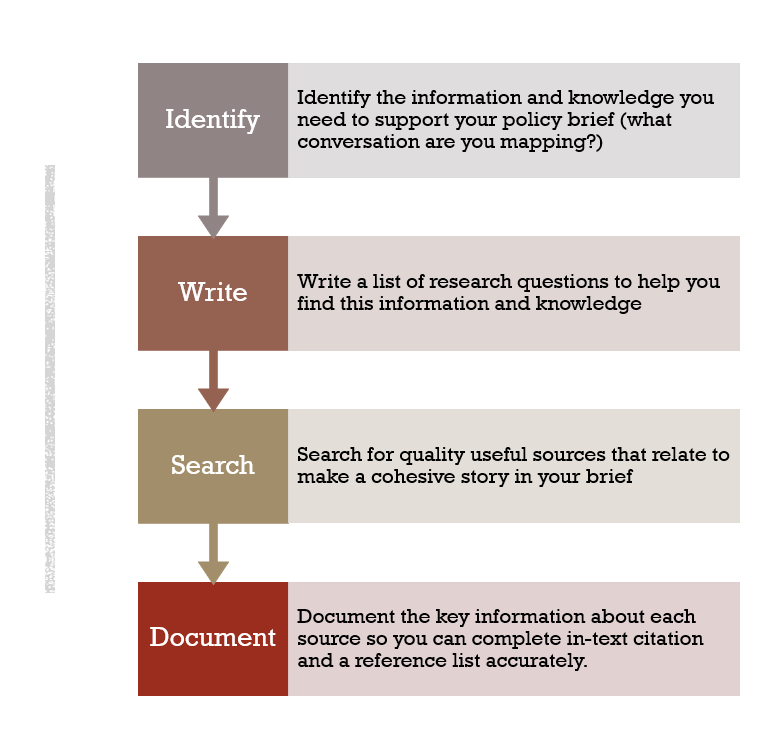
In the following explanation of the strategy, an example is used for illustrative purposes. Here’s the example project:
-
Problem: Many caregivers lack the flexibility in their work conditions to manage effective child-care options, leading to extra long days or compromises in the quality and access of child care.
-
Policy brief idea: On-site child care at large organizations could improve the flexibility and well-being of caregivers during their day, providing for a more productive work environment. This policy brief will conduct research on the potential benefits of on-site child care to both families and employers, and the potential challenges of achieving it.
-
Goal: To provide a persuasive case on an economic and social basis for on-site child care to support a call for regulation that requires it by large employers
So, to develop this project, we can begin a research strategy.
Identify
Write
Search
Document
Synthesizing Research Material
Sometimes, policy briefs are based on primary research, when an organization or advocacy group conducts a study and reports on the findings of that study as evidence and support for the call to action in the policy brief. Other times, such as in our course project, policy briefs are based on secondary research, drawing together evidence and support from multiple pieces of research to build the call to action.
This act of drawing together evidence and support from multiple sources can be tricky. In this section, we will review the nature and strategies for effective synthesis of research material.
READ
-
Read from University Writing Lessons, “Study Room 4” (Smryl, n.d.), Lesson A: “Organizing and Grouping Information” and Lesson B: “Combining and Evaluating Ideas.”
These are interactive lessons. It might be valuable, at first, to simply read through the material, and then work on the practice activities after you have a sense of the lessons.
LESSON
The logic of synthesis is to come to a larger conclusion or set of recommendations based on the cumulative knowledge and information from multiple voices. This is, notably, different from an analysis in which a thesis or argument is developed through key points that may be supported with evidence from different sources.
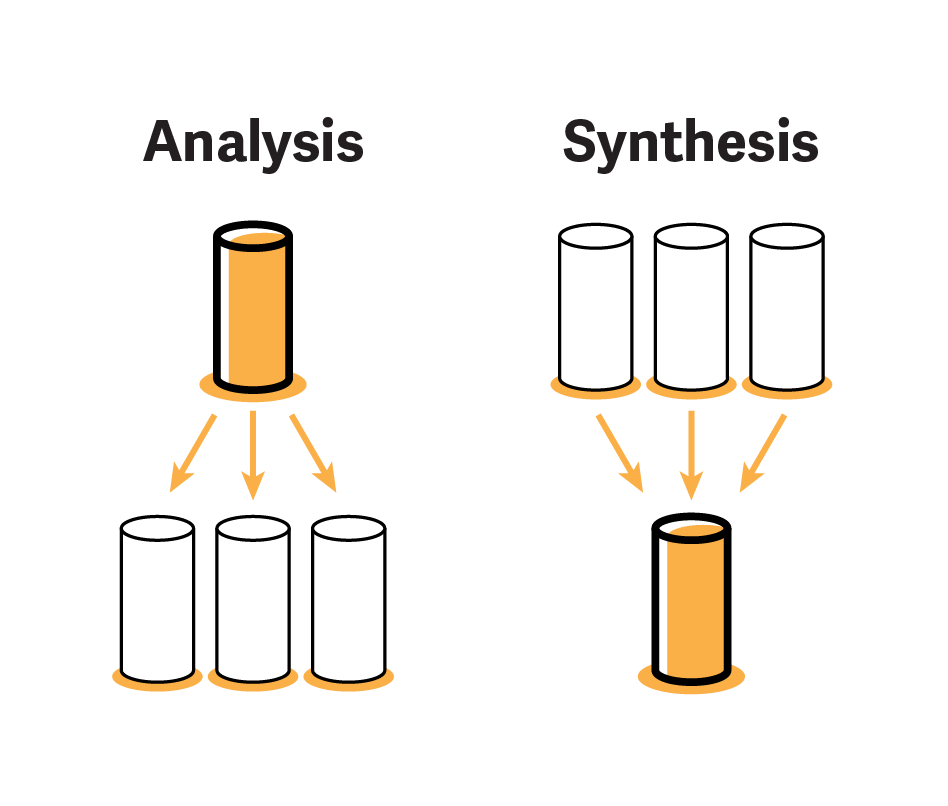
(c) Shannon Smyrl and TRU Open Learning CC BY-NC-SA 4.0
In synthesis writing, the key topics or points of discussion are identified, and information from the set of course material is brought together under those points and mapped, looking, for instance, at comparisons, contrasting views, and multiple examples.
The goal of synthesis is in the name; rather than simply providing a summary of each source, the goal is to explore the relationships between what different authors say about a point of discussion and then, based on these explorations, make some conclusions or recommendations. The persuasion of a policy brief comes through the synthesis of information about a problem and then the pointing to next steps.
Let’s look at a fun example.

What if you wanted to tell a story about all these chocolate bars? How would you begin to manage all the interesting information?
To make our story about the candy bars meaningful, we need to move beyond simply summarizing each candy bar in turn. This would make for a long and unshaped tale, with boring summary and no sense of the relationships between the candy bars.

Research summaries capture the details of each source, but they don’t allow for any synthesis of information. How can the information from each source be made meaningful in connection to the other sources?
We can begin to ask questions about how we might categorize the information.
-
What kinds of information could you identify about these candy bars?
-
What different categories of information do you think are most relevant?
-
Why would you choose those particular categories of information over others?
Try this with some friends!
Gather a selection of candy bars, or a different item, and ask two or three people to sort them into categories. What different categories do people make? Talk about why they think their categories are relevant.
How we might choose to make significant categories of information will depend on what’s important to us. The categories of information we identify are linked to our goal for collecting and synthesizing information.
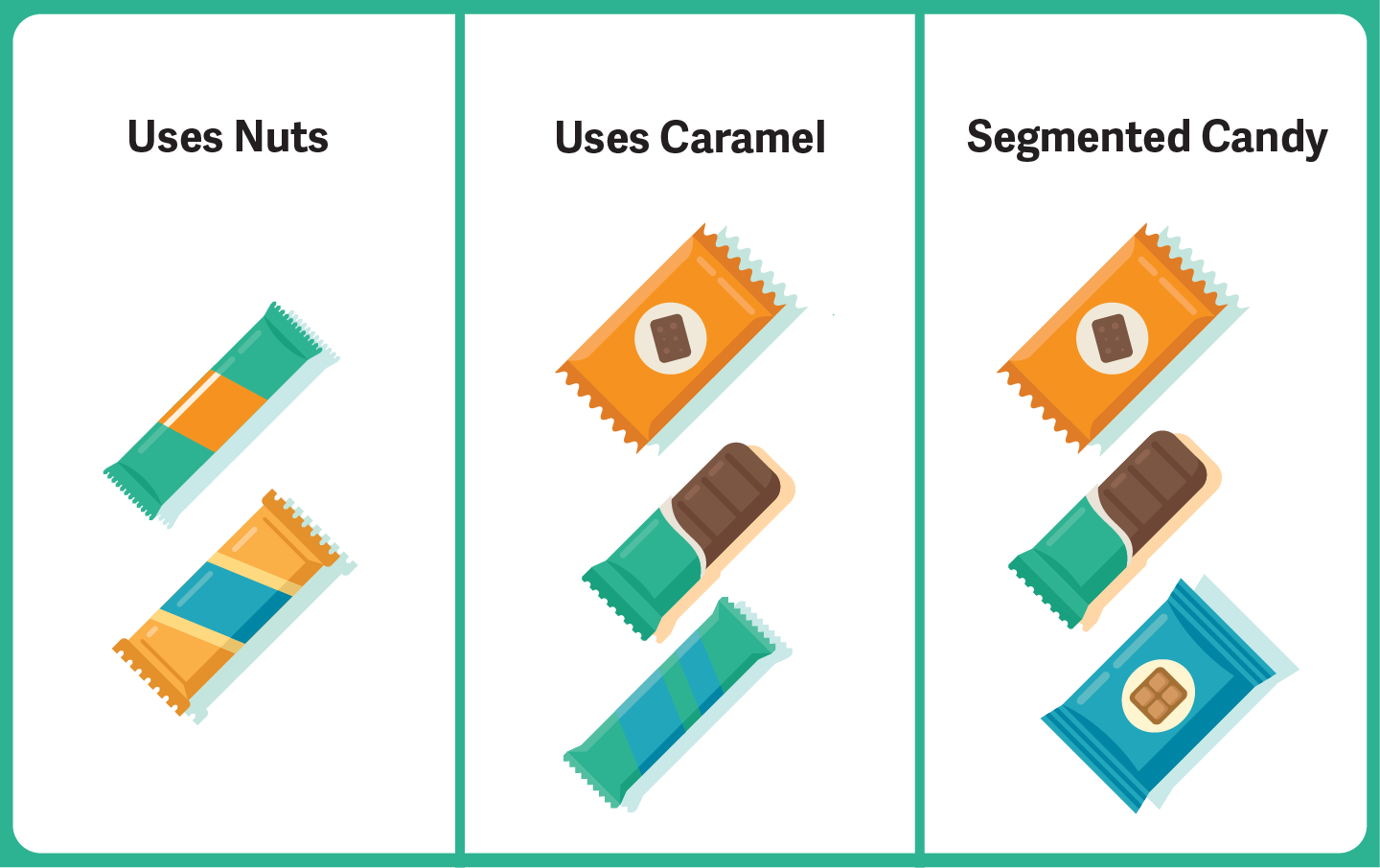
For example, someone with a peanut allergy would certainly be motivated to organize the samples by the presence of peanuts. Others, motivated by comparing the eating experiences, might focus on categories of ingredients, shape, and type of chocolate. And yet others who were motivated by marketing goals might identify categories connected with the image, style, and colour of the packaging.
A research synthesis draws together information from a variety of sources into significant categories of discussion, defined by the information needs of the project.
The challenge, in developing a research synthesis, is identifying these significant categories.
Thinking about what kinds of information and knowledge are relevant to the issue and within the larger discourse community is key. We must ask what information we need to achieve our goal, and then go through each source and find any information that can contribute to our understanding of that category. A table like this may help with notetaking:
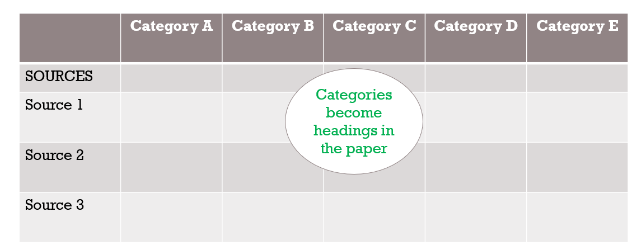
Synthesis writing smoothly interweaves the information from multiple sources to build an understanding of the conversation around a particular topic or category of information, as in this funny example:
Synthesis Writing
Use of Nuts
In some candy bars nuts are used in whole or chunky form (Snickers, 2012), while in others they are ground into the chocolate (Toblerone, 2014).
Use of Caramel
Two approaches dominate in the use of caramel. Mars (2011) and Twix (2014) both use it as a layer; Caramilk (2016) fills segments with caramel instead.
Segmented Candy
Approaches to segmented candy show very little variation. Candy is either segmented into “finger” shapes (Kitkat, 2010; Twix, 2017) or “squares” (Caramilk, 2016)
(c) Shannon Smyrl CC BY-NC-SA 4.0
Documenting Research Material Accurately
READ
-
“Quoting, Paraphrasing, and Summarizing Sources” (Bennetch et al., 2021)
Complete the practice material.
-
Acknowledging, Paraphrasing, and Quoting Sources (University of Wisconsin–Madison, 2003)
-
University Writing Lessons (Smyrl, n.d.), “Boot Camp 3 – Writing with Research.”
Complete the full lessons in Boot Camp 3 to work on your skills.
Unit Task 4: Produce a Research Strategy and Annotated Bibliography (3% of course grade)
UNIT TASK 4
Note: Students in CMNS 3241 must submit this Unit Task 4 for grades.
In this task, the goal is to set up your research strategy to ensure that you find supporting material for your policy brief that is focused within a clear discourse community and is relevant to the perspective and issues you’ve identified for your project.
Use the sample provided earlier in this unit as a guide to completing this task.
Part A: Produce a Research Strategy which includes:
-
Identify.
Outline the conversations you are mapping: Identify the different kinds of information and knowledge you need to support your policy brief—what are some areas of the discourse community in which you might look for useful voices and ideas?
-
Write.
Write a list of research questions that are as focused as possible to help you find the information and knowledge you need. What do you need to know?
-
Search.
Based on your questions, make a preliminary list of search terms, and organizations or publications where you might begin looking for your research. As you find things, use clues to help you find more sources related in the same conversation.
-
Document.
Document the key information about each source you find so that you can assess its authority and relevance to your project and, if you end up using it, so that you have the information needed for citation.
Part B: Produce a preliminary annotated bibliography.
Find a minimum of three sources (you can change them later if your project evolves).
For each source, produce:
-
The proper APA citation.
-
A brief (2–4 sentences) statement about what information or argument the source contains, why it will be helpful to your project, and why it’s a credible or useful voice to include with connections to your discourse community.
If you need help with APA citation, see TRU’s APA Citation Style Guide (7th Edition).
Finishing parts A and B will help you to fully engage in the research for your policy brief. Research may be an ongoing process, so don’t worry if you don’t find everything you need right away.
Unit Task 4 will be graded on a scale of 1% for attempt, 2% for evidence of inclusion of course material, or 3% for thoughtful engagement/interaction with the course material.
Please submit your Unit Tasks 3, 4, and 5 as one document at the end of Unit 2