
Module 4 Book: Designing PowerPoint Presentations for All
The Signaling Principle
“People learn better when cues that highlight the organization of the essential material are added”
(Clark & Mayer, 2016, p. 108)
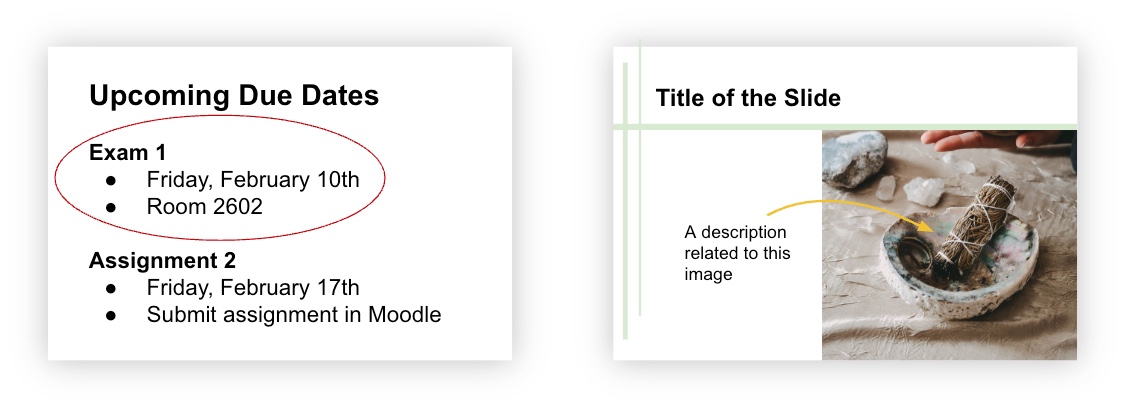
Students need to know what information to pay attention to, especially when multiple pieces of information are on the same slide. Adding cues that direct students to the relevant material provides a signal for how to process the information. Examples of cues include circling an element, highlighting certain words, or an arrow pointing to an element.
The example below illustrates how using cues immediately draws your attention to the important information on the slides:
Advance Organizers
Using advance organizers in your slides is another way to illustrate how information is organized. If you are unfamiliar with advance organizers, read the very short article, “Advance Organizers: Setting the Stage for Learning and Retention” by Temple University.
Using advance organizers provides a way for students to make connections between what they already know and what they are about to learn. They can be integrated within your slides to organize and structure your content, depending on your subject matter and how you teach it.
Move through the following Using Advance Organizers in Your Slides presentation that depicts different ways advance organizers can be used to structure your slides and move through your information in an organized way. How might you be able to use these modified advance organizers in your discipline?