
Module 4 Book: Designing PowerPoint Presentations for All
Multimedia Principle
“Include both words and graphics”
(Clark & Mayer, 2016, p. 70)
Based on cognitive theory and research evidence, people learn better when words (spoken or printed) and pictures are included together, compared to just words alone.
Including both graphics and words encourages students to actively process the information - they are mentally representing the materials in words and pictures and are making connections between the verbal and visual representations. In contrast, for students who have less experience or expertise, using just words may reduce cognitive processing since they may find it difficult to connect the words with other knowledge (Clark & Mayer, 2016, p. 71).
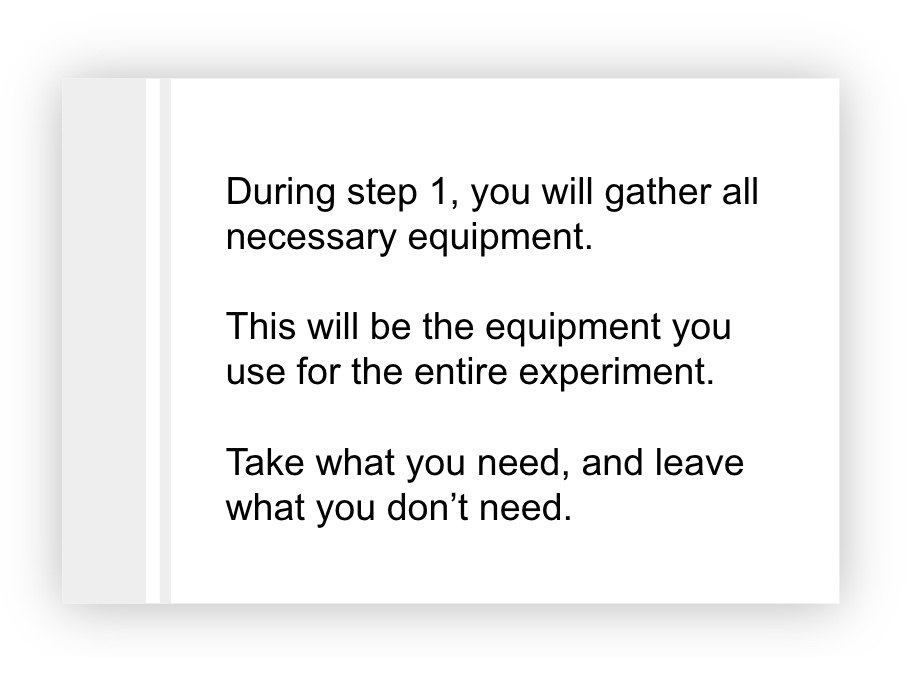
For example, let’s say an instructor wanted to go through the steps students need to perform in preparation for an experimentation. In their slide design below, it details the important information for step 1, related to gathering equipment for an experiment. However, by sharing only text, this may make it difficult for all students to fully process the expectation and know what equipment to gather.
After considering the multimedia principle in the next slide, the text was reduced and enhanced to include only necessary information. Also, a carefully chosen graphic was added to illustrate what needs to be gathered. Now that the text and graphic directly support each other, students can associate the idea of gathering equipment with the graphic provided. Then, the additional information from the previous slide would be shared verbally to support the message being conveyed.

Now, what happens when we consider the idea of combining printed words, pictures, and spoken words, like we do in our slide presentations? The redundancy principle next will explain this further.