
Module 4 Book: Designing PowerPoint Presentations for All
Topic 1: How the brain processes visual and verbal information
Understanding a bit about how our brains process visual and verbal information provides us with insight that can be integrated into our PowerPoint slide designs to maximize learning.
So, how does learning work? According to Clark & Mayer (2016), one metaphor of learning is that humans construct their knowledge, meaning “learning involves making sense of the presented material by attending to relevant information, mentally reorganizing it, and connecting it with what you already know” (p. 33).
This knowledge-construction view is based on three principles from research in cognitive science:
-
Dual channels: Humans have separate channels for processing visual and verbal material (Clark & Mayer, 2016, p. 35)
-
Printed words are processed by the visual channel and spoken words are processed by the verbal channel
-
Images are processed by the visual channel.
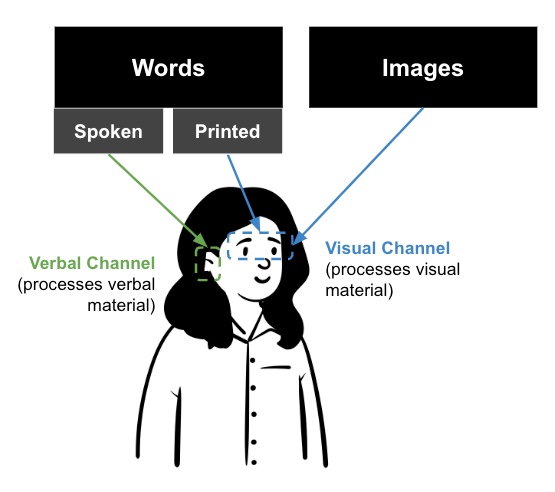
-
-
Limited capacity: Each channel can actively process only small amounts of information at one time which means there is limited capacity (Clark & Mayer, 2016, p. 35).
-
Active processing: Learning takes place when relevant cognitive processing occurs including: engaging with relevant material, organizing the material, and integrating it with previous knowledge (Clark & Mayer, 2016, p. 35).
What can we take away from this research and apply to our slide designs?
-
Be cognisant of how much information on each slide is being processed by the verbal and visual channels
-
Avoid overloading the verbal and visual channels with too much information at one time
-
Strategically combine words and images to foster meaningful learning (this is covered more in Topic 3)