
Module 4 Book: Designing PowerPoint Presentations for All
The Coherence Principle
“Adding extra material can hurt learning”
(Clark & Mayer, 2016, p.151)
People learn better when extraneous material is excluded. In other words, whatever is shared on each slide (images, text, narration) should directly support the learning goals.
Good practices to integrate into your slide design are:
-
Include simple images, text, and narration that directly relates to the learning goals
-
Remove any extraneous, decorative, or “fluff” material that may distract from learning
-
View your slides with a critical eye to reduce, simplify, and clarify, where possible
For example, let’s say an instructor wanted to share a statistic about construction and explain how that relates to job safety, quality, and care. The following slide is an attempt at sharing that message. However, since the slide contains a number of elements, it may distract from learning because it is not clear where to focus or what the overall message is. As the instructor is narrating, the student is left trying to figure out how all the slide elements relate to the overall message.
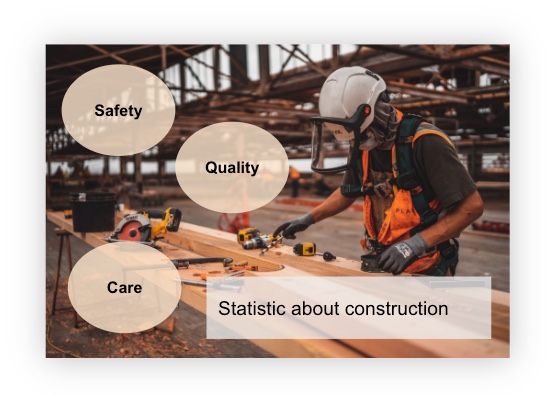
In the next slide, after applying the coherence principle and reducing, simplifying, and clarifying the message, it now contains only relevant elements that support learning. This way, the image and statistic can be used to pique student interest and the instructor can share the message about safety, quality, and care verbally. Now, the student is able to relate the slide elements with the message being shared more efficiently as there is less to focus on and figure out.

Here are a few questions to ask yourself when thinking about the content on your slides and how you will be delivering that content:
-
Do the elements on my slide help students comprehend the material? (DeBell, 2019)
-
Do the slide elements enhance the learning experience or distract from it?
-
Does my message about this slide use simple language to help the students understand? Or, is there an opportunity to trim down a few words to simplify the message? (DeBell, 2019)