
Unit 3: The Communications Package
3.1: Preparing for Knowledge Mobilization
In this section, we will explore some theory and best practices for the development of a strategic plan for the dissemination of your research. Then, later in the unit, you will find more practical lessons supporting the development of different communication documents called for in the plan. To help to put all this context, begin by becoming familiar with the Communications Package assignment.
READ
-
First, read “Definitions” from Knowledge Management and Communication (Bruce et al., n.d.).
-
Now read over Assignment 3: Communications Package.
Note, as you read it over, to reflect on how the communications package will be a project of “knowledge dissemination.” Take note of the four individual pieces required for this package. Skills and techniques for each piece are covered in turn in the sections of this unit.
Sharing Your Research
LESSON
Knowledge mobilization is, for the most part, another term for strategic communicaiton. At times, we can distinguish between strategic communicaiton that is more focused on the interests of a particular organization than in general knoweldge distribution. However, for the purposes of our course project, these concepts align. The main idea here is a strategic sharing of information (from those who create it to those who could use it) for a specific purpose, which might range from increased knowledge to generating action.
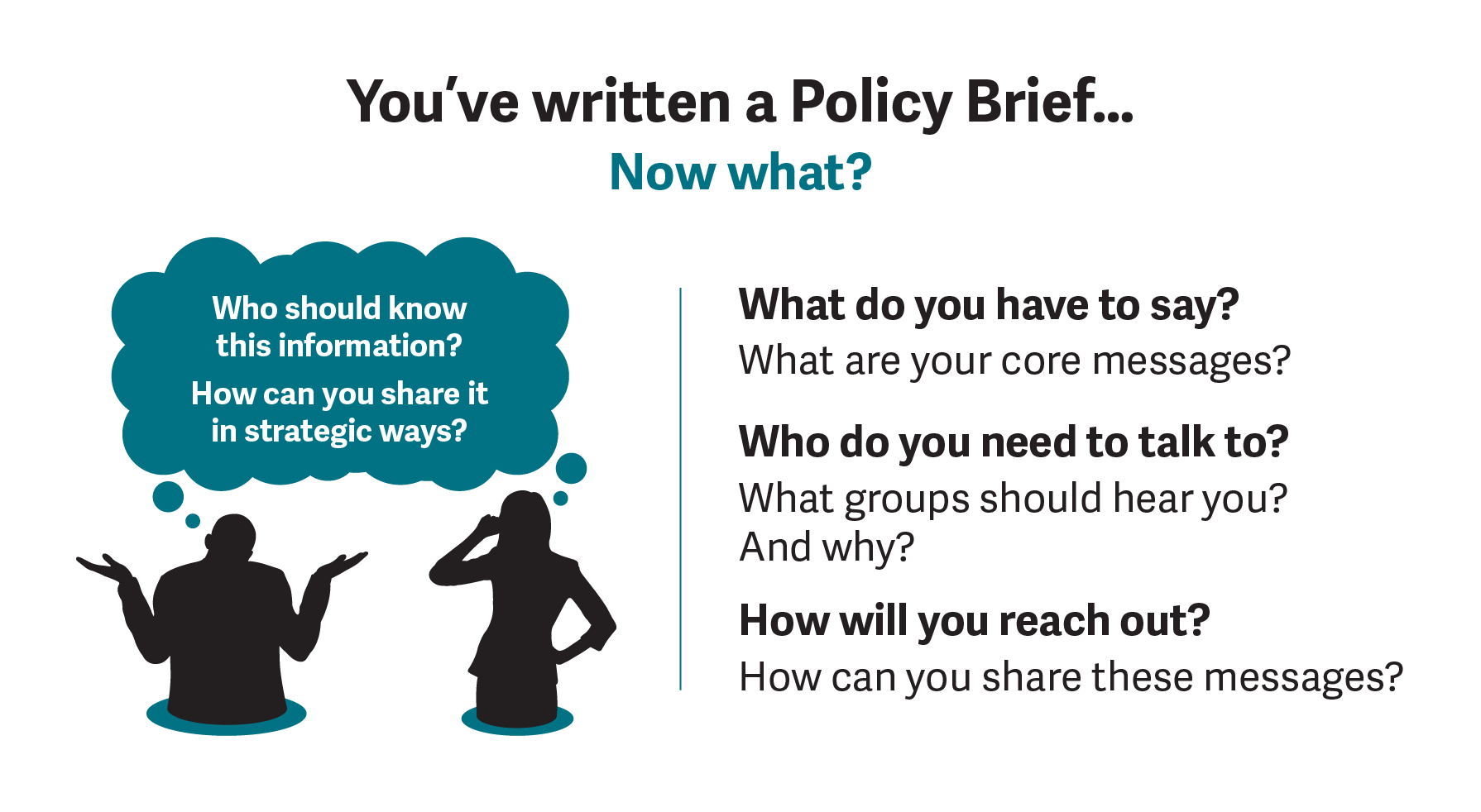
Whereas the policy brief was a project in knowledge synthesis, drawing together many voices within a conversation, the communications package is a project in knowledge dissemination, getting the information out to those who need it. Developing a plan for knowledge dissemination ensures that your efforts are strategic and therefore effective.
READ
-
Read “Building a KMB Plan” in Knowledge Management and Communication (Bruce et al. n.d.).
LESSON
The OER Knowledge Management and Communication (Bruce et al., n.d., Chapter 12) cites Lavis et al.’s (2003) five fundamental questions needed to develop a plan for knowledge dissemination:
-
Audience: To whom should research knowledge be transferred?
-
Message: What knowledge should be transferred to decision-makers?
-
Messenger: By whom should the knowledge be transferred?
-
Mechanism: How should the knowledge be transferred?
-
Impact: With what effect should the knowledge be transferred?
Thinking strategically about each one of these fundamental questions is key to effective dissemination of knowledge. However, taking them in isolation is not enough. The interdependence of these factors must be considered.
For simplicity’s sake, given the nature of our course project, let’s assume that the messenger stays constant—it’s you within the discourse community you connected with for the project.
We can then begin to think about the relationships of the other four factors:
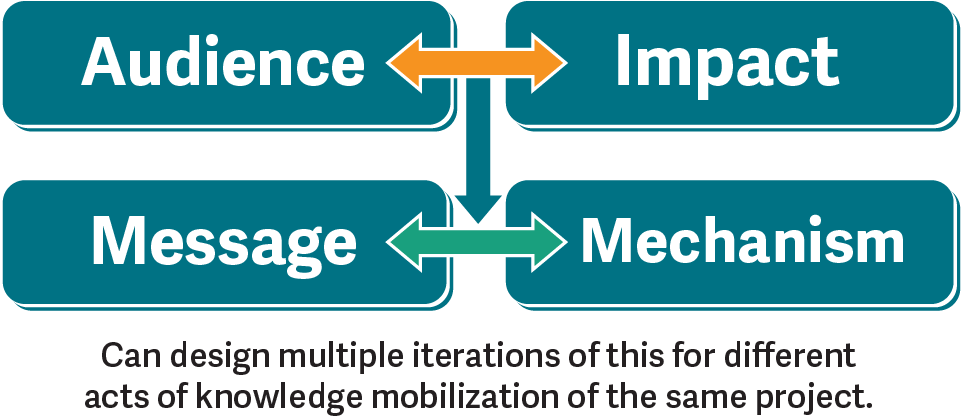
An initial choice of audience will constrain subsequent choices around message and mechanism, as well as impact.
Likewise, an initial focus on a specific message taken from the larger knowledge project (in our case, the policy brief) will drive decisions around audience, mechanism, and impact. The same logic is true of impact and mechanism.
Let’s consider a simple example. You have research that demonstrates the importance of exercise in preventing disease later in life. You have not only evidence of this preventable feature of exercise, but also information on what kinds of exercise are most beneficial.
Now, imagine your options from different directions:
-
Impact—You most want audiences to change their behaviour and exercise more.
-
How would different audiences react to this message? Select an audience: youth, parents, retirees.
-
Given the audience and impact you selected, how might you best shape the message to generate a change in behaviour for that audience? Your message for youth or retirees might be different, but overall, your goal to change their behaviour to exercise more would be the same.
-
Given the audience and message you’ve selected for this impact, which mechanism or channel would you pick? How can you match your mechanism choice to the key features of your audience and message?
-
Now, flip it around. You have been directed to develop a social media campaign that gets audiences to exercise more. How will this change your selection of audience? Message?
-
-
Message—You most want to communicate this link between exercise and long-term health.
-
What impact would you like to focus on? Sharing the information or generating action?
-
Given this impact and message, who might be the most likely target audience?
-
Given the impact, message, and audience, what channels might you use?
-
Now, flip it around. You have been directed to give this message to young people. How might the impact and channel differ?
-
Working through these different thought scenarios is a way to conceptualize the interconnectedness of these four categories; when developing communication plans, it’s important to be nimble in working through these intersections to make the most effective communication.
Intent, Audience, Message, and Channel in Detail
READ
-
Read chapters 27, 28, and 29 from Knowledge Management Communications. (Bruce et al., n.d.).
-
Read “Key Message Development: Building a Foundation for Effective Communications” (Wetherhead, 2011).
LESSON
Defining Intent or Goal
Overall, you may have several goals to achieve in your plan for knowledge dissemination, but each communication piece should have just one. In your final course assignment, for example, you will have three individual communication pieces, and each should have a clearly defined intent; they do not have to be the same.
Consider the range of intents that might be invoked through communication:
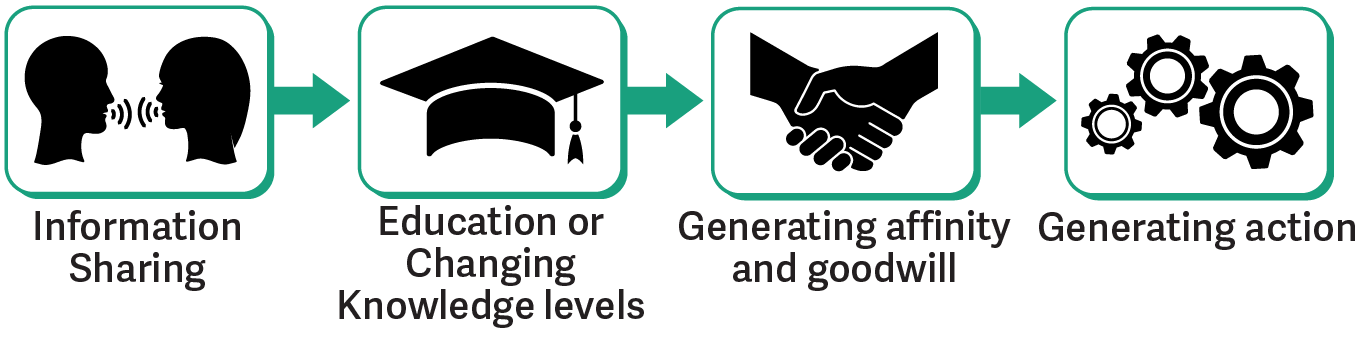
Sometimes, our goal is simply to share information, but our goals can be progressively more persuasive, as we might be interested in our audience learning or adopting the information we share or even gaining an affinity or agreement with it, and finally, we may be interested in prompting action by our audience. The ability to achieve any one of these goals depends very much on the audience relationship to the message we have on offer; how we craft a message will depend very much on what our intent is and how the audience feels about it.
For example, we might want to share with students the date that registration opens, an intent that has no expectation of response. However, we may instead want to share this date with the intent of getting all students registered before they miss an opportunity. This intent of action requires a completely different message and possibly different mechanisms for communication.
As you develop your communication plan, think strategically about the specific intents for each communication piece.
Audience
The selection of target audience is often driven by the goal or intent of the communication, as noted in your reading. The nature of the recommendations in the policy brief and the goals for knowledge dissemination will often dictate a specific audience. However, it’s also possible that in the course of sharing research and information, opportunities come to connect with audiences that had not been anticipated. In such cases, thinking carefully about the intent and message suitable for an audience is key.
|
Desired Outcome/Goal |
Examples of Target Audience |
|---|---|
|
Recognition from industry partners |
Industry partners |
|
Recognition from the academic community |
Specific academic journals, other researchers |
|
Increased recognition by senior leadership at your institution |
Senior Leadership, Research Chairs, Marketing and Communication department |
|
Engagement and interest in your research from undergraduate and graduate students at your institution |
Students, reaching assistants, teaching faculty, student clubs |
|
Interest from media outlets about your research and academic activities |
Marketing and Communications department, newspaper outlets, radio stations, television stations |
(Bruce et al., n.d., Chapter 28) CC BY-NC-SA 4.0
Once selected, the interests and orientation of an audience are defining elements. We need to ask the following kinds of questions:
-
What is their interest in the knowledge begin shared? Why would they care?
-
What is their disposition? Are they amenable or wary of it?
-
What are you asking of them (intent)? Can they provide that? How can they be motivated?
Message
Use the questions and strategic process outlined in chapter 28 from Knowledge Management Communications (Bruce et al., n.d.) as a template for defining the message of your communication pieces; this resource reminds you to think carefully about the relationship to intent, audience, and channel when shaping your message.

A group of bowls full of food by engin akyurt on Unsplash
When working with a larger project, like a policy brief or other research project, it can be difficult to pull out threads of individual messages from the whole. Filtering information for different goals, to different people, means we need to approach our research paper flexibly without linear intent; we might think of our research as a buffet meal rather than a five-course presentation. When we write a research paper, we work carefully to tie all the pieces together in a logical and effective linear product, as you have just experienced writing the policy brief. But now, we can deconstruct this into a table of information nuggets to be selected and communicated at will. You might find, for example, a need to communicate simply the recommendations; or you might focus on a specific finding or point of research within the larger work that you want to share with a particular audience.
Mechanism or Channel
As outlined in your readings, selection of mechanism or channel is made carefully in the context of audience profile and message creation. For example, some information is better shared in some media over others, and we know this from our everyday life. Consider emergent social roles around when, what, and how to text people. Some information is more suitable for texting than other, and certain audiences respond differently to and are more adept at text messaging than others. When we get this wrong, communication can sometimes break down! Message adaptability and audience preference and competency must be considered.
The selection of mechanism or channel is also often influenced by a project’s budget and timelines. While sometimes a national ad campaign might be desirable, it’s not always feasible!
Developing the Communication Planning Document
Communication plans vary in complexity and components, as they are custom built for a wide variety of communication contexts and challenges. For example, consider this resource for information and tips on communication planning suitable for project management: “Communication Planning” (Watt, 2021).
Similarly, you can find plenty of information and templates related to the design of communication plans for campaigns or media events, such as this one from The Community Tool Box (Center for Community Health and Development, n.d.): “Developing a Plan for Communication.”
For the context of this course project, we use a simplified communication planning document, designed to have you think about the fundamental strategy needed in communication planning; you will think strategically about the relationships between impact, audience, message, and mechanism, as you plan ways to communicate content from the policy brief.
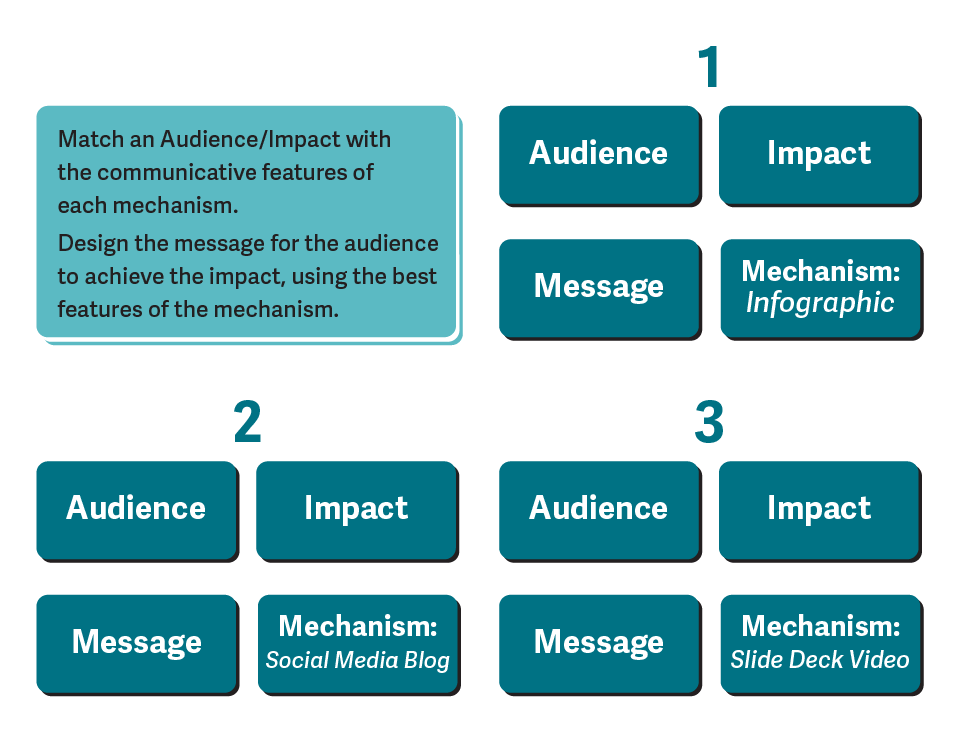
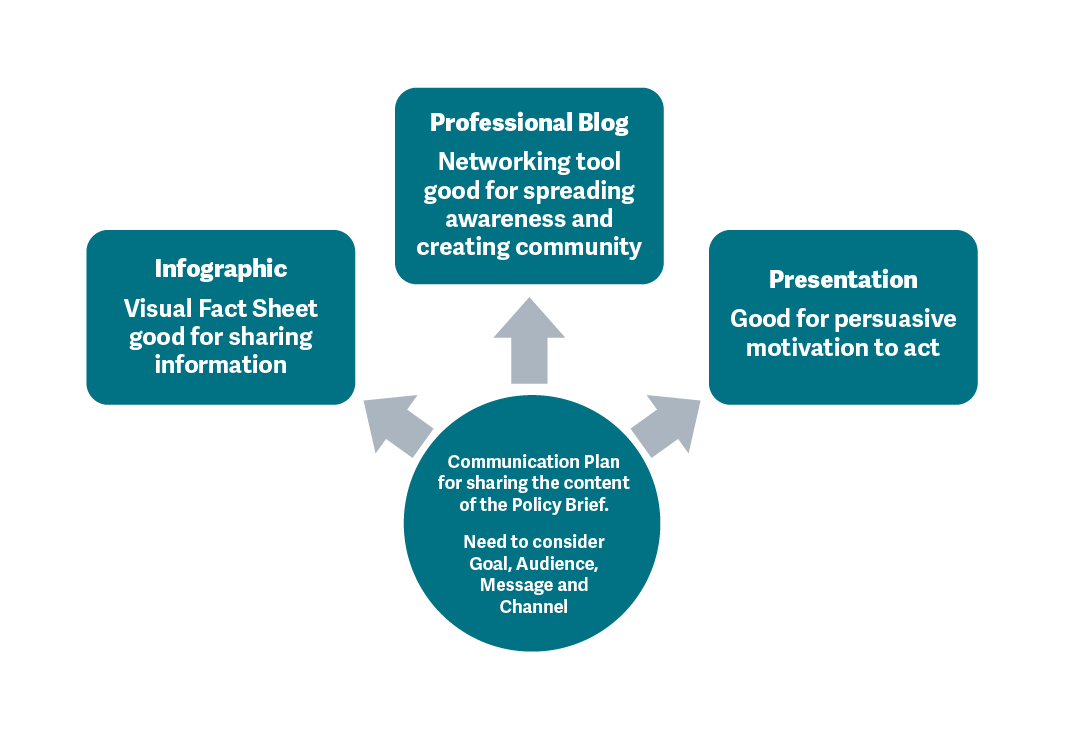
Before jumping in to produce the infographic, professional blog post, and slide deck video, you must create an overall communication planning document for this knowledge mobilization, using the ideas covered in this section of the unit.
In the project, the mechanisms or channels are fixed. This gives you a starting point in beginning to plan for audience, message, and intent. Each mechanism lends itself better to some kinds of intent or goal than others. For example, the professional blog may be particularly suited to the intent to generate good will or affinity for a set of ideas, while the slide deck video, with more direct audience contact and depth, might be more suited to persuasion and a call to action. Finally, infographics, in their design, might be well suited in communicating specific messages or lessons. Each of these mechanisms also engages the audience differently, demanding various amounts of time and energy.
With these mechanisms as a guide, you can begin to define an impact, audience, and message for each of the three elements in the communications package. The unit task below will help you begin this process, and then you can continue using the template provide in the assignment.
Unit Task 6: Determine Goal, Audience, and Messages (2% of course grade)
UNIT TASK 6
The purpose of this task is for you to begin to think about ideas for the knowledge dissemination of information from your policy brief. At this stage, don’t worry too much about connecting audience, message, intent, and channel together. Just begin to identify information for audience, intent, and message. Then, using these ideas, you can start making the connections when completing your communications package for the assignment.
All together, write about 500 words.
Question 1: Audiences
Try to be very specific here and think of advocacy groups, organizations, government ministries, networks, etc.
-
Who could benefit from knowing information in your policy brief?
-
Who is in a position to act on the recommendations in your policy brief in some way?
-
Who would you like to share specific information from the policy brief with because it may benefit you, either by strengthening your network or by linking you with a group with more power?
-
Who would be in a position to continue to distribute your policy brief findings to wider groups?
-
Other audience ideas?
Question 2: Audience Disposition
-
Pick three audiences you’ve defined above. For each one:
-
Explain why you think this audience will be interested in information from your research (or why you think there is benefit in them receiving information).
-
Consider how the audience may be disposed to receiving the information (excited, wary, indifferent?).
-
Consider how each audience may want to engage with the material and/or be part of the knowledge mobilization. Will they want to simply receive it? Continue to share and disseminate it? Act on it in some way? Be persuaded by it to change?
-
Question 3: Main Messages
-
Overall, what are three main messages that you think emerge as important out of your policy brief research/findings?
Unit Task 6 will be graded on a scale of 1% for attempt, 1.5% for evidence of inclusion of course material, or 2% for thoughtful engagement/interaction with the course material.
Please submit your Unit Tasks 6, 7, and 8 as one document at the end of Unit 3.