
Unit 3: The Communications Package
3.3: Playing Speech off Text in Effective Presentations
Presentations can be difficult to pull off effectively. They are a familiar, even common, form of communication, but are rarely as engaging and effective as they can be. The first step is to have a well-organized oral delivery and some attractive supporting slides. Certainly, your resources this section will provide some tips on this. But the next step is a more difficult nuanced and cohesive relationship between the oral delivery and the visuals, playing the oral delivery and the visuals against each other for strategic purposes.
You see this done well, of course, in many TED talks—the visuals are designed not simply to reinforce or replicate the oral delivery, but often to enhance, layer meaning, and even comment on the oral delivery. If you can get this dynamic play between the modalities, you have reached something a bit more engaging.
Presentation Design Standards and Multimodal Techniques
READ
-
Watch David Phillips’s 2014 TED Talk How to Avoid Death by PowerPoint.
How to Avoid Death by PowerPoint | David JP Phillips [20:31]
(TEDx Talks, 2014)
This presents a provocative challenge to rethink how we design presentations to align with our cognitive capabilities. Pay special attention to the five design principles that he elicits through the talk and aim to apply them to your own work.
-
Read Chapter 10, “Designing and Delivering Presentations” in Fundamentals of Engineering Technical Communications (Wahlin, n.d.).
-
Read the article “10 Tips on How to Make Slides That Communicate Your Idea” (TED Staff, 2014) from the TED Blog.
LESSON
A presentation combines multiple modalities: audio, visual images, and written language. We’ve examined principles and techniques for written language already through this course. Let’s consider the semantic contributions of audio and visual images to any communication piece.
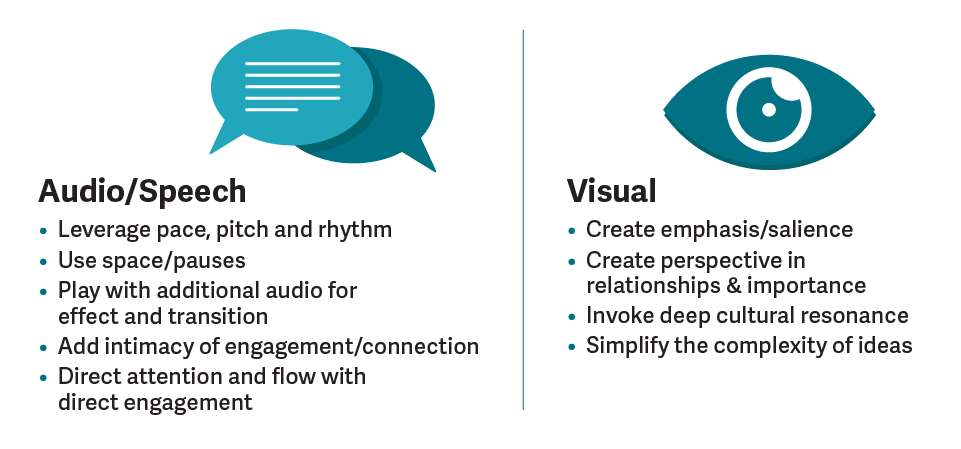
The creative combination of modes come together into a more meaningful whole, when done well. A presentation without visuals can sometimes be difficult to follow and salient ideas might not stand out. Effective and timely use of visuals can work to add meaning in several ways:
-
Visuals can align with the oral presentation as a form of reinforcement or emphasis to help consolidate meaning.
-
Visuals can enhance the content in the oral presentation, adding additional nuance or resonance to the meaning.
-
Visuals can comment on the content in the oral presentation, used to provide irony, humour, or a reflective interpretation.
Consider thus ways to layer meaning in the sound/visual relationship of your design. These rhetorical choices in a presentation design should be developed with consistent use of the best practices outlined for slide deck design in the resources for this section. A successful presentation achieves the intent of the communication through the unique needs of an audience’s ability to take in the core message.
Designing the Presentation for the Course Project
When planning the slide deck presentation, make strategic decisions in the context of the communicative potential of this mechanism. The multimodal nature combines the engagement of oral delivery with the potential to communicate complex ideas with visual support. In this way, the mechanism lends itself well to both information transfer and more persuasive intents.
Consider also the various contexts and audiences that might be suitable for this type of communication. Presentations are often given in broad public settings, such as conferences or community forums, and also used widely in more internal contexts, such as organizational planning or training.
Unit Task 8: Connecting the Visual and the Oral (2% of course grade)
UNIT TASK 8
In this unit task, the goal is to analyze how good presenters develop connections between visual and oral communication for a larger communicative effect.
Find a TED Talk on a subject that interests you—anything (as long as they use visuals!). As you enjoy the talk, reflect on how the speaker strategically uses visuals to make meaning in combination with their oral presentation. Write about 150 words outlining some examples of effective use of visuals to support oral delivery, linking back to principles from the coursework and resources.
-
Overall, what function do the visuals play? Do they align with or restate the verbal ideas? Do they elaborate or enhance them? Do they provide additional commentary or resonance to the meaning?
-
Do you find the visuals helpful in understanding the talk? What would change if you listened only, without them?
-
In either speech or visuals, how does the speaker include signposts in the talk to help you follow along?
-
To what degree does this TED Talk apply the five design principles from Phillips’s talk? Explain how it does or does not use the principes and whether it has an impact on overall effect.
Unit Task 8 will be graded on a scale of 1% for attempt, 1.5% for evidence of inclusion of course material, or 2% for thoughtful engagement/interaction with the course material.
Please submit your Unit Tasks 6, 7, and 8 as one document at the end of Unit 3.